

Why Some Anti-Nausea Drugs Can Affect Your Heart
If you’ve ever been given an anti-nausea shot after surgery or during chemotherapy, you probably didn’t think twice about it. But behind that quick relief from vomiting lies a quiet risk - one that can quietly stretch out the electrical timing of your heart. This is called QT prolongation, and it’s not something most patients hear about, even though it can lead to a dangerous heart rhythm called torsades de pointes - a type of arrhythmia that can suddenly stop your heart.
Many common antiemetics - drugs used to fight nausea and vomiting - do this. Not all of them. But some do, and the difference matters. Especially if you’re older, have heart disease, or are taking other medications that also affect your heart rhythm. The risk isn’t huge for everyone, but it’s real enough that doctors need to pick carefully.
How QT Prolongation Works - And Why It’s Dangerous
Your heart beats because of electrical signals. The QT interval on an ECG shows how long it takes for your heart’s lower chambers to recharge between beats. If that interval gets too long, your heart can misfire. The result? A chaotic, fast rhythm called torsades de pointes. It doesn’t always cause symptoms, but when it does, you might feel dizzy, faint, or even go into cardiac arrest.
Most antiemetics cause QT prolongation by blocking a specific potassium channel in heart cells (called IKr). This slows down the heart’s recovery phase. It’s not the same as a heart attack - it’s an electrical glitch. And while a 20-30 millisecond increase might sound small, the real danger comes when multiple risk factors stack up: high doses, IV delivery, low potassium, other heart meds, or kidney/liver problems.
Experts define clinically dangerous QT prolongation as:
- QTc longer than 500 milliseconds
- An increase of more than 25% from your baseline
- A change of more than 60 milliseconds from your normal ECG
But here’s the catch: a longer QT doesn’t always mean torsades will happen. About 91% of cases where QT prolongation led to serious problems involved patients taking other QT-prolonging drugs too. That’s why it’s not just about the antiemetic - it’s about the whole medication picture.
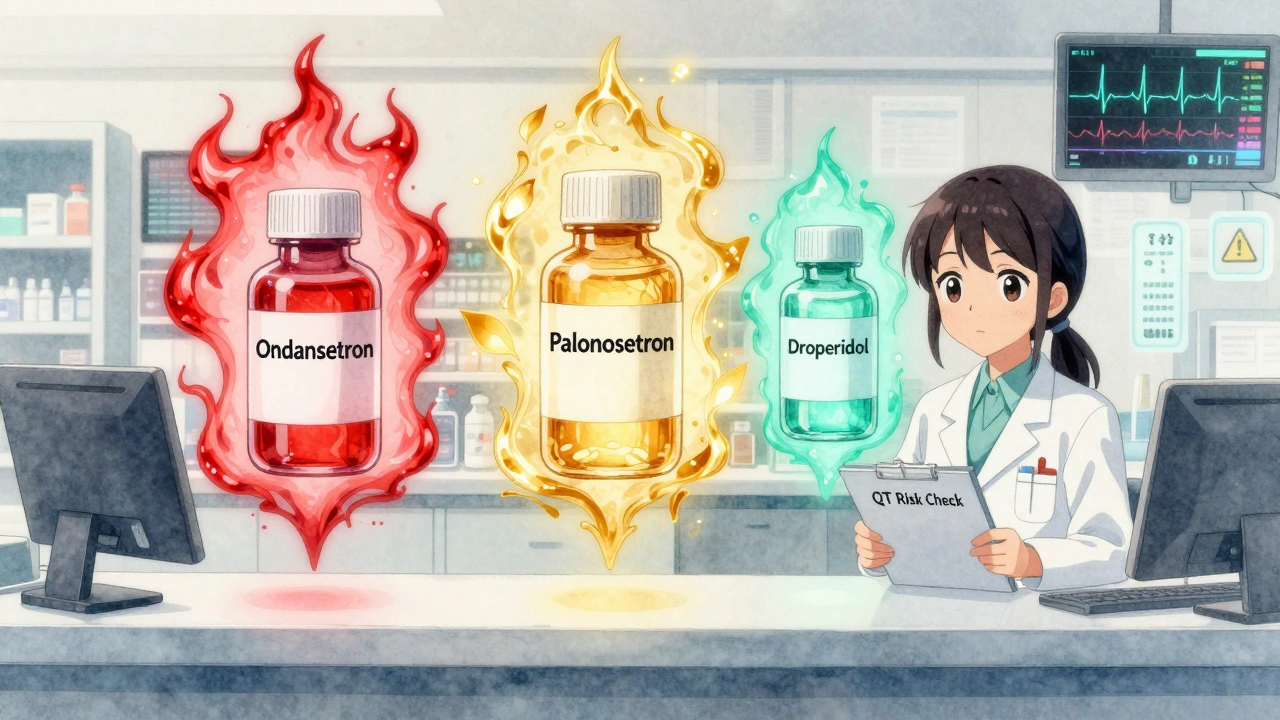
Ondansetron: The Most Common Culprit
Ondansetron (Zofran) is one of the most widely used antiemetics, especially in hospitals and after chemo. But it’s also the one most linked to QT prolongation. Studies show that a single 8 mg IV dose can stretch the QT interval by about 17-20 milliseconds. That’s not massive - but in the wrong patient, it’s enough.
It’s worse with higher doses. In emergency rooms, patients sometimes get 16 mg or more to control severe vomiting. That’s where the risk spikes. Oral ondansetron (pills) rarely causes issues - it’s the IV form that’s the problem. And it’s not just the dose. Giving it too fast - like a rapid IV push - can make things worse.
Compared to other drugs in its class, ondansetron has a higher chance of triggering torsades than granisetron or palonosetron. In fact, experts at EMCrit Project call it the antiemetic with the relatively higher risk of dangerous arrhythmias. That’s why many hospitals now limit IV ondansetron to 4 mg or less, especially in older adults or those with heart conditions.
Droperidol and Haloperidol: The Misunderstood Options
Droperidol was pulled from many markets in the early 2000s because of fears around sudden death. But that fear was based on high doses - 10 mg or more - used for sedation, not nausea. When used at antiemetic doses (0.625-1.25 mg IV), studies like DORM-1 and DORM-2 found no increased risk of QT prolongation compared to placebo or midazolam.
Haloperidol is similar. At the usual 1 mg dose for nausea, the risk is minimal. But if you’re getting multiple doses - say, 2 mg or more IV - then QT prolongation becomes more likely. The key is dose. Many doctors still avoid these drugs out of habit, even though the real danger is rare at the right dose.
And here’s something surprising: olanzapine, a newer drug originally used for schizophrenia, is now being used off-label for nausea. It doesn’t prolong QT at therapeutic doses, and it’s less likely to cause movement side effects than haloperidol. It’s not as strong as ondansetron for vomiting, but for patients with heart risks, it’s a smart alternative.
Palonosetron: The Quiet Winner
If you’re looking for the safest antiemetic with the least heart risk and the longest effect, palonosetron (Aloxi) is your best bet. Unlike ondansetron, it doesn’t prolong the QT interval at all - even at high IV doses. It also lasts longer: about 40 hours versus 4-6 hours for ondansetron. That means fewer doses needed, especially for chemo patients who need protection for days.
Studies show it’s more effective than 8 mg of ondansetron, especially for delayed nausea. And because it doesn’t mess with your heart rhythm, it’s becoming the go-to choice in cancer centers and for high-risk patients. It’s more expensive, yes - but when you factor in avoiding an ECG monitor, a cardiac consult, or a hospital admission for arrhythmia, it often pays for itself.
Drowsiness: The Other Side of the Coin
While heart risks get the headlines, drowsiness is just as important - and often more common. Some antiemetics make you so sleepy you can’t drive or work. Others barely touch your alertness.
Promethazine (Phenergan) is a classic - it knocks you out. It’s often used for motion sickness and nausea, but the sedation can last hours. Prochlorperazine (Compazine) is different - it’s less likely to make you drowsy, even though it’s in the same drug family. That’s why some clinics prefer it for patients who need to stay alert.
Metoclopramide (Reglan) can cause drowsiness too, but it’s more known for causing muscle spasms and tremors because it crosses into the brain. Domperidone doesn’t cross the blood-brain barrier, so it doesn’t cause sedation or movement problems - but it’s not available everywhere, and it still carries a QT risk in older people.
Dimenhydrinate (Dramamine) and meclizine (Antivert) are old-school options for motion sickness. They cause drowsiness, but they don’t affect the QT interval. That makes them safe for older adults with heart issues - as long as you don’t mind feeling groggy.
Who’s at Risk? The Real Red Flags
Not everyone needs to worry. Most healthy people can take ondansetron or droperidol without issue. But if you have any of these, you need to be extra careful:
- Heart disease, especially past arrhythmias or heart failure
- Low potassium or magnesium levels
- Being over 65
- Taking other QT-prolonging drugs - like certain antibiotics, antidepressants, or antifungals
- Chronic kidney or liver disease
- Already on an ECG monitor because of a slow heart rate
And here’s the thing: if you’re on multiple meds, the risk multiplies. One drug might be fine. Two together? That’s where things get risky. That’s why pharmacists now check for “QT drug interactions” before dispensing antiemetics.
What Should You Do?
If you’re prescribed an antiemetic and you’re worried:
- Ask if your drug can prolong your QT interval.
- Find out if you’re getting it orally or IV - IV is riskier.
- Check if you’re on any other meds that affect your heart rhythm.
- Ask if a safer alternative exists - like palonosetron or olanzapine.
- If you’re over 65 or have heart issues, request a simple ECG before starting.
For most people, these drugs are safe. But for those with risk factors, the wrong choice can be dangerous. The goal isn’t to avoid antiemetics - it’s to pick the right one.
Bottom Line: Safer Choices for Safer Care
There’s no one-size-fits-all antiemetic. Ondansetron works great - unless you’re at risk for heart rhythm problems. Droperidol is safe at low doses - but many doctors still avoid it unnecessarily. Palonosetron is the quiet hero: no QT risk, longer lasting, more effective. And if drowsiness is your main concern, prochlorperazine or domperidone might be better than promethazine.
The key is matching the drug to the patient - not the other way around. If you’re getting treatment for nausea, ask your doctor: “Is this the safest option for me?” That one question could prevent a serious problem.
Can antiemetics really cause sudden cardiac death?
Yes, but it’s rare. Drugs like ondansetron and droperidol can cause QT prolongation, which may lead to torsades de pointes - a dangerous heart rhythm that can cause sudden death. This risk is highest with IV doses, in people with existing heart conditions, low electrolytes, or when combined with other QT-prolonging drugs. For most healthy people, the risk is very low.
Is ondansetron safe for older adults?
It can be, but with caution. Older adults are more sensitive to QT prolongation and often take other medications that increase risk. Many hospitals now limit IV ondansetron to 4 mg or less in patients over 65. Oral ondansetron is safer than IV. If possible, consider alternatives like palonosetron or olanzapine, which don’t affect the QT interval.
Does domperidone cause QT prolongation?
Yes, but the risk depends on dose and age. In healthy young adults, doses up to 80 mg per day don’t affect QT. But in older patients, especially those with kidney problems or on other heart meds, even lower doses can be risky. It’s not approved in the U.S., but available elsewhere. Use only under medical supervision.
What’s the safest antiemetic if I have a heart condition?
Palonosetron is the safest choice for patients with heart risks - it doesn’t prolong the QT interval at all. Olanzapine is another good option, especially if you also need help with appetite or anxiety. For drowsiness-prone patients, dimenhydrinate or meclizine are safe alternatives, though they may make you sleepy. Avoid high-dose IV ondansetron and large doses of droperidol.
Do I need an ECG before taking an antiemetic?
Not always - but if you’re over 65, have heart disease, low potassium, or take other QT-prolonging drugs, yes. A simple ECG before starting IV ondansetron or droperidol can catch hidden risks. Many hospitals now screen high-risk patients. If you’re unsure, ask your doctor. It takes less than five minutes and can prevent a serious problem.




ian septian
This is exactly why I always ask my pharmacist about QT risks now. One question saved me from a bad reaction after chemo. Simple stuff, but most people never think to ask.
William Umstattd
The fact that hospitals still routinely administer 8mg IV ondansetron without checking baseline ECGs is medical negligence. This isn't theoretical-it's documented, peer-reviewed, and preventable. People are dying because of lazy protocols.
Sabrina Thurn
The QT prolongation risk profile of antiemetics is a classic example of dose-dependent pharmacology meeting clinical inertia. Ondansetron's risk is real but context-dependent: IV administration, polypharmacy, and electrolyte imbalances are the true triad of danger. Palonosetron's pharmacokinetic profile makes it the preferred agent in high-risk cohorts, particularly oncology settings where prolonged emesis prophylaxis is needed. The cost differential is negligible when you factor in avoided cardiac monitoring and admissions.
Simran Chettiar
You know when you think about the body as a delicate machine governed by invisible currents and rhythms... it becomes clear that we treat medicine like a grocery list rather than a symphony. Every drug is a note, and when you stack too many, the harmony breaks. QT prolongation is not a glitch-it is the body screaming that we are playing too loud. And yet we keep turning up the volume because it works. But at what cost?
Sarah Gray
If you're taking domperidone and don't know your electrolyte levels, you're not a patient-you're a liability. And yes, I'm talking to you, the person who orders it online because 'it's not approved here.' Wake up. This isn't a supplement.
Michael Robinson
It's not about avoiding drugs. It's about knowing who you are when you take them. Your body isn't a lab rat. It's yours. Listen to it.
Kathy Haverly
Oh wow, another ‘educational’ post from someone who clearly doesn’t understand how medicine actually works. You think people just randomly get torsades? No. It’s the same 5% of patients who ignore every warning, take 4 meds at once, and then blame the doctor. This article is just fearmongering dressed as science.
Suzanne Johnston
I appreciate how this breaks down the real trade-offs-not just ‘good vs bad’ drugs, but risk vs benefit based on context. I’ve seen patients avoid nausea meds entirely because they heard ‘it can kill you,’ and then suffer through days of vomiting and dehydration. Safety isn’t about eliminating risk-it’s about managing it wisely.
Haley P Law
I just got my IV Zofran today and now I’m scared to breathe 😭 But honestly? I’m glad I read this. I’m asking for an ECG next time. And maybe a hug. 🤗
Andrea DeWinter
Palonosetron is the quiet hero here and honestly if you have heart issues or are over 65 you should push for it even if it costs more because the alternative could be a trip to the ICU and you dont want that trust me I know
Steve Sullivan
i used to think all nausea meds were the same until my dad had a scare after chemo. now i ask every doc: is this gonna mess with my heart? and if they look confused? i know i'm asking the right thing. 🤝
George Taylor
This... is... overly... detailed... and... yet... still... lacks... context... regarding... real-world... prescribing... patterns... and... institutional... barriers... to... adopting... palonosetron... as... first-line... therapy... due... to... cost... and... formulary... restrictions... which... are... rarely... addressed... in... these... articles... which... is... why... they... remain... academic... exercises... rather... than... actionable... guidance...