
Steroid-Induced Hyperglycemia Management Calculator
Blood Sugar Management Calculator
Calculate your insulin adjustment needs and blood sugar risk while taking corticosteroids. Based on clinical guidelines for steroid-induced hyperglycemia management.
Your Results
Basal Insulin Adjustment: units/day
Mealtime Insulin Needed: units
Optimal Blood Sugar Check Time: 4-8 hours after steroid dose
Important Safety Note: Monitor blood sugar regularly. If fasting levels exceed 140 mg/dL or random levels exceed 180 mg/dL, consult your healthcare provider immediately.
Remember: These calculations are for educational purposes only. Always follow your healthcare provider's specific recommendations.
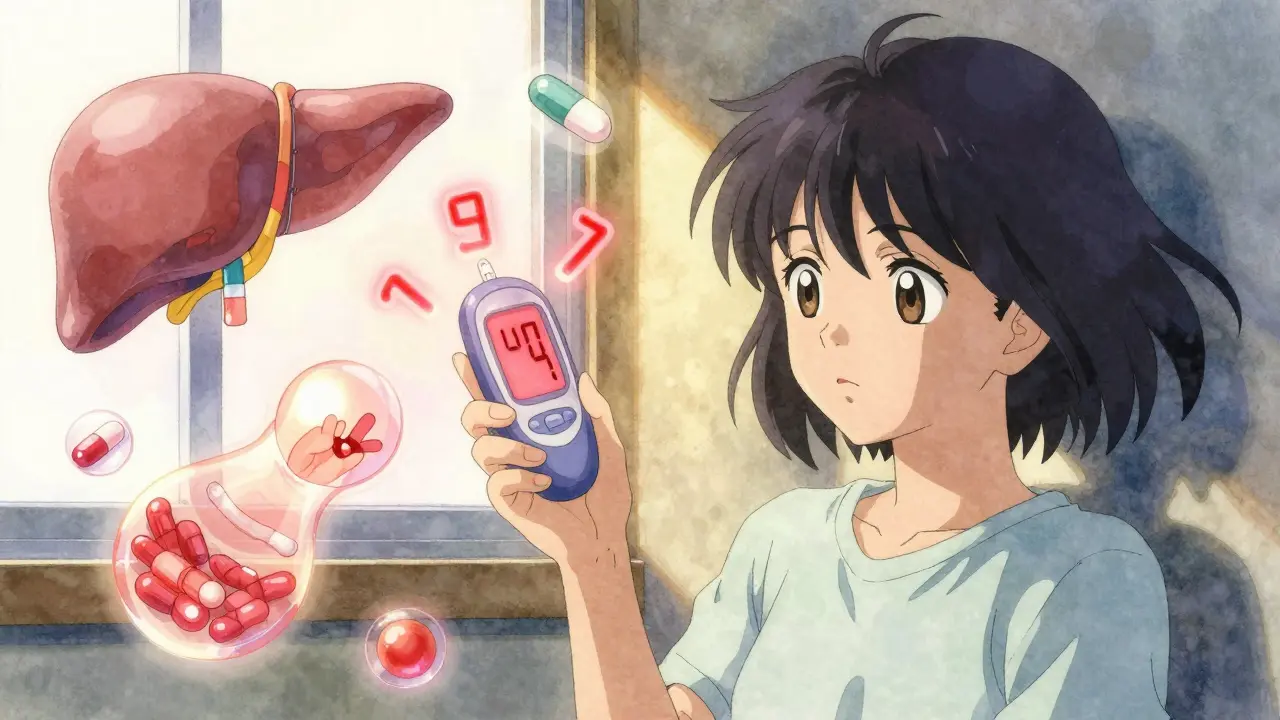
When you’re prescribed corticosteroids like prednisone or dexamethasone, you’re usually told about the side effects: weight gain, trouble sleeping, mood swings. But one of the most dangerous - and often overlooked - risks is hyperglycemia. If you have diabetes, or even if you don’t, these drugs can spike your blood sugar fast. And if no one warns you, it can turn into a medical emergency.
Why Corticosteroids Raise Blood Sugar
Corticosteroids aren’t just anti-inflammatory pills. They mimic your body’s natural stress hormone, cortisol. And when cortisol levels go up, so does blood sugar. That’s not a bug - it’s how your body survives a crisis. But when you’re taking these drugs for weeks or months, your body doesn’t get a chance to reset. Here’s how it works in real terms:- Your liver starts pumping out more glucose - up to 40% more - even when you’re not eating.
- Your muscles stop responding to insulin, so glucose can’t get in where it’s needed. This is called insulin resistance.
- Your fat cells break down faster, releasing fatty acids that make insulin resistance worse.
- Your pancreas struggles to produce enough insulin. In fact, insulin secretion can drop by 20-35%.
Who’s at Risk?
Not everyone on steroids gets high blood sugar. But certain people are much more likely to. If you fit any of these profiles, your risk jumps:- Taking 7.5 mg or more of prednisone daily - that’s just one pill a day for many people.
- Using dexamethasone - it’s six to eight times more likely to cause hyperglycemia than prednisone at the same anti-inflammatory dose.
- Being over 50 years old - your body’s ability to handle sugar declines with age.
- Having a BMI over 25 - extra weight already strains your insulin system.
- Having a family history of diabetes or past gestational diabetes - your genes are already primed for trouble.
- Having kidney problems - your body can’t clear glucose or drugs as efficiently.
What Symptoms to Watch For
Some people feel it right away. Others don’t notice anything until their blood test comes back with alarming numbers. Common signs include:- Extreme thirst - you’re drinking water constantly.
- Frequent urination - you’re running to the bathroom every hour.
- Unusual tiredness - even after a full night’s sleep.
- Blurred vision - your eyes can’t focus properly.
- Headaches - not typical migraines, but a dull, constant pressure.
How High Is Too High?
There’s no single number that says, “You have steroid-induced diabetes.” But medical guidelines give clear thresholds for when to act:- Fasting blood sugar above 140 mg/dL (7.8 mmol/L)
- Random blood sugar above 180 mg/dL (10.0 mmol/L)

Managing Blood Sugar While on Steroids
You can’t just stop taking corticosteroids. They’re often lifesaving - for asthma attacks, autoimmune flares, or after organ transplants. So the goal isn’t to avoid them. It’s to manage the damage. Insulin is the gold standard for managing steroid-induced hyperglycemia. Why? Because it directly counters the liver’s overproduction of glucose and helps muscles take up sugar again. Here’s what works in practice:- Basal insulin - long-acting insulin like glargine or detemir - covers the constant glucose surge from your liver. For every 10 mg increase in prednisone above 20 mg/day, increase your basal insulin by 20%.
- Mealtime insulin - rapid-acting insulin like lispro or aspart - handles the spikes after eating. A common rule: 1 unit for every 5 to 10 grams of carbs.
- Timing matters - steroids peak in your blood 4 to 8 hours after you take them. So if you take your pill at 8 a.m., check your sugar at noon and again at 4 p.m.
What About Oral Medications?
Oral diabetes pills like metformin can help a little, but they don’t do enough when steroids are in full force. Sulfonylureas (like glipizide) might seem like a good option because they force your pancreas to release more insulin. But here’s the danger: when you stop the steroids, your blood sugar drops fast - and sulfonylureas keep pushing insulin out. That’s how people end up in the ER with severe low blood sugar. That’s why experts say: avoid sulfonylureas if you’re on steroids unless you’re under close supervision. And if you’re already on them, your doctor should switch you to insulin before you start the steroid course.What Happens When You Stop Steroids?
Good news: steroid-induced hyperglycemia usually goes away once you stop the drug. Blood sugar levels typically normalize within 3 to 5 days after the last dose. But here’s where people get hurt: they keep taking diabetes meds because they think they have “real” diabetes. That’s a mistake. One study found that 63% of patients continued taking oral diabetes drugs long after stopping steroids - putting themselves at risk for dangerous low blood sugar. If you were diagnosed with high blood sugar while on steroids, ask your doctor to retest your glucose 1 week after you finish the course. If it’s normal, you probably don’t need ongoing treatment.
Real-World Challenges
Most patients don’t get warned. A Reddit thread from October 2023 with over 140 comments showed that 68% of people said their doctor never mentioned the risk of high blood sugar. That’s not negligence - it’s systemic neglect. Primary care doctors are overwhelmed. Hospital staff are focused on the original condition - asthma, arthritis, or cancer - not the side effects. The result? Delayed diagnosis. On average, it takes 9.3 days from the first symptom to a glucose test. That’s nearly two weeks of uncontrolled sugar - enough to cause nerve damage, kidney stress, or even hospitalization. Patients who got proactive monitoring - regular checks and early insulin - reported 92% satisfaction. Those who didn’t? Only 27% felt their care was adequate.What’s New in 2026?
There’s hope on the horizon. A new app called STEROID-Glucose, launched in 2023 by the European Association for the Study of Diabetes, lets you input your steroid dose and blood sugar reading. It then recommends exact insulin adjustments. In early trials, it cut hyperglycemic events by 32%. The NIH is also testing GLP-1 receptor agonists (like semaglutide) as an alternative to insulin. Early results show they cause 28% fewer low blood sugar episodes - and they help with weight loss, which is a bonus for steroid users who gain pounds. Even more promising: new drugs called tissue-selective glucocorticoid receptor modulators. One experimental compound, XG-201, reduced hyperglycemia by 65% compared to prednisone in phase II trials - while keeping the anti-inflammatory power.What You Should Do Now
If you’re about to start corticosteroids:- Ask your doctor: “What’s my risk for high blood sugar?”
- Request a baseline blood sugar test before you start.
- Get a glucometer and learn how to use it.
- Ask if you need insulin - even if you’ve never had diabetes.
- Check your sugar twice a day - especially 4 to 8 hours after your steroid dose.
- After you finish the course, get your blood sugar retested in one week.




Matt W
Man, I was on prednisone for my eczema last year and no one told me about the blood sugar thing. I thought I was just getting lazy or dehydrated. Turned out I was hitting 220 mg/dL at night. Got scared and went to the ER. They put me on basal insulin for two weeks. Scary stuff.
Anthony Massirman
Insulin on steroids? Yeah, that’s the move. Don’t mess around with metformin when your liver’s on a sugar rampage.
Marc Durocher
So basically, if your doctor didn’t warn you, they’re not your doctor anymore. Period.
Solomon Ahonsi
This post is 90% common sense. Why is this even a thing? Doctors are lazy. Patients are dumb. Steroids are powerful. End of story.
Eli Kiseop
Anyone else notice how the symptoms are just like being tired from work or drinking too much coffee? I thought I was just burnt out until my finger started bleeding from all the pricks
Becky M.
i was on 40mg of prednisone for 3 weeks and my sugar went nuts. my doc said ‘oh we’ll just watch it’ and then i passed out at work. i was so mad. i had to start insulin and it saved me. why is this not standard info?
George Firican
It’s fascinating how biology turns against us in the name of healing. Corticosteroids are essentially synthetic cortisol, the body’s emergency signal - a survival mechanism weaponized into a pill. But the body doesn’t know it’s not in a warzone. It doesn’t know you’re not fleeing a lion. It just responds: liver floods glucose, muscles lock insulin out, fat cells scream for help. And we call this medicine? It’s a biological siege. We treat the inflammation, but ignore the metabolic civil war it ignites. We’re not managing a side effect - we’re managing a systemic betrayal. And yet, the most terrifying part? It’s reversible. Your body remembers how to be whole. It just needs someone to remind it - with a glucometer, with insulin, with vigilance - before the damage becomes permanent. This isn’t just medical advice. It’s a plea for awareness in a system that treats symptoms like trivia.
Dan Pearson
Ugh, I’m so sick of these ‘woke’ medical posts. In my day, we took steroids and didn’t whine about sugar. My grandfather took 60mg a day for 6 months and lived to 92. You people are too soft. Get off your phones and stop overtesting.
Nick Flake
THIS. I’ve been on steroids twice. First time, I didn’t check. Second time? Glucometer on my nightstand. Basal insulin at bedtime. I’m alive because I listened. 🙏💉
Brittany Marioni
Can we please, PLEASE, make this a mandatory part of every steroid prescription? Like, a signed acknowledgment form? ‘I understand steroids can cause life-threatening hyperglycemia and I will monitor my blood sugar.’? It’s not hard. It’s not expensive. It’s just… basic human care.
Murarikar Satishwar
As someone from India where steroid misuse is rampant in clinics, I’ve seen patients on 80mg prednisone for months without any glucose monitoring. This post is a lifeline. Doctors here think ‘no diabetes = no problem.’ They’re wrong. We need global awareness, not just Western checklists.
Bob Hynes
my buddy took dexamethasone for his back and thought he was just ‘feeling weird’ for a week. turned out he had ketoacidosis. he’s fine now but he says he’ll never trust a doc again unless they hand him a glucometer on the way out. wild.
Ellie Norris
just got prescribed 10mg prednisone for my allergies and my nurse handed me a glucometer and said ‘check before breakfast and dinner’ - i was stunned. why isn’t this normal everywhere?
Hannah Gliane
Oh wow, so now we’re blaming doctors for not being mind readers? Maybe if you didn’t have a BMI of 35 and a family history of diabetes, you wouldn’t need a glucose monitor. Just saying.
Monica Slypig
I’m a nurse. I’ve seen this 47 times. The ones who survive? They’re the ones who checked their sugar. The ones who didn’t? They’re the ones who came in comatose. Stop being a coward. Test. You’re not being paranoid. You’re being smart.