

Most people think hearing aids go in your ear. But what if the solution doesn’t need to go in your ear at all? Bone-conduction hearing aids work by sending sound straight through your skull bone to your inner ear, skipping the outer and middle ear completely. This isn’t science fiction-it’s a proven, FDA-approved option for people who can’t use traditional hearing aids because of chronic ear infections, birth defects, or single-sided deafness.
How Bone-Conduction Hearing Aids Actually Work
Sound normally travels through the air, enters your ear canal, vibrates your eardrum, and then moves three tiny bones in your middle ear before reaching the cochlea. But if your ear canal is blocked, your eardrum is damaged, or your middle ear bones don’t work right, that path is broken. That’s where bone conduction comes in.
Instead of air, these devices use vibrations. A small processor picks up sound and turns it into mechanical vibrations. These vibrations travel through your skull bone-just like when you hum and feel it in your teeth-and reach the cochlea directly. Your inner ear doesn’t care how the sound gets there; it just needs the right signal. This bypasses the entire problem area.
This method relies on five physical pathways for bone transmission, with the biggest one being the inertia of fluid inside your cochlea. Research from Linköping University shows this fluid movement accounts for about 60% of how you hear through bone conduction. It’s not magic-it’s physics, and it’s been studied since the 1950s.
Who Benefits Most From Bone-Conduction Devices
These aren’t for everyone. They’re designed for three specific groups:
- Conductive hearing loss: When sound can’t get through the outer or middle ear due to earwax buildup, fluid, infections, or malformed ear structures. About 92% of people with chronic ear infections can’t use regular hearing aids-bone conduction is often their only option.
- Mixed hearing loss: A combo of conductive and sensorineural (nerve-related) loss. If the conductive part is the main barrier, bone conduction helps significantly.
- Single-sided deafness (SSD): When one ear is completely deaf and the other works fine. Traditional hearing aids can’t help here. Bone-conduction devices pick up sound from the deaf side and send it to the good ear, restoring balance. People with SSD report hearing birds, footsteps, or conversations from their blind side for the first time in years.
Success rates are high for these cases. For congenital aural atresia (a birth defect where the ear canal didn’t form), 85-90% of patients get usable hearing after implantation. For SSD, patient satisfaction sits between 75% and 80%.
Percutaneous vs. Transcutaneous: Two Types of Systems
There are two main types of bone-conduction devices: those that go through the skin and those that don’t.
Percutaneous systems like Cochlear’s BAHA Connect 6 and Oticon Medical’s Ponto 5 SuperPower require a titanium implant fused to your skull bone. After 3-6 months of healing, a small metal post sticks out through your skin. The sound processor clips onto it. These are powerful-up to 50 dB of gain-and ideal for severe hearing loss. But they come with risks: 15-30% of users develop skin irritation or infection around the abutment, and 8% need revision surgery. Daily cleaning with 70% isopropyl alcohol is mandatory.
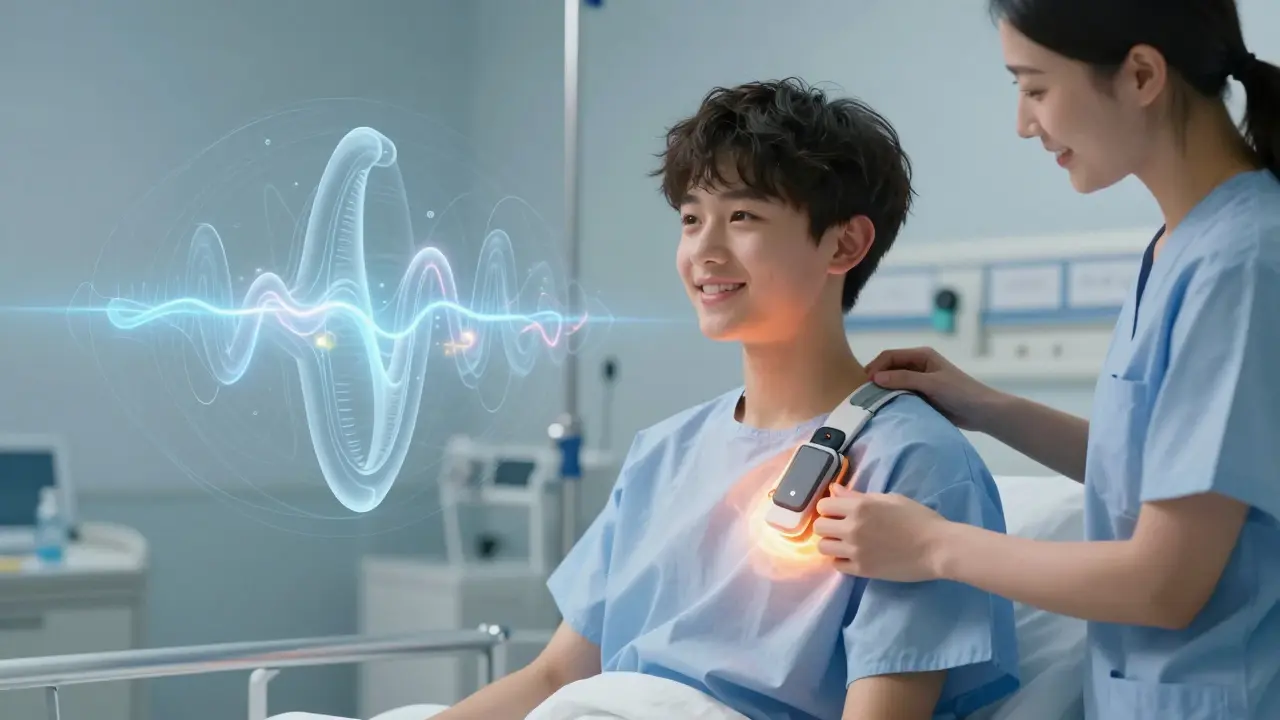
Transcutaneous systems like MED-EL’s Bonebridge and Cochlear’s BAHA Attract use magnets. The internal part is implanted under the skin, and the external processor holds on magnetically through the skin. No hole. No post. No daily cleaning. They’re quieter, more discreet, and better for active lifestyles. But they lose 10-15 dB of signal strength because the sound has to pass through skin and tissue. That’s fine for mild to moderate loss, but not ideal if you need maximum power.
Today, 63% of new implants are transcutaneous-up from 41% in 2019. People are choosing them because they’re safer and less visible.
Cost, Surgery, and Recovery
Getting a bone-conduction device isn’t like walking into a hearing aid store. It’s a surgical procedure. The operation takes 30-60 minutes under local anesthesia. Most people go home the same day.
For percutaneous systems, you wait 3-4 months for the implant to fuse with your bone before the processor is activated. Transcutaneous systems can be turned on right after surgery.
Costs are higher than traditional aids. A bone-conduction implant runs $4,000-$7,000 per ear. Premium air-conduction hearing aids? $1,500-$3,500. Insurance often covers it if you have a documented medical need-like chronic infections or aural atresia. The American Academy of Otolaryngology states these devices are “medically necessary” for those cases.
Recovery is quick. Most people return to normal activities in 48 hours. But adapting to the sound takes time. Your brain needs 2-4 weeks to adjust to hearing through bone vibration. Audiologists recommend structured listening exercises during this period.
Real User Experiences
Reddit’s r/Hearing community has over 140 recent posts from users. About 78% say their quality of life improved dramatically. One user wrote: “I heard a bird chirp from my deaf side for the first time in 15 years.” Another said, “No more itchy, blocked ears-finally, I can wear headphones without pain.”
But it’s not perfect. About 23% of users on HearingTracker.com complain about MRI incompatibility. If you need a full-body MRI, you’ll likely have to get the implant removed. That’s a big deal for people with chronic conditions.
Skin issues are the biggest downside for percutaneous users. Cochlear’s 2022 registry found 28% had skin reactions. For transcutaneous users, satisfaction is higher-92% like that it’s invisible under the skin.
How It Compares to Other Options
For single-sided deafness, the old solution was a CROS hearing aid-a device on the deaf side that wirelessly sends sound to a hearing aid on the good ear. But CROS systems don’t restore natural sound localization. Bone-conduction devices do. A 2022 study in the Journal of the American Academy of Audiology found bone conduction users had 15-20 dB better speech reception in noise than CROS users.
Compared to conventional hearing aids for conductive loss, bone conduction improves speech understanding in noise by 25-40%. That’s not a small difference-it’s life-changing for someone trying to follow conversations in restaurants or meetings.

What’s New in 2025
The field is moving fast. Cochlear just released the BAHA 6 Max with Bluetooth 5.3, 30-hour battery life, and direct streaming from smartphones. MED-EL’s Bonebridge 3, launching in early 2024, uses AI to filter background noise automatically.
The biggest trend? Fully implantable systems. Right now, you still wear something behind your ear. But Sonova is in Phase III trials for a device with no external parts at all-everything is inside. If approved, it could be on the market by late 2025.
Market growth is strong. Bone-conduction devices make up 5.2% of the global hearing aid market but are growing at 8.7% annually-more than double the rate of traditional aids. Adoption is highest in Sweden, where the technology was invented. In the U.S., only 0.4% of hearing-impaired people use them-despite 9 million Americans having single-sided deafness and only 15% getting treatment.
When Bone Conduction Doesn’t Work
It’s not a cure-all. If your cochlea is severely damaged-say, from noise exposure or aging-bone conduction won’t help. It needs a working inner ear. If your sensorineural hearing loss is worse than 45-55 dB, you’ll still need a cochlear implant.
Also, if you have very thick skin over your temporal bone (more than 5 mm), transcutaneous systems won’t work well. The magnet can’t transmit enough energy through the tissue.
And while surgery is minor, it’s still surgery. People with certain autoimmune conditions or poor bone density may not be candidates.
Final Thoughts
Bone-conduction hearing aids aren’t the first thing people think of when they hear “hearing aid.” But for the right person, they’re the only thing that works. If you’ve been told your ears are too damaged for traditional aids, or if you’ve lived with single-sided deafness for years, this might be your solution.
The technology is mature, the results are proven, and the options are better than ever. The trade-offs-cost, surgery, MRI limits-are real. But for many, the benefits far outweigh them. Hearing the world again, even from one side, changes everything.
Are bone-conduction hearing aids better than regular hearing aids?
They’re not better overall-they’re better for specific cases. If you have conductive or mixed hearing loss, or single-sided deafness, and can’t use traditional aids due to ear canal issues, bone conduction is superior. Studies show 25-40% better speech understanding in noise. But if your hearing loss is purely sensorineural and your ear canal is healthy, a regular hearing aid will work better and cost less.
Can I swim or shower with a bone-conduction hearing aid?
Yes, but only if you remove the external processor. The implant itself is waterproof once healed, but the sound processor isn’t. Most are water-resistant for light sweat or rain, but not for swimming or showers. Always take it off before getting wet. Some users use waterproof cases or covers for light water exposure.
Do bone-conduction devices cause pain or discomfort?
The implant site can feel tender for the first few weeks after surgery. Once healed, most users don’t feel the implant at all. For percutaneous systems, the abutment can cause pressure or irritation if not cleaned properly. Transcutaneous systems rarely cause discomfort because there’s no open wound. Some users report a slight pressure sensation when the magnet holds the processor, but it’s usually mild and goes away quickly.
How long do bone-conduction hearing aids last?
The implant is designed to last a lifetime-it’s made of titanium and fuses with your bone. The external processor, however, needs replacing every 5-7 years due to battery wear, tech upgrades, or damage. Most manufacturers offer trade-in programs for older models. The battery lasts 10-30 hours depending on usage and model.
Can children get bone-conduction hearing aids?
Yes. Children as young as 5 can get implantable systems. For younger kids, a softband version is available-it’s a headband that holds the processor against the skull without surgery. This is often used until the child’s skull is thick enough for an implant. Many kids with congenital ear malformations get bone-conduction devices early, which helps their speech and language development.
Will an MRI ruin my bone-conduction implant?
It can. Most implants are made of titanium, which is MRI-safe, but the magnets in transcutaneous systems can heat up or shift during a scan. Percutaneous systems may also be affected. Always tell your radiologist you have a bone-conduction implant. For 1.5T or higher MRI machines, you may need surgery to remove the internal magnet. Newer models are being designed to be fully MRI-compatible without removal.
Is there a non-surgical option for bone-conduction hearing?
Yes. Softband systems are headbands with a sound processor attached. They press the device against the skull behind the ear, transmitting vibrations without surgery. These are common for young children or adults who want to try bone conduction before committing to surgery. They’re less effective than implants but useful for testing and temporary use.
How do I know if I’m a candidate?
See an audiologist who specializes in hearing implants. You’ll need a full hearing test, a CT scan of your skull, and a medical evaluation. If you have conductive/mixed loss, SSD, chronic ear infections, or congenital ear malformations, you’re likely a candidate. If your cochlea is severely damaged, you’re not. Don’t assume-you need professional testing.





Patrick A. Ck. Trip
Bone conduction is a game-changer for those of us with chronic ear issues. I’ve worn hearing aids for over a decade, and the infections were unbearable. This technology doesn’t just help-it restores dignity.
My audiologist recommended it after years of failed attempts. I didn’t believe it at first, but the first time I heard rain on the roof without anything in my ear-I cried.
It’s not perfect, but for people who’ve been told there’s no solution, this is hope made physical.
Thank you for writing this. It’s rare to see such a thorough, accurate explanation.
Sam Clark
As someone who works with hearing-impaired patients daily, I can confirm the clinical data presented here is both accurate and clinically significant.
Transcutaneous systems have revolutionized pediatric care. Softbands allow early intervention, which is critical for language development. The data on 85–90% success rates in congenital aural atresia is not anecdotal-it’s replicated across multiple European and North American centers.
Insurance coverage remains inconsistent, but the AMA and AAAAI both classify these as medically necessary. Advocacy is still needed to ensure equitable access.
Jigar shah
Interesting breakdown. I’m curious about the 10–15 dB signal loss in transcutaneous systems-is this due to skin impedance or magnetic coupling inefficiency? Also, are there any studies comparing the long-term neural adaptation patterns between bone conduction and traditional air conduction users? The brain’s plasticity in processing non-standard auditory inputs seems underexplored.
Would appreciate any citations beyond the Linköping study.
Kent Peterson
This is just another $$$ scam. The government and big med are pushing this because they want you to get surgery. Regular hearing aids work fine. Why do you need a titanium implant just to hear a bird? You’re being manipulated. And MRI? Forget it. You’re stuck with a metal plate in your head for life. Wake up.
Josh Potter
Bro. I got my BAHA 6 Max last month. I just heard my dog bark from my deaf side for the first time since I was 8.
I’m not crying. I’m not. I swear.
Also, Bluetooth streaming to my AirPods? YES. I can finally listen to podcasts while walking the dog without sounding like a cyborg.
Also also-my mom cried when I told her I could hear her whispering. That’s not hype. That’s life.
Stop reading articles. Go see an audiologist. You’re not broken. You’re just waiting for the right tech.
Martin Spedding
Meh. Overhyped. Skin infections, MRI issues, cost. All the same problems as cochlear implants. Just more expensive. Why not just use a CROS? At least you don’t need surgery. This feels like a solution looking for a problem.
Virginia Seitz
I’m so glad this exists 😭 My brother has SSD and he finally heard his daughter say ‘I love you’ from his deaf side. He’s been crying nonstop. Thank you for sharing this. 🙏❤️
Steven Lavoie
My sister got a Bonebridge two years ago. She’s a musician. Before, she couldn’t hear the lower frequencies on her deaf side. Now, she plays piano again-feels the vibrations through the wood, hears the bass through her skull.
It’s not just about hearing speech. It’s about reconnecting with music, nature, the subtle sounds that make life feel whole.
That’s the real win here.
Marie Mee
they're putting chips in your skull and tracking you through your hearing aid i saw a video on tiktok about it they said the government uses it to listen to your thoughts i think this is part of the new mind control program
Meghan O'Shaughnessy
I’ve been using a softband for my 6-year-old since age 3. She’s now in mainstream school, reading at grade level, and doesn’t even think of herself as different.
This isn’t a medical device to her-it’s just how she hears.
Thank you for including the pediatric info. So many people forget kids need this too.
Kaylee Esdale
My aunt got the Ponto 5 last year. She’s 78. Said it felt like the world turned up from ‘muted’ to ‘normal.’
She now hears the fridge hum. The clock tick. Her cat purring from across the room.
She says she didn’t realize how quiet life had become.
It’s not about hearing better.
It’s about hearing again.
And that? That’s magic.
Philippa Skiadopoulou
While transcutaneous systems offer improved safety profiles, the 10–15 dB attenuation remains a significant limitation in noisy environments. Recent studies from the University of Manchester suggest that future iterations may utilize piezoelectric actuators to improve transmission efficiency.
Long-term data (>10 years) on implant stability is still limited, particularly in populations with osteoporosis. Caution is advised for elderly patients with low bone density.