
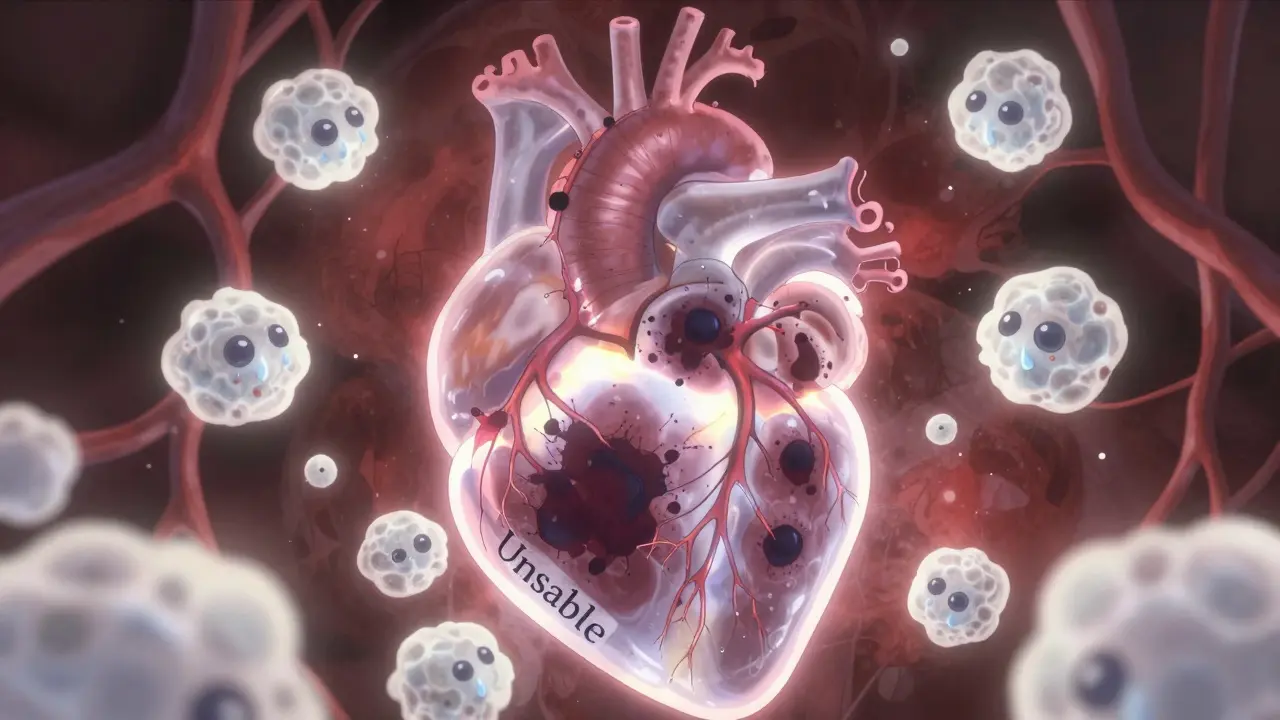
Coronary artery disease isn’t just a buzzword in medical reports-it’s the number one killer worldwide. Every year, more than 18 million adults in the U.S. alone live with it, and over 360,000 die from it. In Australia, heart disease accounts for nearly 1 in 5 deaths. This isn’t something that happens overnight. It’s a slow, silent process that starts decades before symptoms show up. At its core is atherosclerosis: the gradual clogging of your heart’s arteries by fatty deposits called plaques. And if you don’t understand how it works, you can’t stop it.
What Exactly Is Atherosclerosis?
Atherosclerosis is the root cause of most coronary artery disease. It’s not just cholesterol building up like grease in a pipe. It’s a complex biological process that begins with damage to the inner lining of your arteries-often from high blood pressure, smoking, or too much sugar in your blood. Once that lining is injured, LDL (bad) cholesterol slips in and gets trapped. Your immune system sends in white blood cells to clean it up, but instead of fixing the problem, they turn into foam cells and start forming a fatty streak. Over time, that streak hardens into a plaque made of cholesterol, calcium, and scar tissue.Here’s what most people don’t realize: not all plaques are the same. There are two main types-stable and unstable. Stable plaques grow slowly and can narrow the artery by more than 50%. They cause predictable chest pain when you’re exercising, because your heart needs more oxygen but the narrowed artery can’t deliver it. Unstable plaques are the real danger. They’re soft, full of fat and immune cells, and have a thin outer shell. They might only block 30% of the artery, but they can rupture without warning. When that happens, a blood clot forms on top of it, suddenly cutting off blood flow to part of your heart. That’s a heart attack.
Who’s at Risk? The Real Culprits Behind CAD
You’ve probably heard the usual suspects: smoking, high cholesterol, being overweight. But the latest guidelines from the American Heart Association and the American College of Cardiology (2023) break it down more precisely. Risk isn’t just about single factors-it’s about combinations and patterns.High-risk features include:
- Diabetes-especially if it’s been poorly controlled for years
- History of heart attack, stent placement, or bypass surgery
- Chronic kidney disease (eGFR below 60)
- Heart failure with preserved ejection fraction (HFpEF)
- Multiple blocked arteries (affecting two or more vascular beds)
- Smoking, even if you quit years ago
Here’s the hard truth: 60% of people with coronary artery disease have at least one of these high-risk features. And 75% of heart attacks happen in that group. That means if you have diabetes and high blood pressure, you’re not just at risk-you’re in the danger zone. Age matters too. While CAD used to be seen as a disease of older men, it’s now rising fast in women over 50 and even in people in their 40s, especially with rising obesity rates.
What’s surprising? Some people with normal cholesterol still develop severe CAD. Why? Because inflammation plays a bigger role than we thought. High-sensitivity C-reactive protein (hs-CRP) is now being used in clinics to measure hidden inflammation, even in people who look healthy on a standard lipid panel.
How Is It Diagnosed? Beyond the ECG
Many people think an ECG is enough. It’s not. An ECG can look normal even if you have major blockages. That’s why doctors use a step-by-step approach:- Stress test-You walk on a treadmill while your heart rhythm, blood pressure, and symptoms are monitored. If your heart doesn’t get enough oxygen during exertion, it shows up as changes on the monitor or chest pain.
- Cardiac CT angiography-A non-invasive scan that shows calcium buildup and blockages without needles. It’s great for ruling out disease in low-risk people.
- Coronary angiography-The gold standard. A thin tube is threaded into your artery, dye is injected, and X-rays show exactly where and how badly your arteries are blocked. This is usually done if you’ve had a heart attack or if non-invasive tests point to serious disease.
- Ankle-Brachial Index (ABI)-This simple test compares blood pressure in your ankle to your arm. If it’s low, you likely have peripheral artery disease, which means your coronary arteries are probably affected too.
Doctors now also check for INOCA-ischemia with non-obstructive coronary arteries. This means you have chest pain and signs your heart isn’t getting enough blood, but no major blockages. It’s more common in women and often tied to microvascular disease or spasms in small heart arteries.

Treatment: It’s Not Just Pills and Surgery
There’s no magic cure for coronary artery disease. But there are proven ways to stop it from getting worse-and even reverse some damage.Lifestyle changes are the foundation. No pill works as well as quitting smoking, eating real food (not processed junk), moving every day, and managing stress. The PREDIMED study showed that people who switched to a Mediterranean diet-full of olive oil, nuts, fish, vegetables, and legumes-cut their heart attack risk by nearly 30%. That’s better than most drugs.
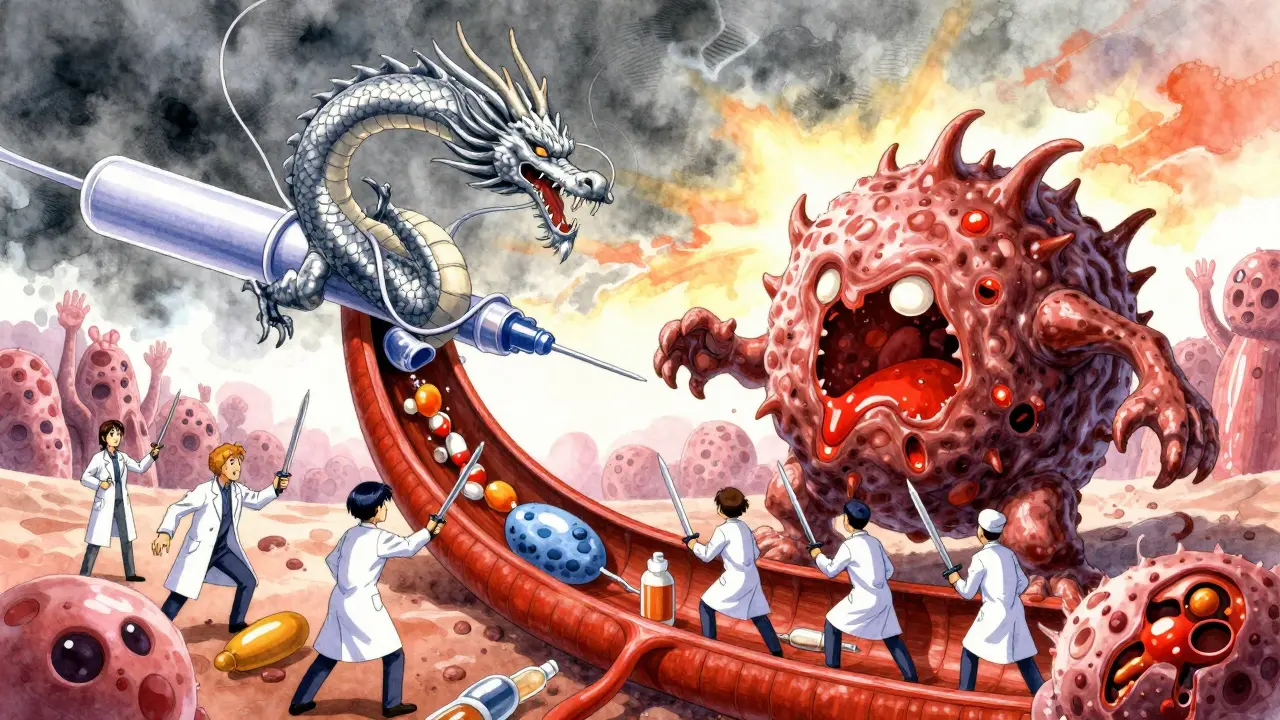
Medications are used to target specific risks:
- Statins-Lower LDL cholesterol and reduce inflammation. Even if your cholesterol is “normal,” statins are often prescribed for people with CAD because they stabilize plaques.
- Aspirin-Used in some patients to prevent clots, but only if the benefits outweigh the bleeding risk. Not for everyone.
- ACE inhibitors or ARBs-Help lower blood pressure and reduce strain on the heart, especially after a heart attack.
- Beta-blockers-Slow your heart rate and lower blood pressure, reducing chest pain and preventing future events.
- SGLT2 inhibitors and GLP-1 agonists-Originally for diabetes, these drugs now show strong heart protection in people with CAD, even if they don’t have diabetes.
Procedures are for when lifestyle and meds aren’t enough:
- PCI (angioplasty and stenting)-A balloon is inflated to open a blocked artery, and a metal mesh tube (stent) is left behind to keep it open. This is often done during a heart attack or for severe angina.
- CABG (bypass surgery)-Used when multiple arteries are blocked or the left main artery is involved. A vein or artery from another part of your body is grafted to reroute blood around the blockage. It’s major surgery, but it can add years to your life.
What’s new? Drug-coated stents now last longer and reduce re-blockage rates. And there’s growing evidence that aggressive cholesterol lowering-getting LDL below 55 mg/dL-can actually shrink plaques over time.
The Future: Personalized Care and Cardio-Oncology
The 2023 guidelines stress one thing: no two patients are the same. Your treatment plan should match your risk level, not just your symptoms. Someone with diabetes, kidney disease, and a prior heart attack needs much stronger therapy than someone with just high cholesterol and no other issues.Another big shift is cardio-oncology. More people are surviving cancer now, but some treatments-like chemotherapy and radiation-can damage the heart. At the same time, cancer patients with CAD are at higher risk of heart events. So now, oncologists and cardiologists work together. A breast cancer patient with CAD might get a different chemo drug or need a stent before starting treatment.
Research is also focusing on plaque stabilization. Instead of just opening blocked arteries, scientists are developing drugs that make plaques less likely to rupture. Anti-inflammatory drugs like colchicine are now being tested in large trials for people with CAD who still have events despite taking statins.
What You Can Do Today
If you’ve been diagnosed with CAD-or if you’re worried you might be at risk-here’s what matters most:- Know your numbers: blood pressure, LDL cholesterol, fasting blood sugar, and waist size.
- Stop smoking. Even one cigarette a day raises your risk.
- Move for at least 30 minutes most days. Walking counts. You don’t need a gym.
- Eat whole foods: vegetables, fruits, beans, nuts, fish, and olive oil. Cut out sugary drinks and ultra-processed snacks.
- Talk to your doctor about whether you need a statin or other meds-even if you feel fine.
- Don’t ignore chest pain, jaw pain, or unusual fatigue. These aren’t always “just indigestion.”
Coronary artery disease is preventable. It’s treatable. But it won’t fix itself. The sooner you act, the more heart muscle you save-and the longer you live.
Can you reverse coronary artery disease?
Yes, to some extent. While you can’t erase all plaque, aggressive lifestyle changes and medications-especially high-dose statins and very low LDL levels-can shrink plaques and make them more stable. Studies show that lowering LDL below 55 mg/dL can reduce plaque volume over 1-2 years. The key is consistency: diet, exercise, and meds must be maintained long-term.
Is coronary artery disease the same as heart disease?
Coronary artery disease is the most common type of heart disease. But heart disease includes other conditions too, like heart failure, arrhythmias, and heart valve problems. CAD specifically refers to blocked arteries supplying the heart muscle. When people say “heart disease,” they usually mean CAD.
Do I need a stent if I have CAD?
Not always. Stents are used when blockages are severe and causing symptoms like chest pain or if you’ve had a heart attack. For stable CAD without symptoms, medications and lifestyle changes are often just as effective as stents at preventing heart attacks. A major trial called ISCHEMIA showed that for most people with stable disease, stents don’t extend life-they just help with symptoms.
Can you have a heart attack with no blockages?
Yes. This is called MINOCA-myocardial infarction with non-obstructive coronary arteries. It can happen due to artery spasms, small vessel disease, blood clots that dissolve quickly, or inflammation. It’s more common in younger women and people with autoimmune conditions. Even without major blockages, heart muscle damage can still occur.
How often should I get checked for CAD if I’m at risk?
If you have risk factors like diabetes, high blood pressure, or a family history, see your doctor at least once a year. Get your cholesterol, blood pressure, and blood sugar checked annually. If you’re over 40 and have multiple risk factors, ask about a coronary calcium scan-it’s a quick CT scan that shows how much plaque you already have. That number can help guide whether you need stronger treatment.
Are natural supplements like fish oil or garlic effective for CAD?
Fish oil may help lower triglycerides slightly, but it doesn’t reduce heart attacks in people already taking statins. Garlic supplements have no proven benefit for preventing or treating CAD. The only supplements with strong evidence are omega-3s (prescription-grade, not over-the-counter) for specific high-risk patients, and plant sterols to help lower LDL. Don’t rely on supplements-focus on food, movement, and proven medications.



Shanahan Crowell
Man, this post hit me right in the chest-literally. My dad had a stent last year, and I didn’t realize how much of this was silent until he started talking about it. I’m starting to eat like my grandma used to-olive oil, nuts, no processed crap. It’s not perfect, but it’s a start. We’ve got to stop waiting for the crash to wake up.
Also, who else noticed that 30% reduction in heart attacks from the Mediterranean diet? That’s more than most drugs. Why aren’t doctors screaming this from the rooftops?
Kerry Howarth
Quit smoking. Move daily. Eat real food. These aren’t suggestions. They’re non-negotiables.
Everything else is just noise.
Tiffany Channell
Let’s be real-the pharmaceutical industry funded 80% of these ‘guidelines.’ Statins? Sure, they lower LDL. But do they actually extend life in people without prior events? The data’s messy. And don’t get me started on SGLT2 inhibitors being pushed as ‘heart protectors’ when they’re diabetes drugs repackaged with a fancy label. This isn’t medicine. It’s marketing dressed in white coats.
Joy F
Here’s the existential truth no one wants to admit: your arteries aren’t just clogged with cholesterol-they’re clogged with neglect. Every cigarette, every sugary latte, every hour spent scrolling instead of walking-it’s not just ‘bad habits.’ It’s a slow-motion betrayal of your own body.
The plaque isn’t just fat. It’s regret. It’s the years you ignored the warning signs because you thought ‘I’m young’ or ‘I’ll fix it later.’ But time doesn’t negotiate. It doesn’t pause for your anxiety, your denial, your ‘I’ll start Monday.’
And now we’ve got doctors talking about ‘plaque stabilization’ like it’s some sci-fi upgrade. But the real breakthrough? It’s not a drug. It’s showing up. Day after day. Even when you’re tired. Even when you don’t feel like it. Even when the world tells you to indulge. That’s the real anti-atherosclerosis pill.
Cardio-oncology? That’s not a trend. That’s the future. Cancer survivors are living longer, but their hearts are paying the price. We’re creating a generation of people who beat cancer only to die of a broken heart. And we’re not talking about it enough.
MINOCA? Yeah. Women get it. Young people get it. People who ‘look healthy’ get it. The system is built to ignore them. Because if you don’t have a 90% blockage, you’re ‘not sick enough.’
And the supplements? Fish oil? Garlic? Please. You’re not saving your heart with a capsule from Walmart. You’re saving it with your choices. Your discipline. Your refusal to be a statistic.
It’s not about being perfect. It’s about being present. Your heart doesn’t need a hero. It needs you. Not tomorrow. Today.
Haley Parizo
They say ‘heart disease is the number one killer,’ but they never say who’s really responsible. The food industry. The sugar lobbyists. The insurance companies that profit from chronic illness. This isn’t a medical problem-it’s a systemic one. We’re being fed poison and then sold pills to undo the damage. It’s capitalism with a stethoscope.
And don’t tell me ‘personal responsibility.’ When your neighborhood only has convenience stores and fast food, and fresh produce costs twice as much, that’s not choice-that’s coercion.
They want you to blame yourself for having a heart attack. But who designed the system that makes healthy living a luxury? Who made the cost of prevention higher than the cost of treatment?
Fix the system. Or stop pretending this is about willpower.
Ian Detrick
My uncle had a heart attack at 48. He was a gym rat, ate ‘clean,’ and took statins. Turns out, his hs-CRP was through the roof. No one tested it. He had no family history. No diabetes. Just… inflammation. Turns out, chronic stress and sleep deprivation were the real culprits.
So yeah, cholesterol matters. But don’t ignore the invisible stuff-your mental load, your sleep, your cortisol levels. You can’t out-exercise a stressed-out nervous system.
Angela Fisher
Okay, but what if the whole thing is a lie? What if atherosclerosis isn’t caused by diet or cholesterol at all? What if it’s the vaccines? Or the 5G? Or the fluoride in the water? I read this one guy on TruthSocial who said the plaques are actually biofilm from the mRNA spike proteins sticking to artery walls. He’s got a PhD in microbiology. And he says the CDC is hiding the real cause because they don’t want people to know the truth.
And why do they keep pushing statins? Because Big Pharma owns the FDA. I know a guy who went on statins and got rhabdomyolysis. His muscles turned to jelly. He’s still in pain. But the doctor just said, ‘It’s rare.’ Rare? My cousin’s cousin had the same thing. They’re covering it up.
And the ‘Mediterranean diet’? That’s just a distraction. Real people don’t eat olive oil and nuts. They eat chicken nuggets because they’re cheap and they’re all we can afford. So why blame us? We’re victims.
I’m not saying don’t eat healthy. I’m saying don’t trust the system. They want you to think you’re broken so they can sell you a fix. But the real fix? It’s not in a pill. It’s in the truth they’re hiding.
Neela Sharma
Heart is not just muscle. It is memory. It holds grief. It holds joy. It holds the silence between breaths.
When you eat fried food, you are not just feeding arteries-you are feeding the ghost of your ancestors who never had a chance to live long.
Walk. Not because the doctor said so. Walk because the earth remembers your feet. And your heart remembers the rhythm of walking-slow, steady, alive.
Medicine can mend. But only you can choose to live.
One step. Then another.
That is your rebellion.
That is your prayer.
Shruti Badhwar
The clinical evidence supporting lifestyle modification as first-line therapy for CAD is robust and unequivocal. While pharmacological interventions are essential in high-risk populations, adherence to evidence-based dietary patterns, regular physical activity, and tobacco cessation remain the most cost-effective and sustainable strategies for primary and secondary prevention.
Furthermore, the integration of biomarkers such as hs-CRP and coronary calcium scoring into risk stratification protocols significantly enhances predictive accuracy beyond traditional risk factors. These tools enable personalized therapeutic approaches, aligning with the 2023 ACC/AHA guidelines.
It is imperative that healthcare systems prioritize preventive cardiology over reactive interventions to mitigate the escalating global burden of cardiovascular disease.
Brittany Wallace
I just started walking every morning after dropping my kid off at school. 20 minutes. No music. Just me and the birds.
It’s not about losing weight or lowering cholesterol. It’s about remembering I’m still alive.
And I’m not done yet. ❤️
Michael Burgess
My brother got a stent after a scare last year. He’s now the most annoying healthy person on the planet-brags about his blood pressure like it’s a trophy. But hey, I’ll take it.
He swapped soda for sparkling water, started meal prepping, and actually talks to his doctor now. No more ‘I’m fine.’
And guess what? He’s sleeping better. Less anxiety. More laughs.
It’s not magic. It’s just… showing up. Even when it’s boring.
Also, if you’re reading this and thinking ‘I’ll start next month’-just start today. Your future self will high-five you. 🙌
Liam Tanner
There’s a lot here. A lot. But the thing that stuck with me? ‘Your heart doesn’t need a hero. It needs you to show up, day after day.’
That’s it. No grand gestures. No detoxes. No miracle pills.
Just showing up.
That’s the real treatment.
Palesa Makuru
You know what’s funny? I live in Cape Town and we have a guy who sells ‘heart detox’ tea made from baobab and wild rosemary. Costs R350 a bottle. People line up for it. Meanwhile, the public clinics can’t even get people on statins. So we’re selling mystical potions to the poor while the rich get genetic testing and coronary calcium scans. That’s not healthcare. That’s colonialism with a side of wellness.
And don’t get me started on how ‘Mediterranean diet’ became a luxury brand. Olive oil in glass bottles? Nuts in organic packaging? Meanwhile, my cousin eats instant noodles because it’s all she can afford on her minimum wage job.
So yeah. ‘Lifestyle changes.’ Right. Tell that to the single mom working two shifts.
Hank Pannell
Here’s the deeper layer nobody’s talking about: atherosclerosis isn’t just a vascular disease-it’s a signal of systemic dissonance. Our bodies evolved to move, to fast, to eat seasonally, to live in rhythm with the sun. Now we’re wired for constant stimulation, constant food, constant stress. The plaque isn’t just cholesterol-it’s the physical manifestation of a civilization out of sync with its biology.
Modern medicine treats the symptom: blocked arteries. But what if the disease is the environment? The 24/7 culture? The isolation? The lack of community? We treat the heart like a broken engine, but maybe it’s screaming because the whole car is falling apart.
And that’s why statins work for some and not others. Because medicine can fix a clog. But it can’t fix a soul that’s been starved of meaning, movement, and connection.
Cardio-oncology is just the tip. What we need is ‘eco-cardiology’-a system that heals the body by healing the world it lives in.