
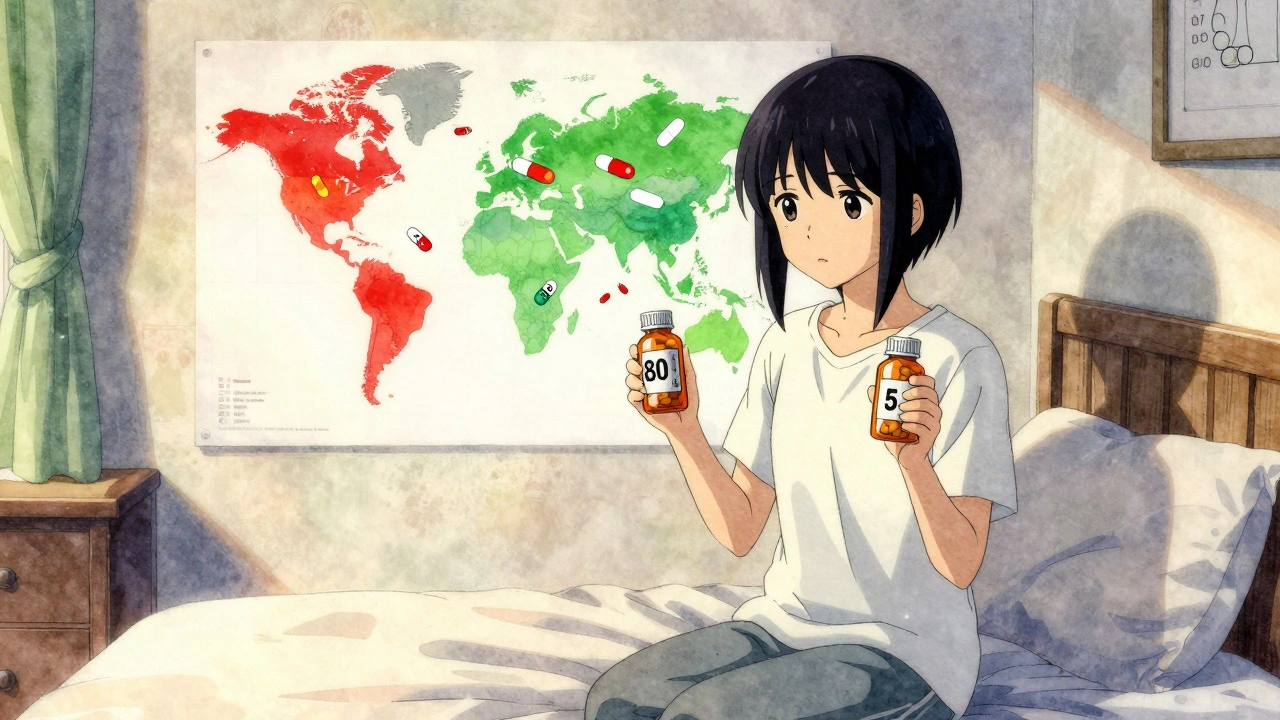
Two people take the same pill. Same active ingredient. Same dose. Same manufacturer. One pays $5. The other pays $80. This isn’t science fiction. It’s real life - and it happens every day across the globe. Generic drugs are meant to be the affordable alternative to brand-name medications. But when you look at what’s actually available and how much it costs in different countries, the system starts to look broken.
Same Drug, Different Prices - Here’s Why
Generic drugs are copies of brand-name medicines. Once the original patent expires, other companies can make them. The idea is simple: more competition = lower prices. But in practice, that’s not what happens everywhere.
In the United States, over 90% of prescriptions are filled with generics. That’s the highest rate in the world. But here’s the twist: the U.S. still pays the most for drugs overall. A 30-day supply of metformin, a common diabetes drug, costs about $10 in India, $15 in Canada, $25 in Germany - and $80 in the U.S. even as a generic. Why? Because the U.S. doesn’t negotiate prices like other countries. There’s no central agency setting limits. Pharmacies and insurers pay what manufacturers charge, and sometimes, that price spikes for no clear reason.
In contrast, the United Kingdom forces generic substitution by law. Pharmacists must switch patients to the cheapest version unless the doctor says no. That’s why 83% of prescriptions there are generics. Prices are kept low because the government buys in bulk and demands discounts. Germany and the Netherlands follow similar rules. Switzerland? Only 17% of prescriptions are generics. Doctors there still prefer brand names. Patients expect them. And the government pays more for brands than it does for generics - so there’s no incentive to switch.
Who Makes Your Generic Medicine?
Chances are, the generic pill in your bottle didn’t come from the U.S. or Europe. It came from India or China.
India produces about 20% of the world’s generic drugs - and 40% of what Americans take. Companies like Cipla and Sun Pharma have over 750 FDA-approved manufacturing sites. That’s more than any other country. But quality isn’t guaranteed. A 2023 study from Ohio State University found that generic drugs made in India were linked to 54% more severe side effects - including hospitalizations - compared to the same drugs made in the U.S. That doesn’t mean all Indian generics are dangerous. But when cost-cutting gets extreme, corners get cut. Excipients (inactive ingredients), storage conditions, and batch testing can suffer.
China is catching up fast. In 2010, it had just 12 FDA-approved drug factories. By 2023, that number jumped to 187. But inspections are still inconsistent. The FDA does pre-announced visits overseas - meaning manufacturers have time to clean up before inspectors arrive. In the U.S., inspections are random. That gap creates risk.
Why Some Countries Have Fewer Generic Options
It’s not just about price. It’s about access.
In the U.S., 94% of off-patent drugs have at least one generic version available. In Belgium? Only 57%. Why the gap? Regulatory delays. In Europe, even after the EMA approves a generic, each country must approve it separately. That adds 18 to 24 months before the drug hits shelves. In the U.S., one FDA approval opens the door nationwide.
Some countries also have weak enforcement. In Italy and Greece, less than 20% of prescriptions are for generics - not because people don’t want them, but because doctors aren’t pushed to prescribe them. Reimbursement policies favor brand names. Pharmacies don’t stock generics because they’re not profitable enough.
South Korea is another odd case. Prices for generics are often lower than in other countries - but people still don’t use them. Why? Cultural trust in brand names runs deep. Even when generics are cheaper, patients ask for the original. Doctors comply.

Supply Chains Are Fragile - And Getting Worse
During the pandemic, India banned exports of 26 key active ingredients - including antibiotics and blood pressure meds - to keep them at home. The ripple effect hit 22 countries. Hospitals ran out. Patients went without.
In 2023, the FDA recorded 147 generic drug shortages in the U.S. alone. Two-thirds were tied to manufacturing problems - mostly at single-source factories in India and China. If one plant fails, there’s no backup. That’s because companies stopped making multiple versions of the same drug. Why? Profit margins are razor-thin. Making 10 versions of the same pill costs more than making one. So they make one. And if that one fails? Everyone suffers.
Even when generics are available, switching between brands can be risky. Patients traveling from the U.S. to Canada often report side effects - not because the active ingredient changed, but because the fillers or coatings did. A generic made in India might use a different binder than the one made in Germany. For most people, it doesn’t matter. For some - especially those on thyroid meds or seizure drugs - even tiny differences can trigger reactions.
Who’s Trying to Fix This?
Not enough people, and not fast enough.
The European Union is pushing for a unified generic approval system by 2030. The goal? Get 80% of prescriptions filled with generics across all member states. Right now, the average is 73% - but it varies wildly from country to country.
The U.S. Inflation Reduction Act of 2022 gave the FDA more money to inspect foreign factories and speed up generic reviews by 30%. That’s a start. But the agency still struggles to keep up with the rise in complex generics - things like inhalers, eye drops, and topical creams that are harder to copy than a simple tablet.
The World Health Organization released a new global benchmarking tool in 2024 to push countries to improve how they test generic drug quality. But enforcement is weak. Countries that don’t meet standards face no penalties.
Meanwhile, drugmakers keep finding ways to delay generics. They tweak a pill’s coating, change the release mechanism, or file new patents on minor improvements. Between 2015 and 2022, 1,247 of these "evergreening" patents were filed on just 12 top-selling drugs. Each one pushes back generic entry by years.
What This Means for You
If you’re on a long-term medication, your price can change overnight - depending on where you live, who makes your pill, and whether a factory in India shut down last month.
Here’s what you can do:
- Ask your pharmacist: Is this generic made in the U.S., India, or elsewhere? Ask for the manufacturer name - it’s on the label.
- Compare prices: Online Canadian pharmacies often sell the same generic for 60-80% less than U.S. retail. But check if they’re licensed and if the drug is approved by Health Canada or the FDA.
- Don’t assume safety: Just because it’s cheap doesn’t mean it’s better. If you notice new side effects after switching generics, tell your doctor.
- Know your rights: In the U.S., you can refuse a generic substitution if you’ve had problems before. In Europe, laws vary - but many countries let you request the brand name if needed.
The system isn’t designed to protect patients. It’s designed to cut costs - and sometimes, that means cutting corners. The truth is, we’ve outsourced the production of our most essential medicines to a handful of countries with different rules, different standards, and different priorities. And when something breaks, we’re the ones who pay the price - in dollars, in health, and in trust.
What’s Next?
The future of generics isn’t just about price. It’s about control. As AI helps companies design new formulations faster, the gap between countries could narrow. But only if regulations catch up. If the U.S., EU, and India start sharing inspection data, harmonizing testing standards, and punishing bad actors - then maybe, just maybe, a pill will mean the same thing no matter where you buy it.
Until then, know this: your medicine is global. But your access? It’s still local.
Why are generic drugs cheaper in some countries than others?
Generic drugs cost less in countries with strong price controls, bulk purchasing, and mandatory substitution laws - like the UK, Germany, and Canada. These governments negotiate prices or cap them. In the U.S., there’s no central negotiation, so prices stay high even for generics. Manufacturing costs are similar worldwide, but what you pay depends on local policy, not production cost.
Are generic drugs from India safe?
Many Indian-made generics are safe and meet FDA standards. Over 750 Indian factories are FDA-approved. But a 2023 study found they were linked to 54% more severe side effects than U.S.-made versions - especially for older drugs where profit margins are tight. Quality varies by manufacturer. Look up the brand name on the pill and check if it’s listed on the FDA’s approved database.
Can I buy cheaper generics from Canada or other countries?
Yes, many U.S. patients save 60-80% buying from licensed Canadian or European online pharmacies. But the FDA doesn’t regulate these imports, so there’s no guarantee the drug is authentic or properly stored. Only use pharmacies verified by PharmacyChecker or similar trusted sites. Never buy from unknown websites - counterfeit drugs are common.
Why do I have different side effects when I switch generic brands?
Generic drugs must have the same active ingredient, but they can use different fillers, binders, or coatings. For most people, this doesn’t matter. But for drugs with narrow therapeutic windows - like levothyroxine, warfarin, or seizure meds - even small differences can affect absorption. If you notice new symptoms after switching, tell your doctor and ask to stick with the same manufacturer.
Why are there so many generic drug shortages?
Most shortages happen because one factory makes the entire supply - and something goes wrong. Quality issues, equipment failure, or raw material shortages can shut down production. Companies stopped making backup versions because margins are too low. In 2023, 68% of U.S. generic shortages came from single-source factories, mostly in India and China.
Will biosimilars change the generic drug landscape?
Yes, but slowly. Biosimilars are generic versions of complex biologic drugs - like insulin or cancer treatments. They’re cheaper than brands (about 50% less), but harder to make and approve. U.S. adoption is still low because insurers and doctors are cautious. Unlike simple pills, biosimilars aren’t always interchangeable. That means patients might need a new prescription each time they switch. They’ll grow, but not as fast as traditional generics.




Ali Bradshaw
Been on metformin for 12 years. Bought it in London for £3. Came back to the States and paid $78 for the same bottle. No joke. My pharmacist said, 'That's just how it is.' I don't need a PhD to know this is broken.
luke newton
Of course it's broken. You people keep outsourcing everything to India and China and then act shocked when the pills give you rashes. We used to make medicine here. Now we make memes and pay $80 for a sugar pill with a fancy label. Wake up.
ashlie perry
the fda lets chinese factories clean up before inspections and no one talks about it
Lucy Kavanagh
India makes 40% of our meds? That's why we're dying. We used to be the world's pharmacy. Now we're just the world's cash register. The NHS keeps us alive with cheap generics while we pay 10x for the same pills. Shameful.
Stephanie Bodde
my mom switched generics and had a seizure. turned out the binder was different. never assume it's the same. talk to your dr. 🙏
Philip Kristy Wijaya
the notion that price equals quality is a capitalist delusion. a pill is a pill. the difference is in the marketing budget and the lobbying power not the chemistry
Mellissa Landrum
theyre all made in china and the fda just rubber stamps them. why do you think the recalls keep happening? its not a coincidence its a conspiracy
Krishan Patel
Let me tell you something. India produces 20% of the world’s generics and over 750 of our FDA-approved facilities. We don’t cut corners. We deliver. You think your $80 pill is better? It’s not. It’s just more expensive because your government lets pharma rip you off. We make medicine for the world. You make excuses.
Jennifer Patrician
the whole system is rigged. the same factory makes the same pill. one batch goes to canada for $15. another batch goes to america for $80. same box. same label. same everything. the only thing different is the price tag. that’s not capitalism. that’s theft
Deborah Jacobs
I’ve been on thyroid meds for 15 years. Switched from one generic to another last year and suddenly I was shaking, exhausted, heart racing. My doctor didn’t even blink. Said, 'It’s the same active ingredient.' But it wasn’t the same pill. The fillers changed. My body knew. I had to go back to the original brand-paid triple. No one talks about how these tiny chemical differences can wreck your life. It’s not just about cost. It’s about trust. And we’ve lost it.
Mark Curry
we need global standards. if a pill is made in india and sold in america, it should be tested the same way. no more pre-announced visits. no more loopholes. just real inspections. and if a company cuts corners, shut them down. period.
Stephanie Fiero
you dont have to accept this. ask for the manufacturer. check pharmacychecker. call your rep. if you dont fight for your meds no one will. its not hopeless its just lazy
Carole Nkosi
the truth is we've outsourced our health to nations with lower labor costs and weaker oversight. we traded safety for savings and now we're paying in suffering. this isn't economics. it's moral failure.
Jimmy Jude
Let’s be real. The real villain isn’t India. It’s not China. It’s not even the FDA. It’s the entire illusion that medicine is a public good. It’s a product. A luxury commodity. We treat pills like toothpaste, but they’re life. And the system knows it. That’s why they let you die slowly while charging you $80. They’re not greedy. They’re just honest about what they are: predators in lab coats.
Lynette Myles
the fda approved 187 chinese factories but only inspects 10% of them annually. that's not oversight that's negligence