
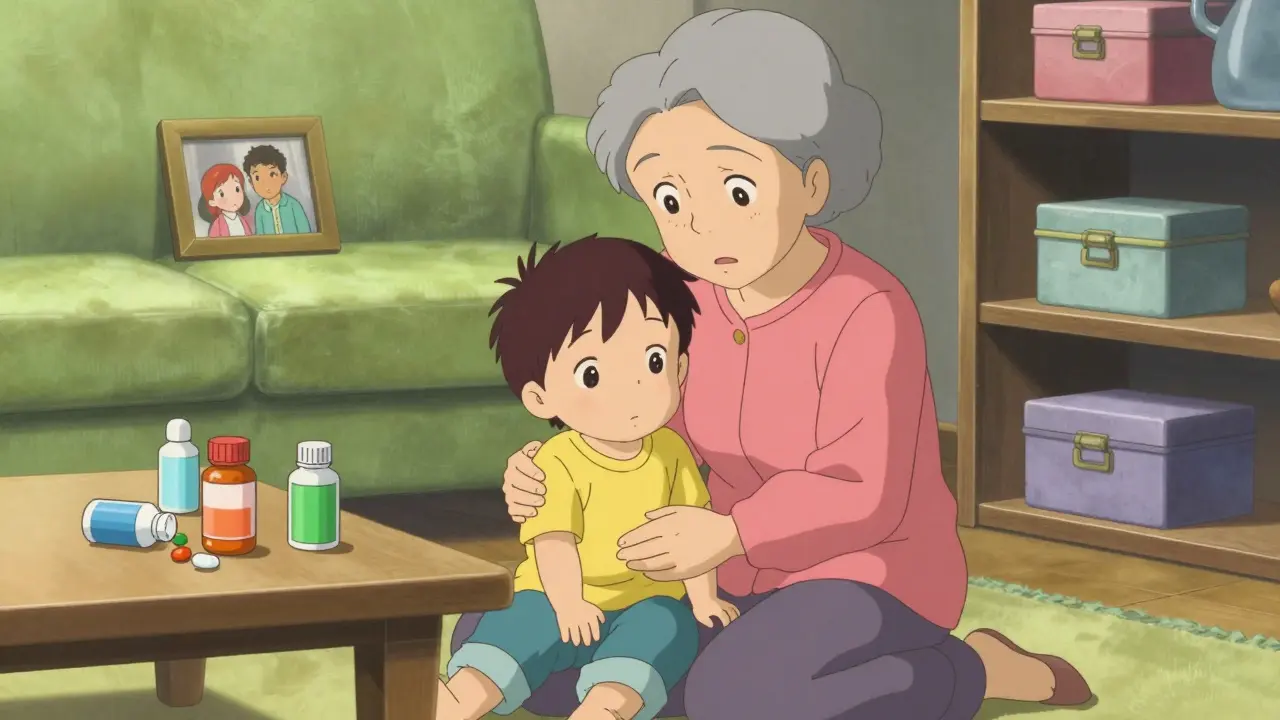
Every year, over 58,000 children under five end up in the emergency room because they got into medicine they weren’t supposed to. And in nearly 4 out of 10 of those cases, the medicine came from a grandparent’s purse, nightstand, or kitchen counter. This isn’t about bad parenting or careless grandparents. It’s about a system that hasn’t caught up with how families really live today.
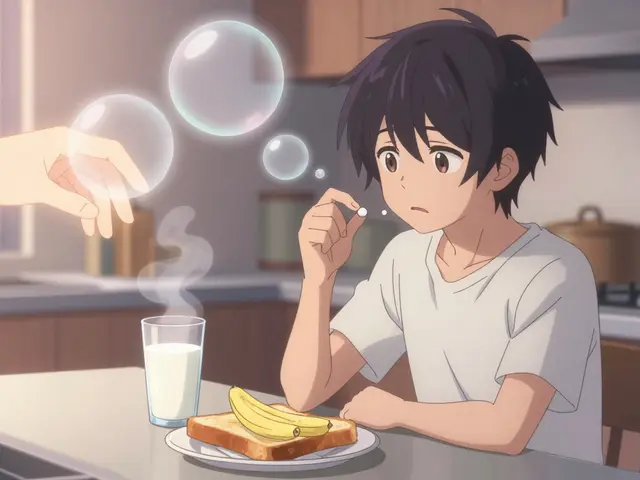
More than 7 million grandparents in the U.S. live with their grandchildren. One in three grandparents provides regular childcare. And most of them are taking multiple prescriptions-on average, 4.7 daily. That’s more than double what parents their age take. With pills scattered across bathrooms, purses, and bedside tables, it’s no surprise kids find them. A 3-year-old doesn’t know the difference between a vitamin and a blood pressure pill. They see a colorful tablet, pop it in their mouth, and it’s too late before anyone notices.
Why Grandparents Are the Missing Piece in Pediatric Safety
Parents know to lock up medicine. Studies show 68% of parents store medications safely. But only 52% of caregiving grandparents do. Why the gap?
Many grandparents believe child-resistant caps are enough. They’re not. Research shows 30% of 4-year-olds can open them in under five minutes. Others think their meds are fine where they are-on the dresser, in the purse, next to the coffee maker. One grandma told researchers, “I keep them where I can find them.” That makes sense-until a grandkid finds them first.
And it’s not just about storage. A quarter of grandparents transfer pills into weekly pill organizers, which are never childproof. Nearly one in three keep meds in non-original containers. That means no labels, no dosing info, no warnings. One little blue pill could be anything: a heart med, a painkiller, a sedative. Kids don’t know, and neither do most grandparents.
Even worse, 12% of grandparents keep meds on their nightstands. That’s where kids climb, crawl, and grab. The CDC says medicine should be stored at eye level or higher-above 4 feet-and locked. But how many grandparents have childproof locks? Only 22% do. Compare that to 58% of parents.
What Actually Works: The PROTECT Campaign That Saved Lives
In 2010, the CDC and the Consumer Healthcare Products Association launched the “Up & Away and Out of Sight” campaign. It wasn’t a poster. It wasn’t a pamphlet. It was a 15-minute conversation-with real tools.
A 2017 NIH study followed 223 grandparents who cared for kids under five. After one short session, safe storage jumped from 39% to 78%. That’s not a small change. That’s life-saving.
What did they do?
- They showed grandparents how to lock medicine in a high cabinet-not the bathroom, not the kitchen, not the bedroom.
- They taught them to keep meds in original bottles with child-resistant caps-even if the caps are hard to open.
- They gave them free lockboxes (cost: $15-$20 each).
- They didn’t say, “You’re doing this wrong.” They said, “Let’s keep our grandkids safe.”
The results? Safe storage improved in both the grandparents’ homes and the grandchildren’s homes. But the biggest change happened where the meds were stored-grandma’s house. That’s where the risk is highest.
How to Talk to Grandparents Without Making Them Feel Guilty
Here’s the truth: Grandparents don’t want to hurt their grandkids. They want to protect them. But they’ve been told for decades that medicine is “just pills.” They’ve never been taught how dangerous they can be to small children.
Start with empathy. Say: “I know you take good care of the kids. I just want to make sure we’re both doing everything we can to keep them safe.”
Don’t say: “You shouldn’t leave your pills out.”
Do say: “I heard a story about a little boy who found his grandma’s heart medicine. He’s fine now, but it was scary. Can we put yours in a locked box so no one else gets hurt?”
Use the CDC’s simple 3-step talk:
- “Medicine is not candy.” Even if it looks like Skittles, it’s not for kids.
- “Only adults give medicine.” Not even aunts, uncles, or babysitters-only the people who are supposed to.
- “If you find medicine, tell an adult immediately.” Teach kids to say, “I found something I shouldn’t touch.”
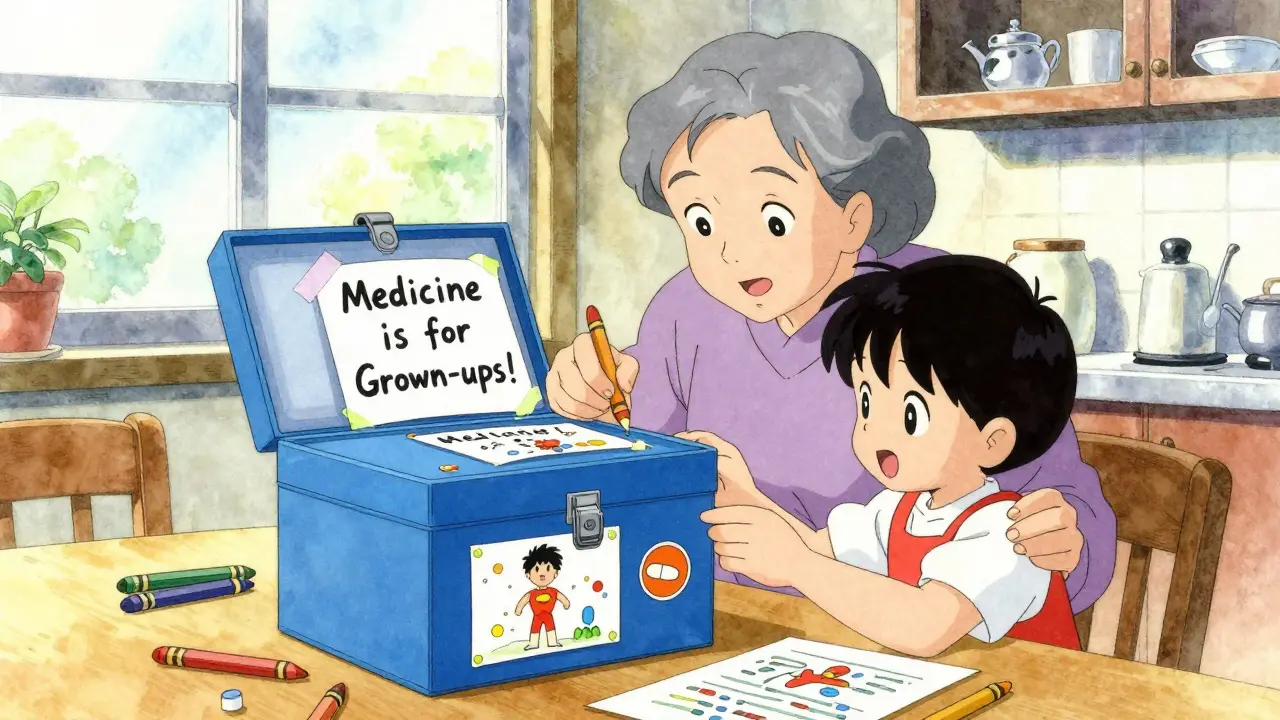
Make it fun. Let the grandkids draw a poster: “Medicine is for grown-ups.” Hang it on the fridge. Let them help pick out a lockbox. When kids feel involved, they remember.
Practical Steps Every Grandparent Can Take Today
You don’t need a fancy system. You don’t need to buy expensive gear. Here’s what works, right now:
- Put all meds in original bottles. No pill organizers unless they’re locked. And even then, keep them locked.
- Store them up high and locked. A cabinet above the fridge, a locked closet, a medicine box on a top shelf. Anything above 4 feet and out of reach.
- Keep purses and bags off the floor. If you carry meds in your purse, hang it up when you visit. Don’t let it sit on the couch or the floor.
- Check your meds every few months. Toss expired or unused pills. Many pharmacies offer free take-back bins. Ask your pharmacist.
- Use a lockbox. You can get one for under $20 at any drugstore. Or ask your pharmacist-they often give them out for free.
And if you have trouble opening child-resistant caps? That’s okay. Ask your pharmacist for an easy-open cap. Or ask a family member to help you refill your pills in a daily dispenser you can lock.
What Parents Can Do to Help
Parents, you can’t control what happens at grandma’s house. But you can make it easier.
- Bring a lockbox when you drop off the kids. Say, “I brought this for your meds-it’s easy to use.”
- Ask, “Where do you keep your medicines?” Don’t wait for a crisis.
- Send a quick text: “Just a reminder-please keep meds locked. We appreciate you.”
- Share the CDC’s “Up & Away” video (available in 12 languages) on your phone. Show it to them. It’s only 2 minutes long.
One dad sent his mom a link to a video of a toddler opening a child-resistant cap. She watched it. Then she bought a lockbox the next day.
What’s Being Done-and What’s Still Missing
Pharmacies are starting to help. Major chains like CVS and Walgreens now offer free lockboxes to seniors. AARP runs “Safety at 65+” workshops. The CDC has a free digital toolkit with videos and printable guides.
But only 12% of Medicare Part D plans give grandparents safety info when they pick up prescriptions. Only 1 in 3 grandparents has ever been told by a doctor or pharmacist how to keep meds away from kids.
California passed a law in 2023 requiring pharmacists to counsel patients over 60 who have visiting grandchildren. Other states are watching. But until this becomes standard care, families have to step in.
There’s also a new app in testing called GRAND SAFE. It sends reminders to grandparents before holidays or visits-when the risk spikes. Early results show it works.
Final Thought: This Isn’t About Blame. It’s About Care.
Grandparents love their grandchildren more than anything. They’re not careless. They’re just unaware. And they’re not getting the information they need.
Medicine safety isn’t just for parents. It’s for everyone who holds a child. A grandparent’s purse, a kitchen counter, a nightstand-these aren’t just places. They’re potential hazards.
One conversation. One lockbox. One moment of clarity. That’s all it takes to stop a tragedy before it starts.
Keep medicine up. Keep it locked. Keep it away. And keep talking.
Why do so many poisonings involve grandparents?
Grandparents often take more medications than parents-on average, 4.7 daily-and many store them in places that are easy for kids to reach, like nightstands, purses, or kitchen counters. While parents are more likely to lock up medicine, grandparents may not realize how quickly a child can get into pills, especially if they’re in non-childproof containers or left out in plain sight. Studies show 38% of pediatric medicine poisonings involve a grandparent’s meds.
Are child-resistant caps really enough to protect kids?
No. While child-resistant caps are required by law, they’re not child-proof. Testing shows that 30% of 4-year-olds can open them in under five minutes. Many grandparents think these caps are sufficient, but that’s a dangerous assumption. The only reliable protection is storing medicine in a locked container, out of reach and out of sight.
What should I do if my grandchild finds medicine?
Call Poison Control immediately at 1-800-222-1222. Even if your grandchild seems fine, some medicines can cause delayed reactions. Do not wait for symptoms. Do not try to make them vomit. Keep the medicine bottle handy so you can tell the operator what was taken. Every second counts.
Can I get a free lockbox for my medicine?
Yes. Many pharmacies-including CVS, Walgreens, and Rite Aid-offer free medicine lockboxes to seniors, especially if they have grandchildren visiting. Ask your pharmacist. You can also request one through the CDC’s “Up & Away and Out of Sight” campaign website or local senior centers. Some community health programs provide them at no cost.
How can I talk to my grandparent about medicine safety without offending them?
Focus on love, not blame. Say, “I know you’re the best caregiver, and I just want to make sure we’re both doing everything we can to keep the kids safe.” Share a real story-like a near-miss from a news article or a friend’s experience. Offer to help them set up a lockbox. Frame it as teamwork: “Let’s make sure no one gets hurt.” Most grandparents will respond positively when they feel respected, not criticized.
What if my grandparent has arthritis and can’t open child-resistant caps?
Ask your pharmacist for an easy-open cap. Many pharmacies can replace standard caps with ones that require less force to open. You can also ask a family member to refill pills into a daily dispenser and then lock that dispenser. Some lockboxes even have push-button or key locks that are easier to use than twist caps. The goal is safety, not difficulty.
Are over-the-counter meds and supplements dangerous too?
Yes. Many people think only prescription drugs are risky, but children can be poisoned by children’s Tylenol, allergy pills, vitamins, and even CBD gummies. One chewable vitamin can contain enough iron to be toxic. Always treat all medications and supplements like dangerous items-store them locked and up high, just like prescriptions.
Is there a program that helps grandparents with medication safety?
Yes. The CDC and Consumer Healthcare Products Association run the “Up & Away and Out of Sight” campaign, which offers free videos, print guides, and lockboxes. AARP also runs “Safety at 65+” workshops in many communities. Some pharmacies offer free safety assessments when you pick up prescriptions. Ask your pharmacist-they’re trained to help.
Akshaya Gandra _ Student - EastCaryMS
omg i had no idea grandmas keep meds on their nightstands 😳 my nani keeps her pills next to her tea mug and i always thought it was just because she’s old and forgetful… but now i get it. this post is scary but also so helpful. ty for sharing!
Jacob Milano
Man, this hits different. I’ve seen my abuela’s purse-full of bottles, half-empty pill organizers, and a random bottle of melatonin labeled ‘for sleep’ that’s actually a blood thinner. She thinks she’s being practical. But kids? They don’t care about practical. They care about shiny. I bought her a lockbox last Christmas. She still hides it in the closet ‘because it’s too big.’ But at least she doesn’t leave the keys on the counter anymore. Small wins, right? 🙏
jigisha Patel
While the emotional appeal of this article is compelling, the statistical foundation is methodologically flawed. The CDC’s 38% figure is drawn from a non-randomized, self-reported dataset with significant selection bias. Furthermore, the assertion that 30% of 4-year-olds can open child-resistant caps is based on a 2003 ASTM standard test protocol, which does not reflect real-world developmental variability. The recommendation for lockboxes is valid, but the framing of blame avoidance is misleading-this is not a failure of education, but of systemic healthcare infrastructure. Pharmacists should be mandated to provide safety counseling upon every script fill, not left to voluntary outreach programs.
Ethan Purser
…I just sat here and cried. Not because of the stats. Not because of the kids. But because I remember my grandma’s hands-shaking, arthritic, holding that tiny blue pill like it was a secret. She never meant to scare me. She just wanted to feel in control. And now I wonder… how many grandmas are out there, alone, with a drawer full of pills they don’t understand, and a grandkid who thinks they’re candy? This isn’t about locks. It’s about love that got lost in translation. 💔
Doreen Pachificus
Interesting. I never thought about how often grandparents are the ones giving meds during visits. My mom’s side keeps everything in the bathroom cabinet-no locks, no labels. I just assumed it was normal. Maybe I should bring my kid’s lockbox next time we visit. Or just… hide the meds myself? 😅
Rory Corrigan
just imagine if we treated meds like guns… 😐
Charlotte N
my aunt just started taking blood pressure meds and she uses a weekly pill organizer… and keeps it on the coffee table. i’ve tried talking to her, but she says ‘i know what’s what’ and i don’t want to sound like a nag. maybe i’ll just leave a lockbox there one day… like a gift. she’ll think i’m being sweet. and maybe she’ll use it. i hope. 🤞
bob bob
Man, I love how this doesn’t blame anyone. Just says ‘here’s the problem, here’s how to fix it, and hey-we’re all in this together.’ I’ve been telling my mom to lock her pills since last year. She still leaves them in her purse on the couch. But last week, she texted me: ‘I put the box on the top shelf. Took me 20 minutes to open it. Worth it.’ I cried. She didn’t even know I’d sent her the link. She just… did it. That’s the power of quiet care.
Vicki Yuan
One of the most effective interventions I’ve seen is when pediatricians hand out lockboxes during well-child visits. Not just to parents-to grandparents who are listed as caregivers. It’s simple, low-cost, and removes the stigma. If we treated medication safety like car seat safety, we’d have zero deaths. We don’t. We wait for tragedy. Let’s stop waiting.
Uzoamaka Nwankpa
It’s so sad that we have to remind people that medicine isn’t candy… but I guess we do. My cousin’s child almost died from a vitamin bottle. The label was faded. The bottle was open. No one knew what was inside. They didn’t even know it was dangerous. I don’t blame them. I just wish someone had told them sooner. 🙏