
Most people assume that if two pills have the same active ingredient, they work the same way. But what if the problem isn’t the drug itself - it’s what’s not supposed to be there?
What You’re Really Taking When You Take a Generic
Generic medications are designed to be identical to brand-name drugs in terms of active ingredients. That’s the law. But when it comes to everything else - the fillers, the dyes, the binders, the preservatives - they can be completely different. These are called inactive ingredients, or excipients. They don’t treat your condition. They’re not meant to. But they’re still in your body, every time you swallow a pill.Think of them like the packaging of a product. You don’t pay for the box, but if the box is made of toxic material, it can still ruin what’s inside. For most people, these ingredients are harmless. But when you’re taking multiple generics at once - say, a blood pressure pill, a cholesterol med, and a thyroid drug - the cumulative effect of these "harmless" additives can become a real problem.
According to a 2020 study, someone on 10 prescriptions ingests an average of 2.8 grams of inactive ingredients per day. That’s almost half a teaspoon of non-medicinal chemicals, every single day. And that’s not counting over-the-counter drugs or supplements.
The Hidden Culprits: Common Problematic Excipients
Not all inactive ingredients are created equal. Some are harmless to almost everyone. Others trigger reactions in sensitive people - and those reactions can be serious.- Lactose - Found in nearly half of all oral medications. Around 65% of the global population has some level of lactose intolerance. A single tablet might contain 50-100 mg. Three generics with lactose? That’s 150-300 mg. For someone with severe intolerance, even 1-2 grams a day can cause bloating, cramps, and diarrhea.
- Propylene glycol - Used in liquid medications, inhalers, and even some creams. Present in 46% of oral liquids. Can cause skin rashes, headaches, or even seizures in high doses, especially in children or people with kidney or liver issues.
- Tartrazine (Yellow #5) - A synthetic dye linked to allergic reactions in about 4% of people. Can trigger hives, asthma, or hyperactivity in sensitive individuals.
- Bisulfites - Used as preservatives. Can cause severe bronchospasm in 5-10% of asthmatics. Often hidden in injectables or nebulizer solutions.
- FD&C dyes - Red 40, Blue 1, and others are used to make pills look different. No therapeutic value. Just marketing. But for people with dye allergies, they’re a silent trigger.
Here’s the kicker: one brand of levothyroxine might use lactose and titanium dioxide. Another generic version of the same drug might use corn starch and magnesium stearate. And a third might use gelatin and FD&C Yellow #6. All three are approved. All three are "bioequivalent." But if you’re taking all three - or switching between them - your body doesn’t know the difference. It just reacts.
Why This Isn’t on the Label
The FDA requires generic drugs to prove they deliver the same active ingredient at the same rate and amount as the brand-name version. That’s it. They don’t have to match the excipients. In fact, the FDA openly says: "Inactive ingredients may vary."But here’s where it gets dangerous: many patients don’t know to ask. Pharmacists don’t always check. And doctors rarely consider it. Package inserts often list ingredients in tiny print, if at all. A 2021 study found only 63% of medication inserts fully disclose inactive ingredients.
When a patient says, "I’ve been taking this generic for years and now I’m breaking out in hives," the first thing doctors check is the active ingredient. They rarely look at the excipients. But in multiple case reports, switching to a different generic - with a different filler - resolved the issue entirely.
Real People, Real Reactions
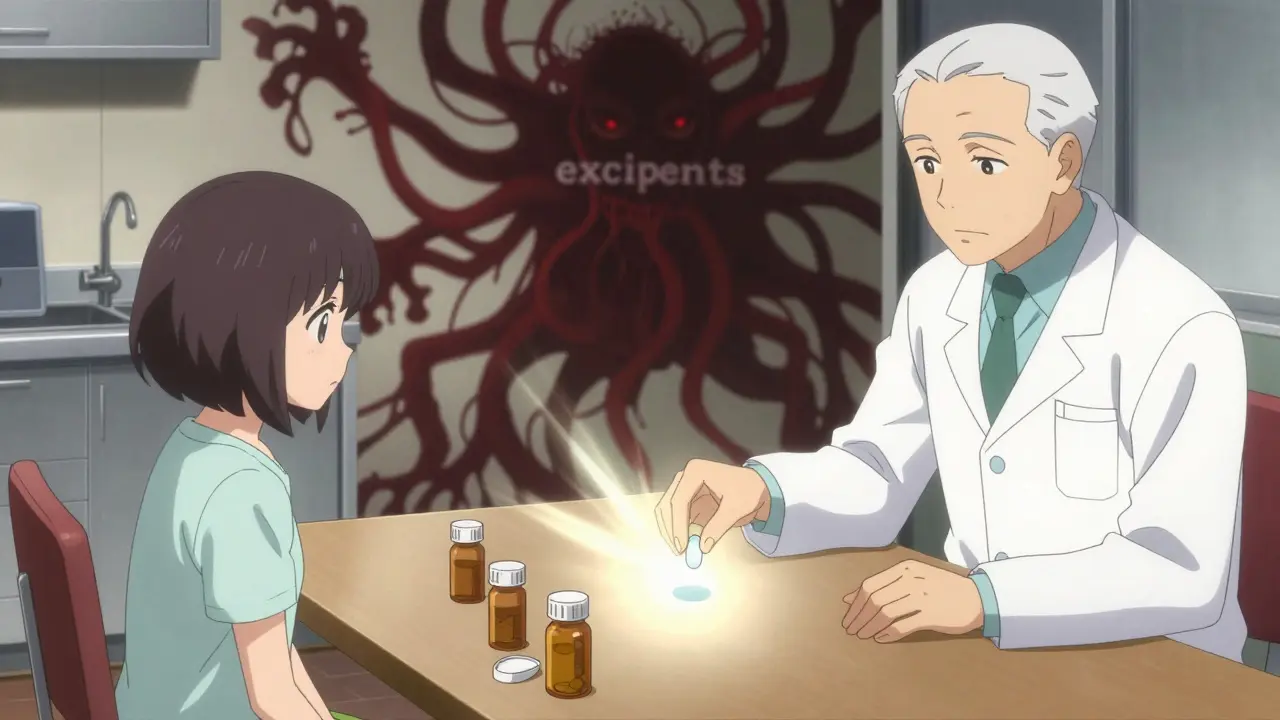
On Reddit’s r/pharmacy, users share stories like this:"I was on three different generics for my blood pressure, cholesterol, and thyroid. I started having daily stomach cramps and diarrhea. My GI doc ran every test. Nothing. Then my pharmacist asked if any of them had lactose. I didn’t even know what that meant. Turns out all three did. I switched to lactose-free versions. Symptoms vanished in 48 hours."
That’s not an isolated case. The FDA’s Adverse Event Reporting System (FAERS) shows that between 2020 and 2023, nearly 47% of reports about "unexpected gastrointestinal distress" in patients on multiple generics couldn’t be explained by the active drugs - only by excipient interactions.
Another patient, a 72-year-old woman on digoxin (a heart medication with a narrow therapeutic window), had her levels drop after switching to a new generic. Her doctor thought she wasn’t taking it. But the new version used a different binder that slowed absorption. Her dose was too low. She ended up in the hospital.
Who’s at Risk?
This isn’t just about allergies. It’s about cumulative exposure.- Polypharmacy patients - Anyone on 4+ daily medications. The average Medicare beneficiary takes 4.8 prescriptions. That’s a lot of excipients.
- People with known sensitivities - Lactose intolerance, asthma, eczema, or dye allergies.
- Children and elderly - Their bodies process excipients differently. Kids are more sensitive to propylene glycol. Seniors have slower metabolism and more chronic conditions.
- People with narrow therapeutic index drugs - Digoxin, warfarin, lithium, levothyroxine. Tiny changes in absorption can mean the difference between healing and crisis.
And here’s the thing: you might not know you’re sensitive until you’re taking three generics at once. One pill? Fine. Two? Still okay. Three? Suddenly, your body can’t handle the total load.
What You Can Do
You don’t need to stop taking generics. But you do need to be smarter about them.- Ask your pharmacist - Not just "Is this generic?" but "What’s in it?" Request the full inactive ingredient list. Most pharmacies can pull it from DailyMed or the FDA’s Inactive Ingredient Database.
- Check your meds - Go to DailyMed (used by 87% of hospital pharmacists). Search your drug by name. Look under "Inactive Ingredients." Write it down.
- Compare all your generics - If you’re on three meds, check all three. Are they all using lactose? All using dyes? That’s a red flag.
- Ask for alternatives - Many generics have lactose-free, dye-free, or gluten-free versions. They might cost a few cents more, but they could save you a trip to the ER.
- Keep a log - Note when symptoms start after a switch. Did your rash appear after you changed your blood pressure pill? That’s data your doctor needs.
Pharmacists are trained to catch this. But they can’t help if you don’t tell them you’re taking multiple generics. Don’t assume they know. Don’t assume it’s not important. It is.
What’s Changing - and What’s Not
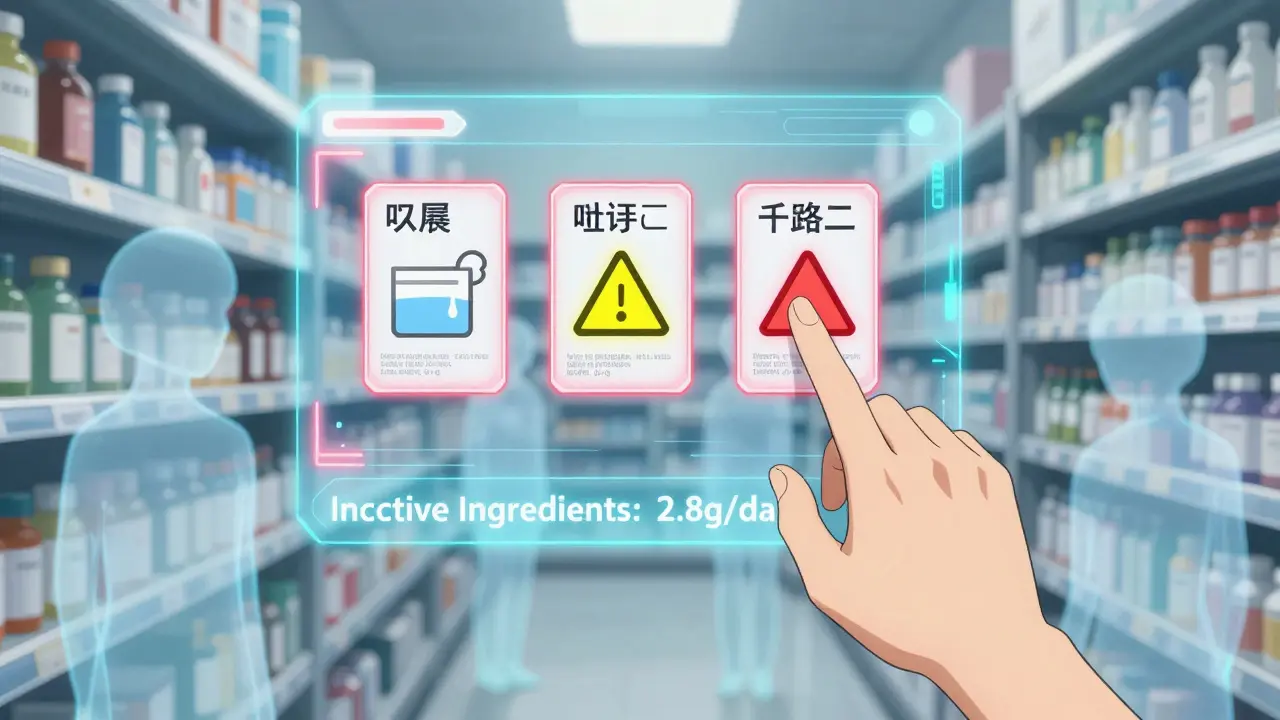
The FDA is starting to pay attention. In January 2024, they launched the Inactive Ingredient Transparency Initiative. By December 2025, all manufacturers must list all excipients in digital labeling. That’s a big step.The European Medicines Agency already requires manufacturers to justify using excipients that affect more than 0.1% of the population. The U.S. is catching up - slowly.
Meanwhile, AI tools like MedCheck AI (released in late 2023) can scan your prescription list and flag potential excipient conflicts with 89.7% accuracy. But unless your pharmacy uses it, you won’t see the benefit.
For now, the system still relies on you - the patient - to be your own advocate.
The Bottom Line
Generic drugs save billions of dollars every year. That’s good. But assuming they’re all the same? That’s dangerous.Active ingredients get all the attention. But sometimes, it’s the invisible stuff - the fillers, the dyes, the preservatives - that’s making you sick. If you’re on multiple generics, especially if you have allergies, digestive issues, or chronic conditions, don’t ignore the fine print. Your body is reacting to more than just the medicine. It’s reacting to the whole package.
Ask questions. Check labels. Talk to your pharmacist. You might not be allergic to your medication. But you might be allergic to what’s in it.
Can inactive ingredients really cause side effects?
Yes. While inactive ingredients don’t treat disease, they can trigger allergic reactions, digestive issues, or even affect how a drug is absorbed. Common culprits include lactose, dyes, and preservatives like bisulfites. People with sensitivities may experience hives, asthma, bloating, or reduced medication effectiveness when exposed to these substances across multiple generics.
Are all generic versions of the same drug the same?
No. Generic drugs must contain the same active ingredient and meet bioequivalence standards, but their inactive ingredients can vary widely. For example, there are over 27 different formulations of levothyroxine sodium tablets, each with different fillers, binders, and dyes. What works for one person may cause side effects in another.
How do I find out what’s in my generic medication?
Ask your pharmacist for the full inactive ingredient list. You can also look up your drug by name on DailyMed (dailymed.nlm.nih.gov), a free government database. Search for your medication’s NDC code or brand name - the inactive ingredients are listed under "Inactive Ingredients" in the full prescribing information.
Should I avoid generic medications altogether?
No. Generics are safe and effective for most people. The issue isn’t generics themselves - it’s the lack of awareness about excipient combinations. If you have no known sensitivities and feel fine on your current meds, there’s no need to switch. But if you’re experiencing unexplained side effects, especially after switching generics, check the inactive ingredients.
Can my pharmacist help me switch to a safer generic?
Yes. Pharmacists can identify alternative generic versions that avoid problematic excipients like lactose, tartrazine, or propylene glycol. Many manufacturers offer lactose-free, dye-free, or gluten-free versions. Your pharmacist can request these alternatives, often at the same price. This is especially important for patients on multiple medications or with known allergies.
Is there a tool that checks for inactive ingredient interactions?
Yes. AI-powered tools like MedCheck AI, released in 2023, analyze prescription lists and flag potential excipient conflicts with 89.7% accuracy. However, these tools are mostly used in hospital systems and large pharmacy chains. If your pharmacy doesn’t use them, you’ll need to check manually using DailyMed or by asking your pharmacist.
What to Do Next
If you’re on multiple generics, take 10 minutes today. Write down every medication you take - including OTC pills and supplements. Look up each one on DailyMed. Circle any that contain lactose, dyes, or preservatives you know you’re sensitive to. Then, call your pharmacist. Ask: "Can we switch any of these to versions without those ingredients?"You don’t need to be a scientist to protect yourself. You just need to ask the right questions.


Spencer Garcia
This is such a crucial point that no one talks about. I switched my thyroid med after years of random stomach issues, and boom-gone in two days. Pharmacists know this stuff. You just gotta ask.
Abby Polhill
Excipient load is a legit pharmacokinetic wildcard, especially in polypharmacy cohorts. The FDA’s bioequivalence framework is fundamentally agnostic to excipient synergy-or antagonism. It’s a regulatory blind spot masquerading as scientific rigor.
Bret Freeman
They’re letting Big Pharma slip toxic junk into our pills under the guise of "cost savings" and we’re just supposed to swallow it? Literally. This isn’t medicine-it’s a corporate loophole with a prescription pad. People are getting sick and no one’s getting fined. That’s not a system failure. That’s a crime.
Lindsey Kidd
OMG YES 🙌 I’ve been telling my mom for years to check her meds-she’s on 7 pills and kept blaming her diet for the rashes. We checked DailyMed and two of them had Red 40. Switched them out and her skin cleared up in a week. You’re not crazy if you feel off-sometimes it’s not the drug, it’s the dye.
Austin LeBlanc
So you’re telling me the government lets drug companies put whatever they want in your pills as long as the active ingredient matches? And you expect me to trust this system? I don’t even trust my bank. This is why people don’t believe in healthcare anymore.
Christine Détraz
I’ve been on three generics for years-no issues. But I also have zero allergies and no digestive problems. This isn’t a universal problem. It’s a specific one. Don’t scare people into thinking all generics are dangerous. Just be aware if you’re sensitive. Knowledge is power.
Gray Dedoiko
My grandma switched her BP med last year and started getting dizzy. Doctor thought it was age. Turns out the new generic had a different binder that slowed absorption. She was getting subtherapeutic doses. Took her 3 months to get back to normal. We didn’t even think to check the filler. Rookie mistake.
Aurora Daisy
Of course the FDA doesn’t care. They’re too busy protecting American pharma profits while the rest of the world actually regulates excipients. We’re the only country where you need a PhD just to read a pill bottle. And we wonder why healthcare is a mess.
Paula Villete
Fun fact: The FDA requires bioequivalence for active ingredients... but not for the 2.8 grams of junk you’re ingesting daily. So technically, your body is getting a different cocktail every time you switch generics. And yet we call them "identical." I mean, if I swapped your coffee creamer for motor oil but kept the caffeine the same... would you say it’s the same drink?
Georgia Brach
The data presented here is anecdotal and lacks statistical rigor. While individual case reports are compelling, they do not constitute population-level evidence of excipient-induced pathology. The burden of proof lies with those claiming harm, not with regulators to preemptively ban benign substances.
Katie Taylor
Stop waiting for permission to protect yourself. Go to DailyMed. Right now. Open your pill bottles. Look at the tiny print. If you see lactose, tartrazine, or bisulfites and you have symptoms-demand a change. Your life isn’t a lab experiment. You’re not a statistic. You’re a person with rights.
siddharth tiwari
theyre putting microchips in the fillers too u know. the fda and big pharma are in cahoots. they want you sick so u keep buying pills. check your meds for gluten and cornstarch-its all part of the plan. i switched to herbal tinctures and now i feel like a new man.