

Warfarin to DOAC Switching Safety Calculator
How to use this tool
This calculator helps determine if you can safely switch from warfarin to a DOAC based on your current INR value and the DOAC you're considering. Please note: this is a guide only and should not replace clinical judgment. Always consult with your healthcare provider.
Input Information
Result
Enter your INR value and select your DOAC to see if you can safely switch.
Switching from warfarin to a direct oral anticoagulant (DOAC) isn’t just a change in pill color-it’s a shift in how your body manages clotting, and it demands precision. Many patients make this switch because they’re tired of weekly blood tests, unpredictable diet restrictions, and the constant worry that their INR is off. But if done wrong, this transition can put you at risk for stroke, bleeding, or both. The good news? When guided by clear, evidence-based steps, switching to a DOAC like apixaban, rivaroxaban, dabigatran, or edoxaban is safer and simpler for most people. The bad news? Too many patients are switched without proper checks, and that’s where things go wrong.
Why Switch at All?
Warfarin has been the go-to blood thinner for over 70 years. But it’s finicky. Your INR (International Normalized Ratio) must stay between 2.0 and 3.0. Go below 2.0, and clots can form. Go above 3.0, and you risk bleeding. To keep it in range, you need blood tests every 1-4 weeks, sometimes more. That’s 12 to 24 visits a year just for monitoring. Plus, warfarin reacts with greens, alcohol, antibiotics, and even vitamin supplements. One missed test or a new medication can throw you off balance. DOACs don’t need routine blood tests. They work more predictably. Their effects are consistent across most people, so you don’t need to adjust doses based on lab results. They also have fewer food and drug interactions. For someone with atrial fibrillation, deep vein thrombosis, or a history of pulmonary embolism, switching often means fewer hospital trips, less stress, and a lower risk of brain bleeding. But here’s the catch: you can’t just stop warfarin one day and start a DOAC the next. Timing matters. And not all patients are candidates.Who Shouldn’t Switch?
Not everyone can switch. Some people absolutely must stay on warfarin. If you have a mechanical heart valve, DOACs are dangerous. Studies show they increase the risk of valve clotting and stroke in these patients. This isn’t a gray area-it’s a hard stop. Other absolute no-go’s:- Severe kidney disease (creatinine clearance under 15-30 mL/min, depending on the DOAC)
- Advanced liver disease (Child-Pugh Class C)
- Pregnancy or breastfeeding
The Critical Timing Rule: INR Is Your Guide
The biggest danger during the switch? A gap in protection. If you stop warfarin too early, you’re unprotected. Start the DOAC too late, and you’re still at risk for clots. Start too soon, and you could overdose on anticoagulation. Here’s what works, based on guidelines from the American Heart Association and European Society of Cardiology:- INR ≤ 2.0: Start the DOAC immediately.
- INR 2.0-2.5: Start the DOAC the same day or the next day.
- INR 2.5-3.0: Wait 1-3 days. Recheck INR.
- INR ≥ 3.0: Delay the switch. Recheck in 3-5 days.
- Rivaroxaban: Safe to start at INR ≤ 3.0
- Edoxaban: Only start if INR ≤ 2.5
- Apixaban and dabigatran: Require INR ≤ 2.0
Side Effects You Might Not Expect
DOACs are generally safer than warfarin, but they’re not risk-free. The biggest advantage? A 30% lower risk of brain bleeding. That’s huge. But other side effects pop up during the transition.- Gastrointestinal bleeding: Especially with dabigatran. It can irritate the stomach lining. If you have a history of ulcers, this matters.
- INR falsely elevated: DOACs can make your INR look higher than it really is. This doesn’t mean you’re over-anticoagulated-it just means the test is unreliable. Never use INR to monitor DOACs.
- Missed doses: Warfarin’s long half-life gives you a buffer. If you forget a dose, you’re probably still protected. DOACs? Their effect fades in 12-24 hours. Skip one pill, and your protection drops fast.

Special Cases: Kidneys, Age, and Surgeries
Renal function is critical. DOACs are cleared by the kidneys. If your creatinine clearance (CrCl) is below 50 mL/min, you likely need a lower dose. For example:- CrCl 30-50 mL/min: Use reduced dose of apixaban or edoxaban
- CrCl < 30 mL/min: Avoid DOACs entirely
- You’re on dabigatran. CrCl = 90 mL/min. Low-risk procedure (like a dental extraction): Hold for 24 hours, restart after 12 hours.
- You’re on dabigatran. CrCl = 45 mL/min. High-risk surgery (like hip replacement): Hold for 96 hours, restart 24-48 hours after.
What You Need to Do Before the Switch
This isn’t a one-time conversation. It’s a checklist. Before you get your new prescription:- Get recent bloodwork: Your kidney function (creatinine), liver enzymes, and full blood count should be tested within the last 6 months.
- Check your current INR: This must be done on the same day or the day before you start the DOAC.
- Calculate your CrCl: Use the Cockcroft-Gault equation. Your doctor should do this. If they don’t, ask.
- Review all medications: Some antibiotics, antifungals, and even St. John’s Wort can interfere with DOACs. Make sure your pharmacist reviews everything.
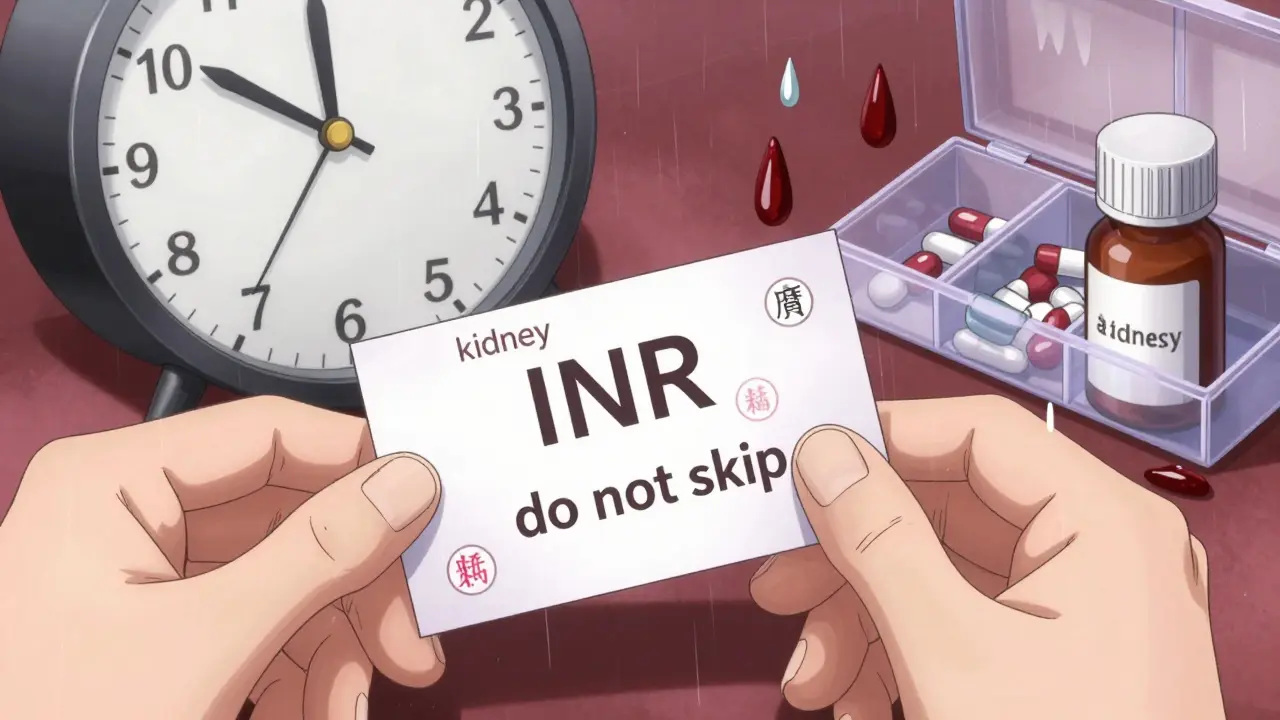
- Get your patient materials: You should receive an anticoagulant alert card and a patient guide. Keep it in your wallet.
What to Watch For After the Switch
The first 30 days are critical. You’re still adjusting. Watch for:- Bleeding that doesn’t stop easily (nosebleeds, gum bleeding, bruising)
- Dark, tarry stools or vomiting blood
- Sudden headaches, dizziness, or weakness (could signal internal bleeding)
- Swelling or pain in legs (possible clot)
What If You Can’t Get an INR Test?
In rural areas or during disruptions (like a pandemic), testing might be hard. If you absolutely can’t get an INR, guidelines say: wait 2-3 days after your last warfarin dose before starting the DOAC. But if you’re older, have kidney issues, or your last INR was above 2.5, wait longer. Err on the side of caution. Never guess. If you’re unsure, delay the switch. It’s better to stay on warfarin for a few more weeks than to risk a stroke or major bleed.Reversing DOACs: Limited Options
Warfarin can be reversed with vitamin K or fresh frozen plasma. DOACs? Not so easy. There are reversal agents, but they’re expensive and not always available.- Dabigatran: Idrucizumab (Praxbind)
- Rivaroxaban, apixaban, edoxaban: Andexanet alfa (Andexxa)
Cost and Access
DOACs cost 20-50 times more than warfarin. In the U.S., warfarin is $10-30 a month. DOACs run $500-700. Insurance often covers them, but not always. If cost is a barrier, talk to your doctor. Sometimes, staying on warfarin with better monitoring is the smarter choice.Final Thought: It’s Not About the Pill-It’s About the Process
Switching from warfarin to a DOAC isn’t about picking a ‘better’ drug. It’s about matching the right tool to the right person. For many, it’s a life improvement. For others, it’s a risk too big to take. The key is structure. No shortcuts. No assumptions. No skipping the INR. If your doctor skips the blood test, ask why. If they don’t check your kidney function, insist on it. You’re not being difficult-you’re protecting your life.Can I switch from warfarin to a DOAC on my own?
No. Switching requires clinical oversight. Only clinicians trained in anticoagulation management should make this decision. Skipping INR checks, ignoring kidney function, or changing doses without guidance can lead to stroke or life-threatening bleeding. Always work with your doctor or anticoagulation clinic.
Do I still need blood tests after switching to a DOAC?
You won’t need INR tests anymore, but you still need kidney function checks. Most guidelines recommend a blood test for creatinine and estimated kidney clearance every 6-12 months. If you’re over 75, have diabetes, or have heart failure, your doctor may check you more often.
Which DOAC is safest?
There’s no single ‘safest’ DOAC. Apixaban has the lowest risk of major bleeding in real-world studies. Dabigatran has higher GI bleeding risk. Rivaroxaban may have slightly higher stroke risk in some patients. The best choice depends on your kidneys, age, weight, and other conditions. Your doctor should pick based on your profile-not just cost or habit.
What if I forget to take my DOAC?
If you miss a dose and it’s less than 6 hours late, take it right away. If it’s more than 6 hours past, skip the dose. Never double up. DOACs lose their effect in 12-24 hours, so missing a dose leaves you unprotected. Set phone reminders. Use pill organizers-just not for dabigatran.
Can I switch back to warfarin if I don’t like the DOAC?
Yes, but it’s not simple. Switching back requires overlapping anticoagulants. You’ll need to restart warfarin and use a temporary injectable anticoagulant (like heparin) until your INR reaches therapeutic levels. This is complex and risky. Only do it under close medical supervision.


Noah Cline
Switching from warfarin to a DOAC isn't a lifestyle upgrade-it's a pharmacokinetic recalibration. The INR thresholds aren't suggestions; they're pharmacodynamic guardrails. If your creatinine clearance is below 50 mL/min and you're on dabigatran, you're essentially playing Russian roulette with your renal clearance pathways. Apixaban's lower bleeding risk isn't magic-it's a function of its dual CYP3A4 and P-gp clearance. You want safety? You need to understand the enzyme kinetics, not just the pill color.
And don't get me started on the false INR elevation. That's not a lab error-it's a direct interference from factor Xa inhibitors skewing the thrombin time assay. If your clinician is still using INR to monitor rivaroxaban, they're operating in 2008. Time to update your guidelines.
Lisa Fremder
Stop overcomplicating this everyone just take the pill and stop whining about blood tests
Justin Ransburg
I want to commend the thoroughness of this post. It’s rare to see such a comprehensive, evidence-based breakdown that balances clinical precision with patient-centered communication. The distinction between absolute contraindications-like mechanical valves-and relative ones, such as borderline renal function, is critical. Many patients are either over- or under-counseled, and this guide bridges that gap.
For those considering the switch, I encourage you to treat this as a partnership with your provider. Ask about CrCl calculations, request your INR log, and don’t hesitate to ask for the anticoagulant alert card. Knowledge isn’t just power-it’s protection.
Sumit Mohan Saxena
It is imperative to emphasize that the transition protocol must be individualized. The guidelines cited are robust, yet real-world clinical practice often deviates due to resource constraints or misinterpretation. For instance, in settings where point-of-care INR testing is unavailable, the 2–3 day waiting period post-warfarin discontinuation is prudent, but only if the patient’s last INR was ≤2.5. A creatinine clearance calculated via Cockcroft-Gault must be verified with actual serum creatinine values, not estimated from age alone.
Furthermore, the moisture sensitivity of dabigatran capsules is frequently overlooked. Storage in pill organizers, even for short durations, can lead to degradation exceeding 15% potency loss. This is not theoretical-it has been documented in pharmacovigilance reports from India and Southeast Asia. Always retain the original blister pack until ingestion.
Katherine Farmer
Let’s be brutally honest-this entire DOAC transition narrative is a pharmaceutical marketing triumph disguised as clinical progress. Apixaban and rivaroxaban weren’t adopted because they’re safer-they were adopted because they’re profitable. The ‘no monitoring’ advantage is a myth. You still need renal panels, liver enzymes, CBCs, and frequent follow-ups. And yet, providers are incentivized to switch because they get paid for ‘anticoagulation management visits’ under Medicare codes.
And the reversal agents? Andexanet alfa costs $25,000 per dose. Who’s footing that bill when your uncle bleeds out after missing a dose? The system doesn’t care. It’s designed to maximize revenue, not minimize hemorrhage. The real question isn’t ‘which DOAC?’-it’s ‘who benefits?’
Full Scale Webmaster
Okay so I’ve been on Eliquis for 3 years now and I swear to god this whole DOAC thing is a scam. I had a stroke 2 years ago after forgetting one dose. I didn’t even know I could get a clot from one missed pill. My doctor said it was fine I just needed to be more careful. More careful? I’m a 68-year-old with diabetes and I’m supposed to remember a pill every 12 hours? Meanwhile my neighbor on warfarin gets tested every 2 weeks and he’s fine. I’ve had 3 ER trips because of bruising and one time I was vomiting blood and the ER doc said ‘well you’re on a DOAC so we can’t reverse it’ and they just gave me fluids. I almost died. I’m going back to warfarin and I’m telling everyone.
And what’s with this ‘dabigatran is moisture sensitive’ nonsense? I’ve had mine in a pill organizer for a year. No problem. I think this is just fearmongering. The system wants you scared so you’ll pay more for ‘specialized care.’
Also I read somewhere that the FDA approved these drugs because they were bribed by Big Pharma. I don’t trust any of this. I’m getting a second opinion. And if they try to switch me again I’m calling the news.
Angel Wolfe
They don't want you on warfarin because they can't control you. The INR tests are a trap. They're using it to track you. DOACs are fine if you're not a target. But if you're on government benefits or have a history of mental health? They're putting something in the pills. You think the kidney checks are for safety? No. They're mapping your biometrics. The pills are linked to your social security number. Don't believe me? Look up the patent filings for apixaban and the NSA. They're not worried about bleeding-they're worried about you bleeding out in public and raising questions.
Sophia Rafiq
I switched to apixaban last year and honestly the only thing I miss is the weekly blood draw-it gave me something to do. My doctor was super chill about it and we just used the INR as a baseline then switched. I forget doses sometimes but I set a reminder and it’s fine. The only weird thing was that my gums bled a bit at first but it stopped. Don’t overthink it. Your doc knows more than you think.
Ajay Krishna
As someone who has guided over 200 patients through this transition in rural India, I can say with confidence: the greatest barrier is not pharmacology-it’s access. Many patients here lack even basic lab infrastructure. In such cases, we follow the WHO-recommended delay protocol: 3 days after last warfarin dose, provided the last INR was below 2.5. We prioritize apixaban due to its lower renal dependence and cost-effectiveness.
Education is key. We use pictorial guides in local languages to explain pill timing and bleeding signs. We teach patients to recognize dark stools-not as ‘digestive issues’ but as potential hemorrhage. We don’t use dosette boxes for dabigatran. We never do. We’ve had two cases of treatment failure due to this alone.
It’s not about which drug is ‘better.’ It’s about which one can be safely delivered in your context.
Charity Hanson
Y’all are overthinking this. I switched from warfarin to rivaroxaban after my PE and it changed my life. No more finger pricks. No more broccoli guilt. I take my pill at 8 PM with dinner and I’m done. I check my kidneys once a year and I feel better than I have in a decade.
Yes, missing a dose sucks-but I set two alarms and I’ve never missed one since. If you’re scared, talk to your pharmacist. They’re not there to sell you pills-they’re there to keep you alive. I used to be terrified of bleeding, but now I’m living. That’s the real win.
Don’t let fear of the unknown keep you stuck in the past. You deserve to feel normal again.
Brandon Vasquez
I appreciate the depth of this post. It’s clear, factual, and respectful of the patient’s autonomy.
I’ve had patients who were switched without INR checks. It doesn’t end well.
My advice? If your doctor hasn’t reviewed your labs in the last 90 days, pause the switch. Ask for the CrCl calculation. Write down the name of the DOAC and its dosing rule. Keep the anticoagulant card.
You’re not being difficult. You’re being responsible.
And if you’re unsure? Wait. It’s always safer to wait.
Vikas Meshram
The assertion that dabigatran is moisture-sensitive is scientifically inaccurate. The capsule shell is hydrophobic and the active ingredient is stabilized under standard storage conditions. The claim that it loses potency in pill organizers is an urban legend propagated by overcautious pharmacists with no basis in peer-reviewed literature. The FDA labeling does not support this. Furthermore, the Cockcroft-Gault equation is obsolete; eGFR using CKD-EPI is the current standard. Anyone still using the former is practicing outdated medicine. And to the conspiracy theorists: DOACs are not surveillance tools. That is pseudoscience.