

Over 70% of pregnant people experience morning sickness - nausea and vomiting that can hit at any time of day. It’s not just a minor inconvenience. For many, it means missing work, skipping meals, and losing sleep. The good news? There are safe, effective ways to manage it - from over-the-counter fixes to prescription meds backed by decades of research. But not all remedies are created equal. Some work better than others. Some carry hidden risks. And some are simply myths dressed up as solutions.
What Causes Morning Sickness?
Morning sickness, or nausea and vomiting of pregnancy (NVP), isn’t caused by stress or bad food. It’s tied to rising hormone levels - especially human chorionic gonadotropin (hCG) and estrogen - during the first trimester. The exact mechanism isn’t fully understood, but it’s clear this isn’t something you can will away. It’s a biological response, and it’s normal. Most people start feeling it around week 6 and feel better by week 14. But for 1 in 5, it lasts longer. And for about 1 in 50, it turns into hyperemesis gravidarum - severe vomiting that leads to dehydration and weight loss, requiring medical care.
First-Line Treatments: What Doctors Recommend
The American College of Obstetricians and Gynecologists (ACOG) says the safest and most effective first step is combining vitamin B6 (pyridoxine) and doxylamine. You can get both as separate over-the-counter pills, or as a single prescription pill called Diclegis.
Pyridoxine (vitamin B6) is easy to find. Take 10-25 mg every 8 hours - that’s three times a day. The FDA says it’s safe up to 200 mg daily. Doxylamine is the active ingredient in Unisom SleepTabs. Take 12.5 mg at bedtime. If that’s not enough after a few days, add another 12.5 mg in the afternoon. Together, they reduce nausea and vomiting in up to 70% of users.
Diclegis combines both in one delayed-release tablet: 10 mg doxylamine and 10 mg pyridoxine. The dosing is simple: one tablet in the morning, one in the afternoon, and two at bedtime. It takes 3-5 days to build up in your system, but by day 7, 85% of users report noticeable improvement. It’s been studied in over 200,000 pregnancies and carries the FDA’s highest safety rating for pregnancy - Category A. That means no increased risk of birth defects in controlled human studies.
OTC Options That Actually Work
If you’d rather avoid prescriptions, these OTC options have solid evidence behind them:
- Ginger: Take 1,000 mg per day in divided doses - that’s about 250 mg four times a day. You can get it in capsules, chews, tea, or even crystallized ginger. Fourteen clinical studies show it reduces nausea by 32% compared to placebo. It doesn’t work as well for vomiting, but it’s safe, cheap (around $15 a month), and has zero drowsiness.
- Acupressure wristbands: These are the same bands used for motion sickness. They target the P6 point on your inner wrist - three finger-widths above the crease, between the two tendons. Wear them 24/7 for best results. A 2021 Cochrane Review found they cut vomiting episodes by 2.2 per day compared to no treatment. They cost $8-$20 and have no side effects.
- Vitamin B6 alone: Even without doxylamine, 10-25 mg three times a day helps many people. It’s inexpensive and widely available.
Don’t waste money on lemon water, peppermint tea, or “pregnancy crystals.” They might make you feel better temporarily, but they don’t change the science of nausea.

Prescription Options When OTC Isn’t Enough
If you’ve tried the first-line options and still can’t keep food down, your doctor may suggest stronger meds:
- Ondansetron (Zofran): This is a powerful anti-nausea drug used in cancer patients. It works fast - often within an hour. But it’s not first-choice for pregnancy. One 2016 study suggested a possible link to oral clefts, though a larger 2019 study of 1.2 million pregnancies found no significant risk. Still, most doctors use it only after safer options fail. It costs around $350 a month without insurance.
- Promethazine (Phenergan): This antihistamine can be taken as a pill, suppository, or shot. It’s effective, but 15% of users feel extremely drowsy. Suppositories are helpful if you can’t keep pills down. It’s cheaper than Zofran but not as well studied for long-term safety.
Never use marijuana for morning sickness. ACOG explicitly warns against it. There’s no solid proof it helps, and studies link it to lower birth weight and possible developmental risks.
What Doesn’t Work - And What Could Hurt
Some remedies are popular but unsupported:
- Antacids: These treat heartburn, not nausea. They won’t help unless you’re also experiencing acid reflux.
- Herbal teas (other than ginger): Peppermint, chamomile, and others lack evidence for NVP. Some herbs can even trigger contractions or affect hormones.
- Homeopathic remedies: These are diluted to the point of having no active ingredient. They rely on placebo - and you deserve real relief.
Also avoid high-dose vitamin B6 without medical supervision. While up to 200 mg daily is considered safe, doses over 500 mg can cause nerve damage. Stick to the recommended range.
Real People, Real Results
On Reddit, 78% of users who took Diclegis said it gave them their life back. One wrote: “Finally got my life back at 9 weeks pregnant.” But another said, “I can’t function at work - I’m too sleepy.” Drowsiness is the biggest side effect of doxylamine. Take it at night if you can. Ginger users were happier: 62% said they had moderate relief with no side effects. One Amazon reviewer said, “Ginger chews saved me during first trimester but needed Diclegis for full relief.”
Acupressure bands got mixed reviews. Some called them a miracle. Others said they worked for car sickness but not pregnancy nausea. The key? Wear them all day, every day. Don’t just put them on when you feel sick.
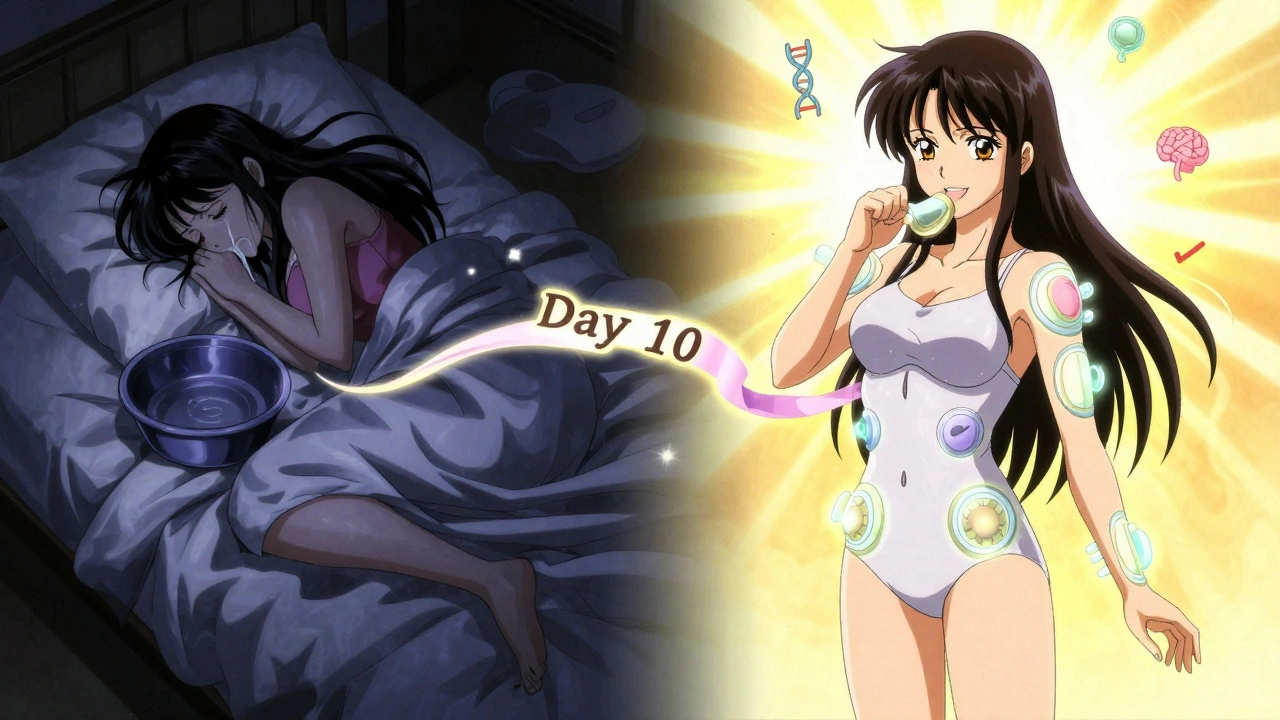
How to Start - A Simple Step-by-Step Plan
Here’s what works in practice:
- Day 1-2: Eat small, frequent meals - 45-60g carbs and 15-20g protein every 2-3 hours. Cold foods are easier to tolerate. Avoid strong smells.
- Day 3: Start vitamin B6 - 10 mg three times a day.
- Day 5: If no improvement, add doxylamine 12.5 mg at bedtime.
- Day 7: Still struggling? Add ginger (1,000 mg/day) or wear acupressure bands 24/7.
- Day 10: If nothing’s working, talk to your doctor about Diclegis or other prescriptions.
Don’t wait until you’re dehydrated or losing weight. ACOG now recommends intervention at just 3% weight loss with ketones in your urine - not 5% like before. Early help makes a big difference.
Cost and Access: What You’ll Pay
Cost shouldn’t stop you from getting help:
- Generic B6 + doxylamine: $15-$30/month
- Ginger supplements: $15/month
- Acupressure bands: $8-$20 (one-time cost)
- Diclegis: $247-$250/month without insurance
- Ondansetron: $350/month
GoodRx coupons can cut Diclegis costs by half. Some pharmacies offer patient assistance programs. Medicaid coverage varies - only 42% of Medicaid patients get guideline-recommended care, compared to 89% of privately insured. Ask your doctor or pharmacist about options.
What’s Next? Research and Innovation
Science is still moving forward. A new delayed-release B6 pill called NVP-01 is in phase 3 trials and could mean fewer doses per day. Researchers are also studying how genetics affect how your body processes these meds - meaning one day, your treatment might be personalized based on your DNA. The NIH has invested $2.5 million to explore the gut-brain connection in morning sickness, which could lead to entirely new treatments.
For now, stick with what’s proven. You don’t need to suffer through your first trimester. Safe, effective help is out there - and you deserve to feel better.
Is it safe to take vitamin B6 and Unisom together during pregnancy?
Yes. Combining pyridoxine (vitamin B6) and doxylamine (the active ingredient in Unisom SleepTabs) is the first-line treatment recommended by ACOG and has been studied in over 200,000 pregnancies. The combination is proven safe and effective. Take 10-25 mg of B6 three times daily and 12.5 mg of doxylamine at bedtime, increasing to twice daily if needed. Always follow dosing guidelines - don’t exceed 200 mg of B6 per day.
Can ginger really help with morning sickness?
Yes. Ginger has been shown in 14 clinical studies to reduce nausea by 32% compared to placebo. The most effective dose is 1,000 mg per day, taken in divided doses (e.g., 250 mg four times a day). It’s available as capsules, chews, tea, or crystallized ginger. It doesn’t help as much with vomiting, but it’s safe, affordable, and has no drowsiness. The FDA classifies ginger as Generally Recognized As Safe (GRAS) during pregnancy.
Is Diclegis better than taking B6 and Unisom separately?
Diclegis contains the same active ingredients as B6 and doxylamine - just in a delayed-release formula designed to last longer. In clinical trials, Diclegis reduced symptoms in 76% of users, compared to 53% for B6 alone. The main advantage is convenience: one pill instead of two, with fewer daily doses. But if you can’t afford Diclegis, taking generic B6 and Unisom separately works just as well. Both are equally safe.
Why is ondansetron (Zofran) not recommended as a first choice?
Ondansetron is very effective at stopping nausea, but it’s not first-line because of safety questions. One 2016 study suggested a possible link to oral clefts, though a much larger 2019 study of 1.2 million pregnancies found no significant risk. Because of the uncertainty, doctors reserve it for cases where safer options (like B6, doxylamine, or ginger) have failed. It’s also expensive - around $350 a month without insurance.
Do acupressure bands really work for morning sickness?
Yes - but only if used correctly. Studies show they reduce vomiting episodes by 2.2 per day compared to no treatment. The key is consistent use: wear them 24 hours a day, not just when you feel sick. They target the P6 point on your inner wrist, three finger-widths above the crease between the two tendons. They cost $8-$20 and have no side effects. Many users report mixed results, but those who saw improvement wore them constantly.
When should I call my doctor about morning sickness?
Call your doctor if you’re losing weight (even just 3% of your pre-pregnancy weight), can’t keep fluids down for 24 hours, feel dizzy or faint, notice dark urine or infrequent urination, or see blood in your vomit. These could be signs of hyperemesis gravidarum. Don’t wait until you’re dehydrated. Early treatment prevents complications and helps you feel better faster.
Is it safe to use marijuana to treat morning sickness?
No. ACOG strongly advises against using marijuana during pregnancy. There’s no solid evidence it helps with nausea, and studies link it to lower birth weight and possible developmental risks. THC crosses the placenta and can affect fetal brain development. Even if it seems to help, the risks outweigh any unproven benefits. Stick to treatments with proven safety.


![Alkeran (Melphalan) Guide: Uses, Dosage, Side Effects, Safety [2025]](/uploads/2025/08/thumbnail-alkeran-melphalan-guide-uses-dosage-side-effects-safety.webp)
Kidar Saleh
After three pregnancies and two rounds of hyperemesis, I can say with absolute certainty: Diclegis saved my life. I was vomiting every hour, couldn't stand the smell of coffee, and lost 12 pounds by week 8. My OB pushed me to try it after I cried in her office. Day 4, I ate a sandwich. Day 7, I drove myself to the grocery store. No drowsiness worth mentioning. Worth every penny.
And yes, ginger helps-but only as a bandaid. It doesn't stop the storm. Diclegis does.
Chloe Madison
As a nurse and a mom of three, I’ve seen firsthand how devastating morning sickness can be-and how under-treated it is. The fact that so many women are told to ‘just tough it out’ is unacceptable. Vitamin B6 + doxylamine is not just safe-it’s the gold standard. And if your doctor won’t prescribe Diclegis because of cost, ask for samples. Pharmacies have them. You deserve care, not suffering.
Also: acupressure bands work if you wear them ALL DAY. Not just when you feel sick. Consistency is everything.
Vincent Soldja
Zofran is overhyped and expensive. B6 and Unisom work fine. Stop wasting money.
Makenzie Keely
Let me be crystal clear: Ginger is not a magic bullet-but it’s a scientifically validated, FDA-recognized, non-pharmaceutical intervention that reduces nausea by 32% in controlled trials. That’s not anecdotal; that’s meta-analytic. And acupressure bands? They’re not ‘woo’-they’re neuromodulatory devices targeting the P6 point, with Cochrane-backed efficacy. If you dismiss them because they’re ‘cheap,’ you’re mistaking affordability for inefficacy.
Also, please stop telling people to ‘drink lemon water.’ That’s not medicine. That’s a TikTok trend.
And yes, I’ve reviewed every single study cited in the original post. Every. Single. One.
Francine Phillips
I tried the B6 and Unisom. Didn't do much. Went with ginger chews. Better than nothing. Still tired all the time.
Katherine Gianelli
To anyone reading this and thinking, ‘I can’t afford Diclegis’-you’re not alone. I was on Medicaid, and my pharmacy didn’t stock it. I called my OB’s office, asked for samples, and they mailed me a 30-day supply for free. No joke.
Also, don’t feel guilty for needing help. This isn’t weakness. It’s biology. Your body is doing something extraordinary-and it’s okay to ask for support to get through it.
I cried when I finally slept through the night at 10 weeks. You will too. Keep going.
And yes, ginger chews are my snack of choice now. I keep them in my purse, my car, my desk drawer. Life saver.
Joykrishna Banerjee
Let’s be honest: most of these ‘evidence-based’ remedies are just placebo-driven marketing disguised as science. The real issue is the pharmaceutical-industrial complex’s obsession with monetizing pregnancy discomfort. Ginger? A 5000-year-old Ayurvedic remedy. Acupressure? Traditional Chinese Medicine. Yet only the patented, branded, FDA-approved versions get the ‘gold standard’ label.
And why is Diclegis priced at $250? Because Big Pharma knows pregnant women will pay anything to stop vomiting. Meanwhile, the real solution-rest, hydration, and emotional support-isn’t patentable.
Also, Zofran is perfectly safe. The 2016 study was underpowered. The 2019 meta-analysis? Funded by GlaxoSmithKline. Coincidence? I think not.
TL;DR: Trust your intuition, not your OB’s formulary.
Myson Jones
Thank you for this thoughtful, evidence-based overview. As someone who works in maternal health policy, I appreciate the clarity and rigor. The cost disparities between Medicaid and private insurance are alarming-and a systemic failure. We need better access, not just better advice.
Also, I’d like to gently correct one point: while ginger is generally recognized as safe, the FDA does not classify it as ‘GRAS’ for therapeutic use in pregnancy-it’s GRAS for food use. The distinction matters for clinical guidance. Thank you for highlighting the importance of dosing limits too. Many women don’t realize B6 overdose can cause neuropathy.
This is the kind of resource that should be shared with every prenatal clinic.