
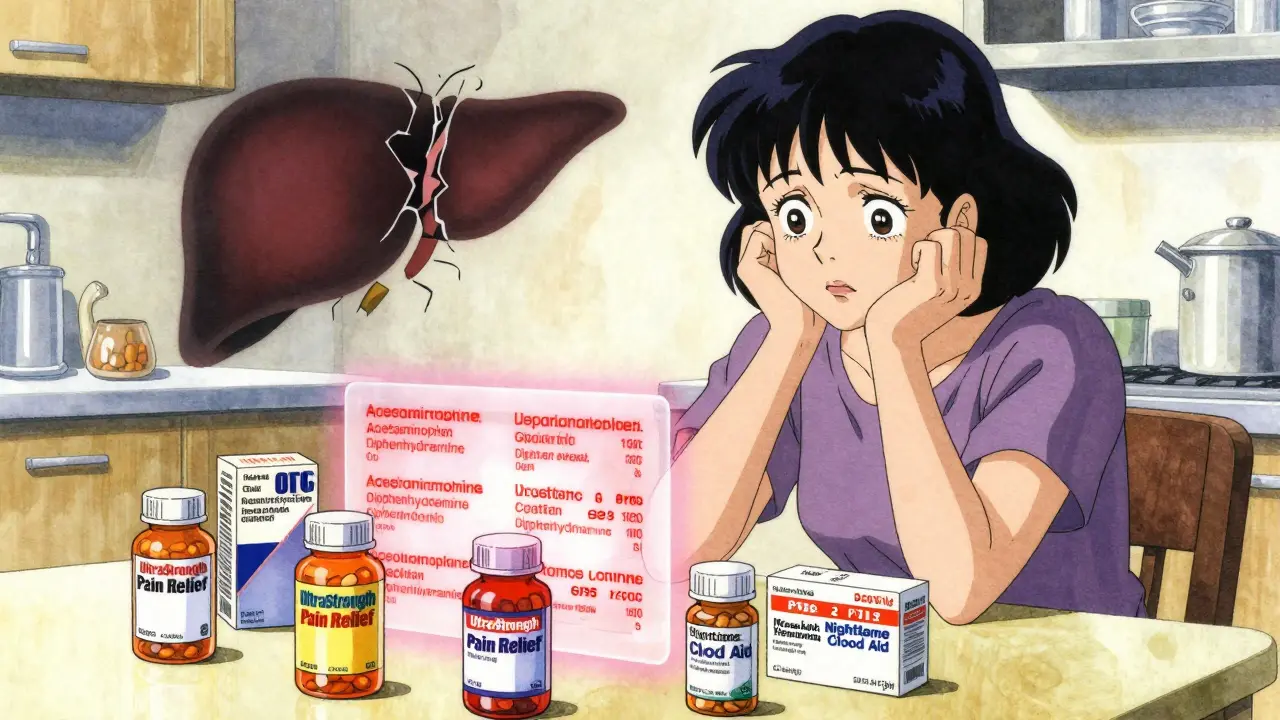
It’s easy to think that taking more medications means better health-especially if you’re juggling prescriptions for high blood pressure, arthritis, diabetes, and a sleep aid. But what if two of those pills have the same active ingredient hiding under different names? That’s not extra help. That’s a hidden danger. Every year, tens of thousands of people end up in the emergency room because they didn’t realize they were doubling up on the same drug. And it’s not just one or two people. Double ingredients are one of the most common-and preventable-mistakes in medication use.
What Are Double Ingredients?
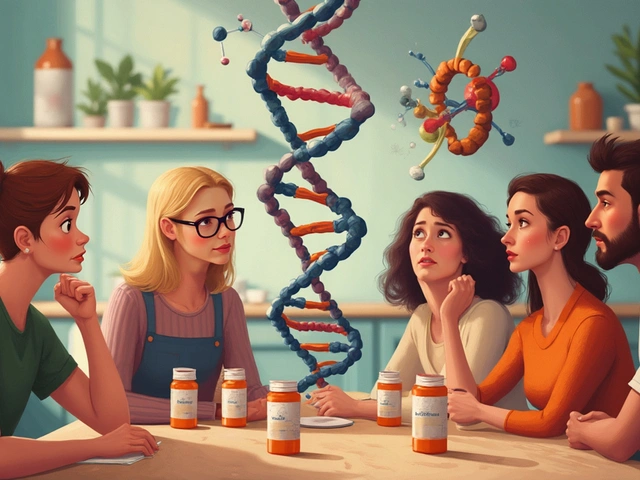
A double ingredient happens when you take two or more medications that contain the same active drug. It sounds simple, but it’s surprisingly easy to miss. For example, you might be prescribed Vicodin for pain, which contains acetaminophen and hydrocodone. At the same time, you pick up a store-brand cold medicine labeled "Daytime Cold Relief," which also has acetaminophen. You’re not trying to overdose. You just want to feel better. But now you’re taking two doses of acetaminophen in one day-and maybe more if you also took a nighttime pain reliever or a flu tablet. The result? Liver damage, hospitalization, or worse.The most common culprits are:
- Acetaminophen (Tylenol, Panadol): Found in over 600 OTC and prescription products, including painkillers, cold medicines, and sleep aids.
- Diphenhydramine (Benadryl): Used in allergy meds, sleep aids, and cold remedies. Can cause extreme drowsiness or confusion.
- Pseudoephedrine: Found in decongestants like Sudafed and many combo cold formulas. Can spike blood pressure and heart rate.
- NSAIDs (ibuprofen, naproxen): Present in pain relievers, arthritis meds, and some menstrual products. Can cause stomach bleeding or kidney issues when doubled.
The CDC says adults over 65 account for 65% of hospitalizations from accidental double dosing. But it’s not just older adults. Anyone taking five or more medications-prescription or not-is at risk. And here’s the kicker: 45% of prescription labels don’t clearly warn you about overlapping ingredients with OTC products.
Why This Happens
You’re not being careless. The system is set up to make this mistake easy.First, different brands use different names. One company calls their pain reliever "UltraStrength Pain Relief," another calls theirs "Rapid Relief Plus." But both have 500 mg of acetaminophen. You don’t know unless you read the fine print. And most people don’t.
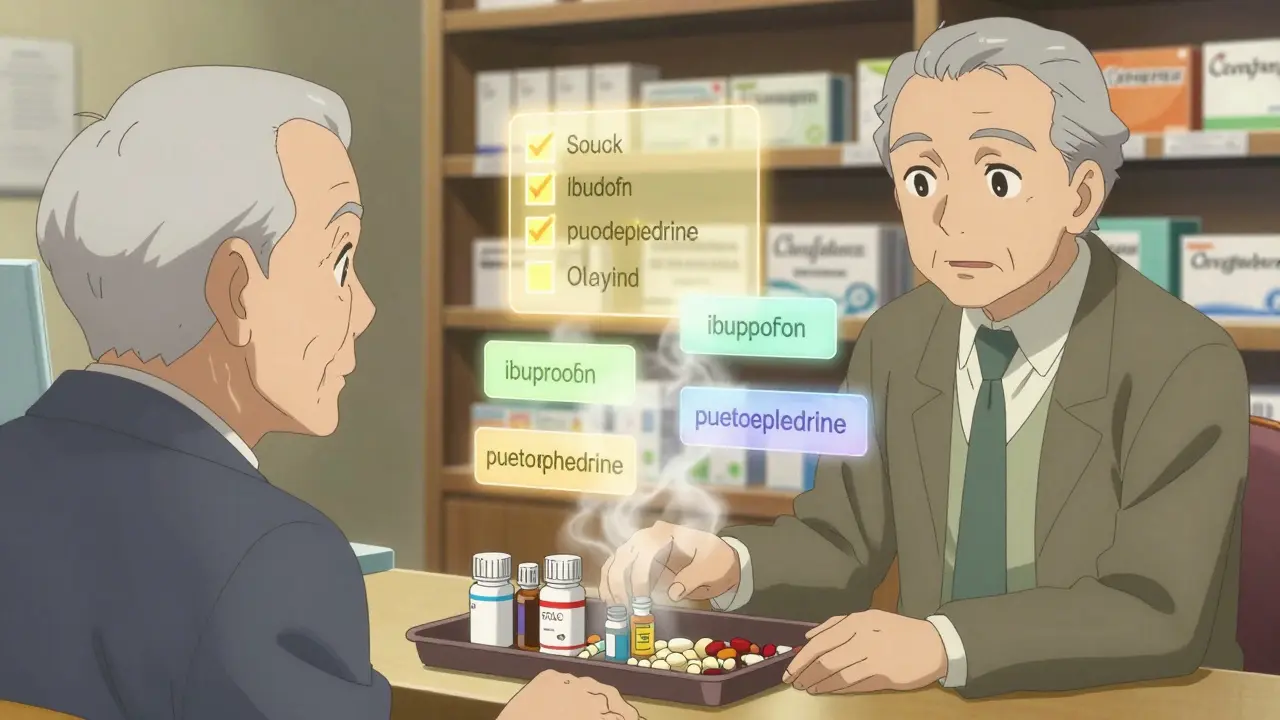
Second, many patients don’t tell their doctors about OTC meds, supplements, or herbal remedies. A 2020 study found that 68% of people using traditional or complementary medicines never mention them to their provider. That means your doctor thinks you’re only on four prescription drugs-but you’re actually on eight, including a nightly sleep aid with diphenhydramine and a daily joint supplement with ibuprofen.
Third, using multiple pharmacies makes it worse. If you fill your diabetes script at CVS and your pain meds at Walgreens, neither pharmacy’s system sees the full picture. A 2021 study showed that when patients use just one pharmacy, systems catch double ingredient risks 92% of the time. When you use multiple pharmacies? That drops to 45%.
The Real-World Cost
This isn’t theoretical. People are getting hurt.On Reddit, a user named "MedSafety101" shared how they took three different cold medicines-each with pseudoephedrine-because they thought each one "did something different." Within hours, their blood pressure spiked to 210/110. They ended up in the ER. Another patient from UCLA Health described being told by their doctor to take "a little extra Tylenol" for pain, not realizing their arthritis pill already had it. Three weeks later, they had acute liver failure.
Surveys show that 61% of adults have experienced symptoms from double ingredients. The most common? Dizziness (38%), extreme sleepiness (32%), and stomach bleeding (12%). These aren’t "just side effects." They’re warning signs of an overdose.
The economic toll is just as serious. Preventable drug errors cost the U.S. healthcare system $42 billion a year. About one-third of that comes from polypharmacy mistakes like double ingredients. And while they only affect 17% of all adverse drug events, they’re responsible for 37% of cases among people using both prescription and OTC drugs.
How to Protect Yourself
The good news? Almost all of these errors are preventable. You don’t need a PhD in pharmacology. You just need to be smart about what’s in your medicine cabinet.1. Make a complete medication list. Write down everything you take-every pill, patch, liquid, or capsule. Include:
- Prescription drugs
- OTC medicines (even if you only take them once in a while)
- Vitamins and supplements
- Herbal remedies (like echinacea, melatonin, or turmeric pills)
- Any medicines from other doctors
For each one, write the name, dose, how often you take it, and why. Keep a copy in your wallet and another at home. Update it every time you start or stop something.
2. Use one pharmacy. If you can, fill all your prescriptions at the same place. Pharmacists are trained to spot dangerous overlaps. They run checks every time you pick up a new script. If you use multiple pharmacies, you’re basically asking them to work blindfolded.
3. Read the Drug Facts label. Since 2020, the FDA requires all OTC products to have a standardized "Drug Facts" panel. Look for the "Active Ingredients" section. If you see the same name twice across different products, you’re doubling up. Don’t assume "different brand = different medicine."
4. Ask your pharmacist every time. When you get a new prescription or OTC product, say: "Could this interact with anything else I’m taking?" Pharmacists caught 87% of potential double ingredient issues during medication therapy management visits in 2022. That’s your safety net.
5. Review your meds with your doctor-at least once a year. Bring your list. Say: "I’m taking all these. Are any of them doing the same thing?" If you see multiple doctors, make sure each one gets the full list. A 2021 study found that when providers check your meds against your diagnosis list, double ingredient errors drop by 54%.
6. Watch for red flags. If you feel unusually sleepy, dizzy, confused, or have stomach pain after starting a new medicine, stop taking it and call your pharmacist. These could be signs of an overdose.
What’s Changing
The system is starting to catch up. Since 2022, major electronic health record systems like Epic and Cerner now include automatic "double ingredient checks" that alert doctors when a new prescription overlaps with something already on file. Apple Health, integrated into iOS 17 since September 2023, now flags duplicate active ingredients when you enter your meds manually. The FDA’s new Drug Facts label rules, fully in effect by December 2025, will make it even harder to miss what’s inside a pill.But technology alone won’t fix this. It still comes down to you. The most effective tool isn’t an app or a system-it’s a written list. A 2020 study found that people who kept an updated medication list reduced double ingredient errors by 78%. That’s not a small number. That’s nearly eight out of ten avoidable hospital visits.
Final Thought
Medicines are powerful. They save lives. But they can also hurt you if you don’t know what you’re taking. You don’t need to remember every chemical name. You just need to know: What’s in this pill? And am I taking it more than once? Keep your list. Talk to your pharmacist. Use one pharmacy. And never assume that because two pills look different, they work differently. Sometimes, they’re the same drug in disguise.Can I take two different brands of pain relievers together?
No-not without checking the active ingredients. Many pain relievers, even different brands, contain the same drug, like acetaminophen or ibuprofen. Taking two at once can lead to overdose. Always read the Drug Facts label and compare active ingredients before combining.
I take a prescription and an OTC sleep aid. Is that dangerous?
It could be. Many OTC sleep aids contain diphenhydramine or doxylamine, which are also found in some prescription sedatives and antihistamines. Combining them can cause extreme drowsiness, confusion, or even trouble breathing. Always tell your doctor or pharmacist about all sleep aids you use-prescription or not.
Do herbal supplements count as medications?
Yes. Supplements like melatonin, St. John’s Wort, or turmeric can interact with prescription drugs. Some, like melatonin, can add to the sedative effect of other medications. Others, like St. John’s Wort, can reduce the effectiveness of blood thinners or antidepressants. Always include them in your medication list.
Why don’t doctors always ask about OTC medicines?
Many doctors assume patients only take prescriptions. They’re under time pressure and may not think to ask. But studies show that 67% of patients with double ingredient errors say their providers never asked about OTC meds. That’s why it’s your job to bring up everything-don’t wait to be asked.
Can I use a pill organizer to avoid double dosing?
Pill organizers help with timing, but they won’t stop you from taking duplicate ingredients. If you put two different pills with the same active drug in the same compartment, you’re still overdosing. Always check active ingredients first, then use the organizer as a reminder-not a safety net.
What should I do if I think I’ve taken too much of a drug?
Stop taking the medicine immediately. Call your pharmacist or doctor. If you have symptoms like nausea, vomiting, dizziness, confusion, or chest pain, go to the ER or call emergency services. For acetaminophen overdose, early treatment can prevent permanent liver damage.



Maddi Barnes
Okay, but let’s be real-how many of us actually read the Drug Facts label? I’ve got a drawer full of bottles that say "Acetaminophen 500mg" and I just assume they’re different because one’s blue and one’s green. 🤦♀️ I mean, if the FDA had to make it obvious, why do I still have to Google "is this the same as Tylenol?" before I take a cold pill? My pharmacist just sighs when I walk in. I think they’ve given up on me. 😔
Robin bremer
lol i just took 2 diff pain meds b4 work n now my head feels like a water balloon. 🤯 guess i’m the human version of a double dose meme. anyone else got a story like this??
James Roberts
Wow. This is actually one of the most important public health posts I’ve seen in years. 🙌 And yes, I’m one of those people who used to think "different brand = different medicine." I’ve been taking Advil and a "muscle relaxer" that both had ibuprofen. I didn’t even know ibuprofen was in the "muscle relaxer." My doctor was shocked. Now I have a laminated list taped to my fridge. 🧠💊 You’re not just warning people-you’re saving lives. Thank you.
Greg Scott
Used to be a pharmacist. Saw this happen way too often. Elderly folks, especially, think "it’s just a little extra"-but "a little extra" of acetaminophen is 4000 mg over 24 hours. That’s the max. And it’s not like your liver yells at you. It just… stops. Quietly. No warning. That’s why I always tell people: if you’re unsure, don’t take it. Call someone. Don’t guess.
aine power
Pharmacists are the real MVPs. Stop pretending doctors are in charge.
Jeremy Williams
It’s not just about the pills. It’s about how we’ve outsourced our own health to systems that don’t care if we live or die. The fact that 45% of prescriptions don’t warn about OTC overlaps isn’t negligence-it’s design. The system wants you dependent, confused, and paying more. You think your pharmacy is helping? They’re scanning barcodes. They’re not reading your life. You have to be your own advocate. No one else will.
Jonathan Rutter
You’re all being naive. This isn’t about accidental overdoses. It’s about pharmaceutical companies intentionally designing drugs to overlap. They want you to take more. They profit from confusion. Why else would they use 30 different brand names for acetaminophen? It’s not incompetence-it’s capitalism. And don’t even get me started on how they lobby to keep the labels confusing. The FDA? A puppet. The CDC? A PR firm. You’re being played. Read the fine print? The fine print is written by lawyers who want you dead.
Oana Iordachescu
Did you know that 78% of all medication errors occur within 48 hours of a hospital discharge? And that 63% of those involve OTC drugs not being recorded? This is not an accident. This is a systemic collapse. The government has known this since 2010. They’ve had the technology. They’ve had the data. But they chose not to act. Why? Because if they fixed this, they’d have to fix the entire healthcare profit model. And they won’t. So you? You’re on your own. Write your list. Memorize the active ingredients. Trust no one.
Irish Council
One pharmacy. Always. That’s it. Done.
Jana Eiffel
There is a deeper philosophical question here: if a person takes two pills with the same active ingredient, unaware, does the overdose exist in reality-or only in the clinical record? The body does not distinguish between brand names. The law does. The system does. But the body? It simply registers dosage. And so, the tragedy is not merely medical-it is epistemological. We have created a world where knowledge is fragmented, where meaning is obscured by branding, and where the self is no longer sovereign over its own chemistry. The pill organizer is not a tool. It is a symbol of surrender.