
When you pick up a generic pill at the pharmacy, you expect it to work just like the brand-name version. But behind that simple tablet lies a complex manufacturing process where small errors can lead to serious risks. Quality defects in generics aren’t rare glitches-they’re systemic problems tied to how these drugs are made, not what they’re made of. And these issues aren’t just about appearance. They can mean the difference between a drug working as intended or failing to treat your condition at all.
What Causes Generic Drug Defects?
Generic drugs are cheaper because manufacturers don’t have to repeat costly clinical trials. But they still must prove they’re bioequivalent to the brand-name drug. That’s where the pressure starts. With profit margins often under 5%, many companies cut corners to stay competitive. This leads to three main problems: outdated equipment, rushed production, and underfunded quality control. Take tablet manufacturing, for example. A tablet press can produce over 1,000 pills per minute. If the machine isn’t calibrated properly-or if the powder blend isn’t uniform-defects creep in. Common ones include:- Capping: The top or bottom of the tablet splits off. This happens when compression force exceeds 15 kN and moisture content drops below 2%. It’s common in hydrophobic drugs like certain pain relievers.
- Lamination: Layers peel apart. This occurs when turret speeds go above 40 rotations per minute and pre-compression isn’t strong enough.
- Sticking: The tablet sticks to the punch head. It’s worse when the active ingredient melts below 120°C and moisture levels rise above 4% during long runs.
- Mottling: Uneven coloring. While mostly cosmetic, it signals inconsistent mixing and can signal deeper formulation issues.
- Weight variation: Tablets vary more than ±5% from target weight. When granule flow rates drop below 0.5 g/s, dose accuracy fails in over 12% of batches.
These aren’t theoretical concerns. In 2023, the FDA recorded 1,842 adverse event reports tied directly to visible defects in generic tablets-chipping, cracking, discoloration, and crumbling. Pharmacists reported that 42% of patients complained about how their pills looked or felt.
Why Generics Are More Vulnerable Than Brand Drugs
Branded drugmakers invest 15-18% of production costs into quality assurance. Generic manufacturers average just 8-10%. That gap shows up in inspections. In 2023, 57% of generic manufacturing facilities failed FDA checks, compared to 28% for branded ones. The reason? Aging equipment, shared production lines, and minimal investment in automation. Consider sterile injectables. These require near-perfect cleanliness. A single speck of glass or fiber in an IV bag can cause infection or even death. Yet, 8.7% of generic injectable batches had particulate contamination in 2023, according to FDA data. Brand-name injectables? Only 2.1%. The difference? Brand manufacturers use dedicated clean rooms. Generics often share lines with other drugs, increasing cross-contamination risk. Complex generics face even higher risks. Inhalers, modified-release tablets, and liquid suspensions have more variables. Defect rates for these reach 14.7-18.2%, versus 9.3% for simple immediate-release tablets. Yet, these are the very drugs patients rely on for chronic conditions-diabetes, epilepsy, heart failure.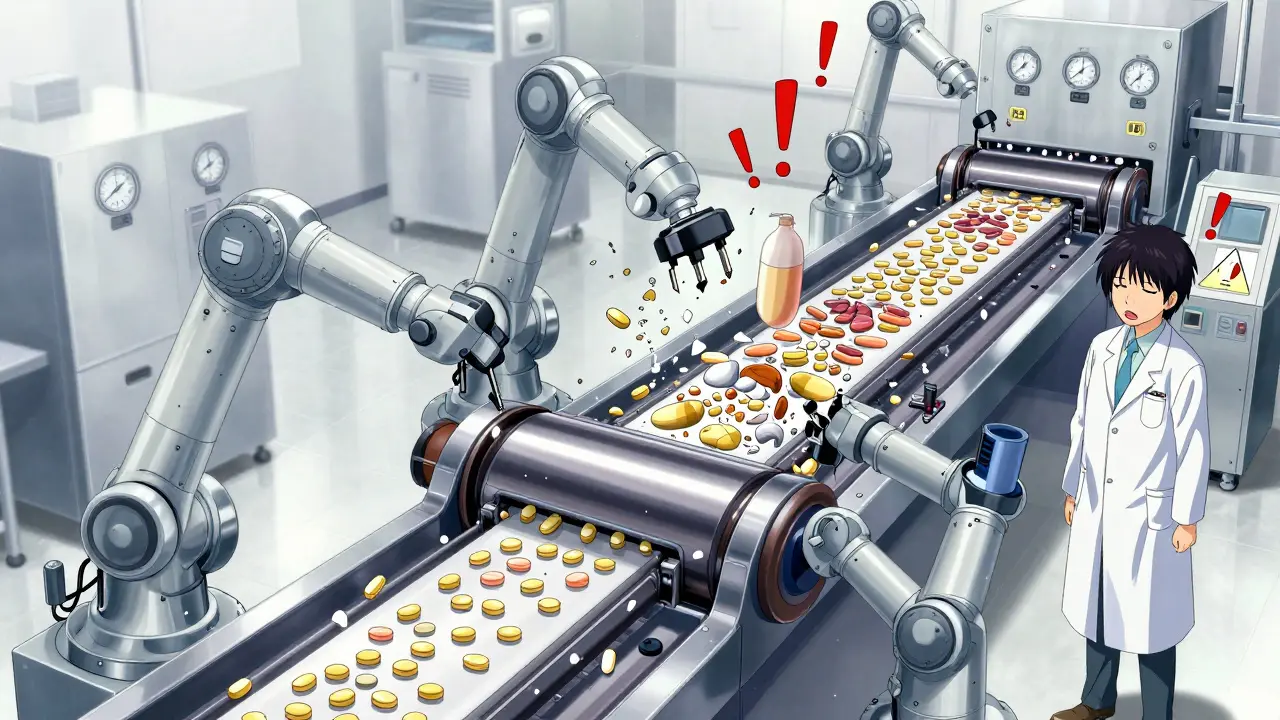
The Real-World Impact: When a Pill Doesn’t Work
A defective tablet might look fine. But if the active ingredient isn’t evenly distributed, you might get too little-or too much-of the drug. This isn’t hypothetical. In 2021, a study in JAMA Internal Medicine found that 7.3% of generic drug applications failed bioequivalence tests due to manufacturing inconsistencies, not formulation errors. One pharmacist in Ohio described receiving a batch of generic metformin ER tablets that crumbled during dispensing. Patients reported the pills didn’t control their blood sugar. Lab tests later confirmed inconsistent drug release profiles. The batch was recalled, but not before dozens of patients had to switch back to the brand-name version. Similar issues popped up with levothyroxine. Patients on the same generic brand reported sudden fatigue, weight gain, or heart palpitations. Blood tests showed inconsistent thyroid hormone levels. The manufacturer hadn’t changed the formula-but their mixing process had. Without real-time monitoring, the shift went unnoticed until patients suffered.How Quality Is (and Isn’t) Monitored
Most generic manufacturers still rely on manual visual inspection. Human inspectors can miss up to 30% of defects. Even trained workers get tired. A 2023 study found that after 90 minutes of inspecting tablets, error rates jumped 40%. The best manufacturers use automated systems. High-speed cameras detect defects as small as 0.1 mm at 600 tablets per minute. These systems cut human error to under 2%. But they cost $500,000 or more. Most generic companies won’t spend it. The FDA requires routine testing, but inspections are random. A facility might go years between checks. And when violations are found, penalties are often mild. A warning letter doesn’t shut down production. It just delays it. Meanwhile, the FDA’s 2022 Quality by Design (QbD) guidance pushes manufacturers to map out “design space”-the exact range of parameters where quality is guaranteed. But only 12% of generic firms have fully adopted it. The rest still operate on guesswork.
What’s Being Done-and What’s Not
Some progress is happening. The FDA’s Emerging Technology Program now includes 47 generic manufacturers using continuous manufacturing. This process reduces defects by 65% compared to traditional batch methods. Companies like Sandoz and Dr. Reddy’s are testing AI-powered inspection tools that detect defects with 92% accuracy-far better than human or traditional machine vision. The 2024 Drug Supply Chain Security Act now requires track-and-trace for high-risk generics. Early results show a 22% drop in counterfeit-related defects. That’s a start. But the scale of the problem is overwhelming. The Generic Pharmaceutical Association estimates it would take $28.7 billion to upgrade all U.S. generic manufacturing facilities to modern standards. Annual investment? Just $1.2 billion. At this rate, it’ll take 24 years to catch up. And the pressure to cut costs isn’t easing. Generic drug sales hit $462 billion in 2023 and are projected to hit $782 billion by 2030. More volume means more profit potential-but also more risk if quality slips.What Patients and Providers Can Do
You can’t control the manufacturing process. But you can take action:- If your generic pill looks different-new color, shape, or texture-ask your pharmacist. It might be a different maker.
- Report unusual side effects or symptoms after switching generics. Use the FDA’s MedWatch system. Your report adds data to a growing pattern.
- If you’re on a critical drug-thyroid, seizure, heart-ask your doctor if the brand-name version is medically necessary. Sometimes the cost difference is worth the safety.
- Pharmacists: If a batch crumbles, stains, or smells off, don’t dispense it. Document it. Push for testing.
Quality isn’t optional in medicine. A pill that looks wrong often is wrong. And when it fails, it’s not just a financial loss-it’s a health risk.
Why do generic drugs have more quality defects than brand-name drugs?
Generic drugs face higher defect rates because manufacturers operate under extreme price pressure. While brand-name companies invest 15-18% of production costs into quality assurance, generics average only 8-10%. This leads to outdated equipment, shared production lines, minimal automation, and insufficient staff training. In 2023, 57% of generic manufacturing facilities failed FDA inspections compared to 28% for branded ones.
What are the most common physical defects in generic tablets?
The most common defects include capping (tablet splitting), lamination (layer separation), sticking (tablet adhering to machine parts), mottling (uneven color), and weight variation (tablets outside ±5% of target weight). These stem from improper compression force, moisture levels, granule flow, or inconsistent mixing. For example, capping occurs when compression exceeds 15 kN and moisture drops below 2%.
Can defective generics actually fail to treat a condition?
Yes. If the active ingredient isn’t evenly distributed, patients may receive too little or too much of the drug. In 2021, 7.3% of generic drug applications failed bioequivalence tests due to manufacturing inconsistencies-not formulation issues. Patients on generic levothyroxine and metformin have reported treatment failures linked to inconsistent dosing from defective batches.
How can I tell if my generic drug is defective?
Look for visible changes: unusual color, shape, texture, or odor. If tablets crumble, chip, or stick together, that’s a red flag. If you notice new side effects after switching to a new generic batch, it could be a quality issue. Always check the manufacturer name on the bottle-it may have changed without your knowledge.
Are there regulations to prevent these defects?
Yes. The FDA enforces Current Good Manufacturing Practices (CGMP), and the USP sets standards for weight variation and purity. But inspections are infrequent and often reactive. In 2023, 24% of all drug recalls were due to CGMP violations, with 63% of generic recalls traced to manufacturing defects. Enforcement is improving, but resources lag behind the scale of the problem.
For now, the system relies on patients and providers to notice the signs. Because when a pill fails, the consequences aren’t just financial-they’re personal.



Donnie DeMarco
Bro. I took some generic metformin last month and one of the pills just fell apart in my hand like it was made of crushed cereal. I thought I was going crazy. Then I saw the batch number and looked it up-turns out 3 other people in my town had the same issue. FDA needs to stop playing whack-a-mole and start shutting down these sketchy plants. 😒
Tom Bolt
The systemic underfunding of generic drug quality control is not merely a regulatory failure-it is a moral abdication of the state’s duty to protect public health. The FDA’s reliance on random inspections, rather than mandatory, real-time, data-driven quality assurance protocols, constitutes a gross negligence that has directly contributed to patient morbidity and preventable hospitalizations. This is not capitalism. This is manslaughter with a pill dispenser.
Shourya Tanay
The bioequivalence gap in complex generics-particularly modified-release formulations-isn't just about particle size distribution or dissolution profiles. It's about the lack of in-line process analytical technology (PAT). Without real-time Raman spectroscopy or NIR monitoring, you're essentially manufacturing blind. And when you're producing 500k units/hour on a shared line? You're gambling with someone's life. The 14.7% defect rate for inhalers? That's not a statistic. That's a death sentence waiting to be dispensed.
LiV Beau
I’m a nurse and I’ve seen this firsthand. 🥺 One of my patients switched generics for her seizure med and started having breakthrough seizures. We thought it was non-compliance-until we checked the batch. The pills were literally crumbling. She cried because she thought she was ‘broken.’ We switched her back to brand and she hasn’t had a seizure in 8 months. This isn’t about money. It’s about dignity. 💔
Gene Forte
We all want affordable medicine. But affordability should never mean unacceptable risk. A pill is not a soda can. It’s not a t-shirt. It’s a tool that keeps people alive. If we can’t guarantee quality in life-saving drugs, then we’ve lost something fundamental as a society. Let’s invest now-or pay later with lives.
Kenneth Zieden-Weber
Oh wow. So the FDA says 'trust us' while letting factories with more rust than equipment churn out pills that look like they were made in a garage with a waffle iron? And we're supposed to be grateful? I mean, I get it-$28.7 billion to fix it all sounds like a lot. But how much did we spend on that one rocket that exploded? $4 billion? And we cheered. Hmm.
Chris Bird
This is why you dont trust america. Pharma companies make billions and then outsource to india and china. Then when people get sick, they say 'its not our fault'. Just stop pretending you care. The pills are made to be cheap. Not safe. Thats the business model.
David L. Thomas
The real kicker? The 12% of generic manufacturers that adopted Quality by Design are seeing defect rates drop below 3%. That’s not magic. That’s science. But why aren’t we scaling this? Because the ROI on automation isn’t sexy to shareholders. So we keep letting patients become the quality control department. And honestly? That’s just lazy.
Bridgette Pulliam
I read this entire post. Twice. And I’m still not sure if I’m more angry or heartbroken. My mother takes levothyroxine. She’s 79. She doesn’t know what a tablet press is. She just knows the pills changed color again. And now she’s afraid to take them. That’s not healthcare. That’s a horror story written in pill form.
Mike Winter
It’s ironic, isn’t it? We live in an age where we can track a coffee bean from farm to cup with blockchain, but we can’t guarantee that a life-saving pill contains the right amount of active ingredient? The systems exist. The technology exists. What’s missing is the will. And that’s the most dangerous defect of all.
Randall Walker
I work in a pharmacy. We had a batch of generic insulin last year. The vials looked fine. The labels were perfect. But the patients? They were crashing. Turns out the insulin was clumping. We didn’t catch it until three people ended up in the ER. FDA didn’t even send a letter. Just a ‘we’re looking into it.’ Meanwhile, my boss told me to just tell patients to ‘shake harder.’