
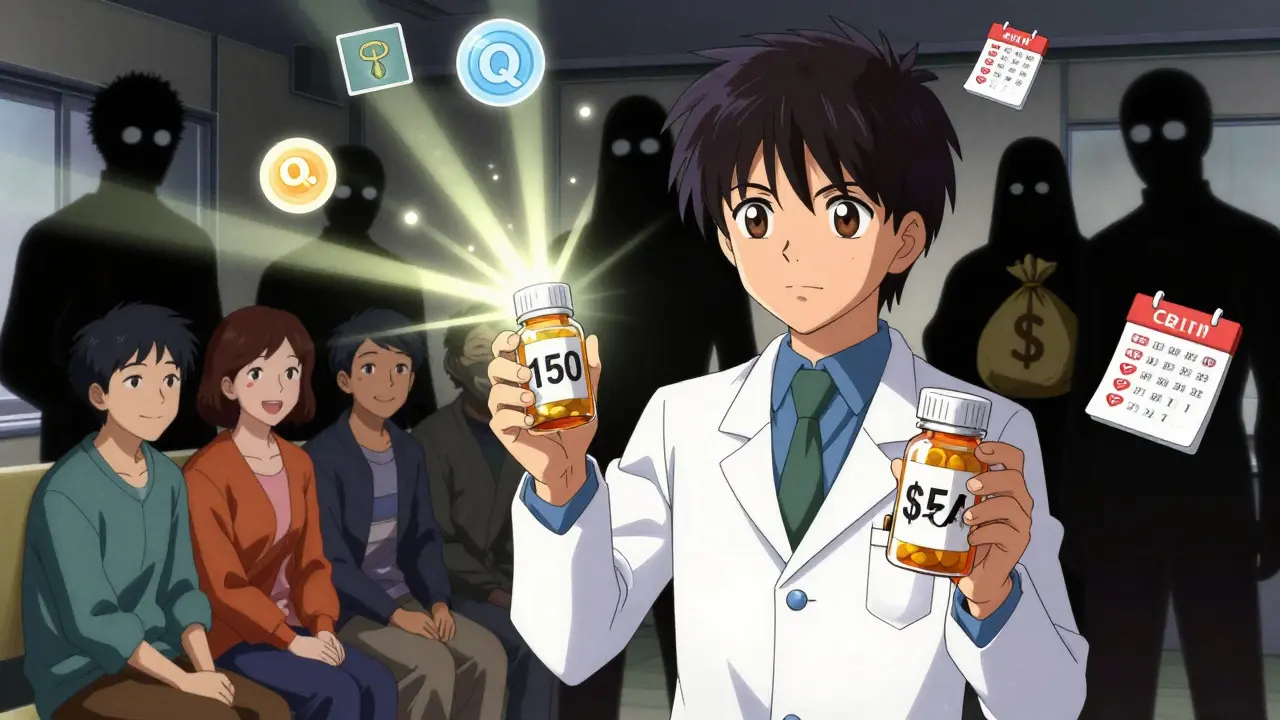
Generic drugs aren’t just cheaper versions of brand-name medicines-they’re often the key to saving billions in healthcare spending. But not all generics are created equal. Some cost 10 times more than others with the same active ingredient. How do we know which ones actually deliver the best value? That’s where cost-effectiveness analysis comes in.
What cost-effectiveness analysis really measures
Cost-effectiveness analysis (CEA) doesn’t just look at the price tag. It asks: For every extra dollar spent, how much better is the patient’s health outcome? The standard unit of measurement is the quality-adjusted life year, or QALY. One QALY equals one year of perfect health. If a drug extends life by two years but the patient spends half that time in poor health, it might only count as 1.5 QALYs. For generics, CEA compares the cost of one drug to another based on how well they work-not just how much they cost. A drug that costs $50 but only improves health slightly might be less cost-effective than one that costs $70 but adds a full QALY. The goal is to find the treatment that gives you the most health for your money.Why generic prices vary wildly
You’d think if two pills have the same active ingredient, they’d cost the same. But they don’t. A 2022 study in JAMA Network Open looked at the top 1,000 generic drugs in the U.S. and found something shocking: 45 of them cost more than 15 times what another generic in the same therapeutic class cost. That’s not a pricing error-it’s a market failure. Why does this happen? Three big reasons:- Therapeutic substitution confusion: Some insurers list a higher-priced generic because it’s in a different dosage form-say, extended-release instead of immediate-release-even though the clinical effect is nearly identical.
- Spread pricing by PBMs: Pharmacy Benefit Managers (PBMs) profit from the gap between what they pay pharmacies and what they charge insurers. If a $10 generic is replaced by a $150 generic, and the PBM gets a 20% cut, they make more money. The patient and insurer pay more. No one wins except the middleman.
- Outdated formularies: Many insurance plans don’t update their lists of covered drugs fast enough. A cheaper generic might have been available for six months, but the plan still covers the old, pricier version.
How competition drives prices down
The more generic manufacturers enter the market, the faster prices drop. Data from the FDA shows that when the first generic competitor arrives, prices fall an average of 39%. With six or more competitors, prices plunge more than 95% below the original brand price. Here’s what happens over time:- One generic competitor: 54% lower than brand price
- Two generic competitors: 65% lower
- Four generic competitors: 79% lower
- Six or more: over 95% lower
The hidden flaw in most cost-effectiveness studies
Here’s the problem: 94% of published cost-effectiveness analyses ignore the future. They look at today’s prices and assume they’ll stay the same. But if a drug’s patent is set to expire in 18 months, that’s not the right comparison. A 2021 ISPOR conference presentation showed that when analysts fail to account for upcoming generic entry, they make two big mistakes:- They overvalue brand-name drugs
- They undervalue new generic alternatives
Therapeutic substitution: the easiest way to cut costs
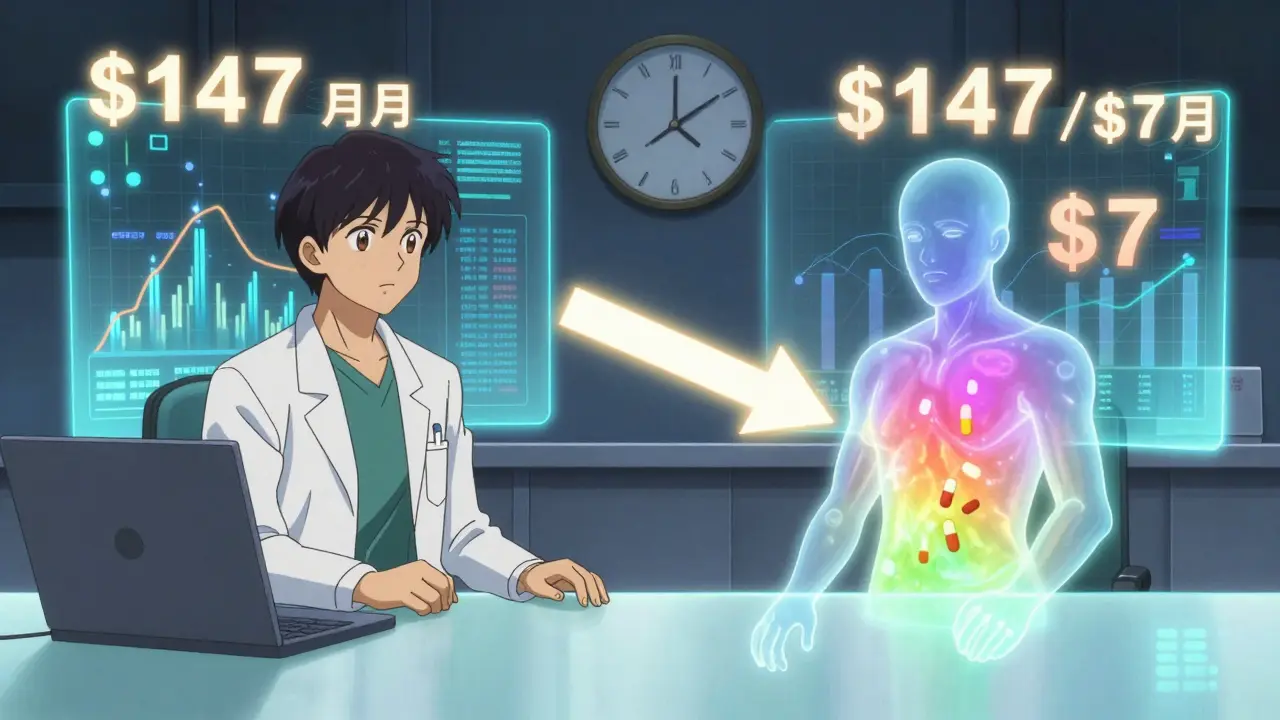
You don’t always need to switch to a generic of the same drug. Sometimes, switching to a different drug in the same class saves more money. The same JAMA study found that when patients were switched from a high-cost generic to a lower-cost alternative in the same therapeutic class, total spending dropped by 88% in some cases. For example:- High-cost generic statin: $147/month
- Lower-cost alternative statin: $7/month
- Same clinical effect: confirmed by multiple trials
Who’s doing it right-and who’s falling behind
In Europe, over 90% of health technology assessment agencies use formal cost-effectiveness analysis to decide which drugs to cover. In the U.S., only 35% of commercial insurers do the same. The rest rely on formulary lists built on old data, lobbying pressure, or PBM incentives. The Institute for Clinical and Economic Review (ICER) stands out. They publish detailed reports that include:- Price forecasts based on patent expiration
- Comparisons of multiple generics and therapeutic alternatives
- Transparent assumptions about future market entry

What needs to change
To make cost-effectiveness analysis work for generics, three things must happen:- Update formularies quarterly: Don’t wait a year to remove a $150 generic when a $5 version is available.
- Require forecasting in CEA models: Every analysis should include a scenario for generic entry within the next 24 months.
- Eliminate spread pricing: PBMs should be paid a flat fee, not a percentage of the drug price. That removes the incentive to favor expensive generics.
Why this matters for patients
You might think this is just a policy issue. But it’s personal. If your prescription costs $120 and a $4 alternative works just as well, you’re paying $116 more every month. That’s $1,392 a year. For someone on a fixed income, that’s groceries, rent, or insulin. And it’s not just about money. When drugs are too expensive, patients skip doses, split pills, or stop taking them entirely. That leads to hospital visits, complications, and higher long-term costs. Cost-effectiveness analysis isn’t about cutting care. It’s about making sure every dollar spent delivers real health value.What you can do
If you’re a patient:- Ask your pharmacist: “Is there a cheaper generic or alternative drug that works the same?”
- Check if your insurer has a preferred generic list.
- Use tools like GoodRx to compare cash prices across pharmacies.
- Prescribe by therapeutic class, not brand name.
- Review formulary updates every quarter.
- Advocate for CEA-based formulary decisions at your hospital or clinic.
Are generic drugs as safe and effective as brand-name drugs?
Yes. The FDA requires generics to have the same active ingredient, strength, dosage form, and route of administration as the brand-name drug. They must also meet the same strict standards for quality, purity, and performance. Bioequivalence studies prove they work the same way in the body. Over 90% of U.S. prescriptions are filled with generics-and they’ve been used safely for decades.
Why do some generics cost more than others?
Price differences come from market factors, not quality. One generic might cost more because it’s in a different dosage form (like extended-release), because the manufacturer has fewer competitors, or because Pharmacy Benefit Managers (PBMs) profit from higher prices through spread pricing. Sometimes, insurers simply haven’t updated their formularies to include cheaper options.
Can switching to a cheaper generic cause side effects?
Rarely. The FDA requires generics to be bioequivalent, meaning they deliver the same amount of active ingredient into the bloodstream at the same rate as the brand. For most people, switching causes no difference. However, in a small number of cases-like with narrow-therapeutic-index drugs such as warfarin or levothyroxine-some patients may need to stay on the same manufacturer’s version. Always talk to your doctor before switching.
What’s the difference between generic substitution and therapeutic substitution?
Generic substitution means swapping one brand-name drug for its generic version-same active ingredient, same dose. Therapeutic substitution means switching to a different drug in the same class that treats the same condition but may have a different active ingredient. For example, switching from one statin to another. Therapeutic substitution often saves more money and is just as effective.
Why don’t all insurers use cost-effectiveness analysis?
Many insurers rely on outdated formularies, PBM contracts, or internal policies that don’t prioritize cost-effectiveness. Some lack the data infrastructure or expertise to run these analyses. Others face pressure from pharmaceutical companies to include certain drugs. Only about 35% of U.S. commercial payers use formal CEA, while most European agencies do.
How can I find the cheapest generic for my medication?
Ask your pharmacist for the lowest-priced generic option. Use price-comparison tools like GoodRx or SingleCare. Check your insurer’s formulary list for preferred generics. If your prescription is expensive, ask your doctor if a therapeutic alternative exists-sometimes a different drug in the same class costs a fraction of the price.



Rosalee Vanness
God, I wish my pharmacist would just tell me this stuff instead of acting like I’m asking for forbidden knowledge. I’ve been paying $130 for a blood pressure med for years, and last month I asked if there was a cheaper version-turns out, it was $4. FOUR DOLLARS. I felt like an idiot for not asking sooner. Why is this information so buried? It’s not like generics are some secret underground medicine-they’re literally the same pills, just without the fancy packaging and the CEO’s yacht fund.
And don’t even get me started on PBMs. They’re the reason my insurance says ‘covered’ but I still get billed $80. They’re not middlemen-they’re middlemen who get paid to make you suffer. I’m not mad, I’m just… deeply disappointed in capitalism’s ability to turn healthcare into a rigged game of Monopoly where the players don’t even know the rules.
I’ve started printing out ICER reports and bringing them to my doctor. She thinks I’m weird. I think she’s asleep at the wheel. We need to stop treating drug pricing like it’s a magic spell and start treating it like math. It’s not complicated. Cheaper = better, if it works the same. Why is that so hard to implement?
Also, I now use GoodRx like it’s my personal religion. I check every script. I’ve saved over $2,000 in 18 months. I’m not a hero. I’m just someone who refused to be robbed quietly.
John Tran
so like… i mean… think about it man… the whole system is just… a metaphor for human greed right? like we’re all just… floating in this sea of pills and profit and no one’s asking why we’re even swimming? generics are the truth, but the truth is too ugly for the corporate machine to swallow. it’s not about health-it’s about control. the pmb’s? they’re not even people anymore. they’re algorithms with suits. and we’re just… data points with prescriptions.
and the worst part? we let them. we just nod and hand over our cash like it’s some kind of sacred ritual. i mean… if you could buy a car that runs the same as a ferrari but costs $200… would you still buy the ferrari? no. but for some reason… with pills? we do. why? because we’ve been trained. brainwashed by ads and fancy logos and doctors who got free lunches from pharma reps.
we’re not sick. we’re sold.
and the system? it’s not broken. it’s working exactly how it was designed.
…i’m gonna go cry now.
laura Drever
Ugh. Another one of these. We know all this. The data’s been out for a decade. Why are we still talking about it like it’s news? Formularies are outdated. PBMs are parasites. Doctors are lazy. Patients are clueless. The system is a dumpster fire. Congrats. You wrote a 2,000-word essay on why the sky is blue.
Also typo: ‘PBM’s’ not ‘PBMs’ in paragraph 3. Fix it. You’re embarrassing yourself.
jefferson fernandes
Let me be clear: this isn’t a debate. It’s a moral emergency. We are allowing people to die-literally die-because of a $116 monthly overcharge on a drug that’s been generic for three years. This isn’t economics. This is negligence dressed up as policy.
Every time a patient skips a dose because they can’t afford it, we are complicit. Every time a formulary stays unchanged for 14 months while a $3 alternative exists, we are failing. Every time a PBM profits from spread pricing, they are stealing from sick people.
And yet, we sit here and call it ‘the market.’ The market doesn’t care if you have diabetes. The market doesn’t care if you’re on Social Security. The market doesn’t care if you’re a single mom working two jobs. The market is a machine that grinds people into profit.
We need to stop pretending this is complicated. The solution is simple: force formulary updates quarterly. Ban spread pricing. Reward doctors who prescribe based on cost-effectiveness, not habit. And hold PBMs legally accountable for overcharging.
This isn’t politics. It’s basic human decency. And if you’re not screaming about this, you’re part of the problem.
Acacia Hendrix
While I appreciate the empirical framing of the cost-effectiveness model, the underlying assumption-that QALYs are a valid metric for health equity-is fundamentally flawed. The QALY framework implicitly devalues elderly populations, disabled individuals, and those with comorbidities by assigning lower utility weights to their lived experience. This is not cost-effectiveness-it’s utilitarian rationing disguised as science.
Furthermore, the reliance on FDA bioequivalence thresholds (80-125% AUC) is statistically insufficient to capture inter-individual pharmacokinetic variability, particularly in polypharmacy contexts. The notion that ‘same active ingredient = same outcome’ is a reductive fallacy that ignores pharmacogenomic heterogeneity, gut microbiome interactions, and non-adherence patterns.
And while the $4 blood pressure example is compelling, it neglects the fact that real-world adherence is inversely correlated with out-of-pocket cost reduction in low-income populations due to structural barriers like transportation, literacy, and pharmacy access. Cost-effectiveness without equity is just efficiency with a conscience.
Perhaps we need a new metric: QALY-adjusted-for-access (QAA), which integrates socioeconomic determinants into the model. Otherwise, we’re optimizing for a fantasy.
James Castner
There is a profound philosophical truth buried in this entire discussion: healthcare is not a commodity. It is a covenant. And yet, we have allowed it to be reduced to a spreadsheet-QALYs, PBMs, formularies, spread pricing-all cold, mechanical abstractions that erase the human face of suffering.
When a grandmother chooses between insulin and groceries, when a veteran skips his blood thinner because the copay is $120, when a child with asthma can’t get the cheapest inhaler because the insurer hasn’t updated its list-these are not policy failures. These are moral failures.
Cost-effectiveness analysis, as it stands, is a tool that can be used for good. But it is not a moral compass. That must come from us-from the doctors who prescribe wisely, the pharmacists who speak up, the patients who ask the hard questions, the legislators who dare to cut the greed.
We are not here to optimize for profit. We are here to honor dignity. The cheapest generic isn’t just cheaper-it’s more humane. And if we can’t see that, then we’ve lost something far more valuable than money.
Let this be the moment we choose compassion over calculus.
With reverence for every life that depends on a pill.
Adam Rivera
Just wanted to say-this post made me feel less alone. I’ve been telling my friends for years that generics are the same, but they think I’m crazy when I say my $150 statin is just a $7 pill with a different label.
My mom’s on levothyroxine, and we had to switch manufacturers three times because the insurance kept changing the ‘preferred’ one. Each time, she felt weird-tired, shaky, off. Turns out, even though it’s ‘bioequivalent,’ her body doesn’t like the fillers in the new version. So now we pay full price for the one she tolerates.
Point is: the system’s broken, but it’s not all black and white. Sometimes the cheapest isn’t the best-for you. And that’s okay. We need flexibility, not just price tags.
Thanks for writing this. I’m sharing it with my whole family now.
lucy cooke
Oh please. Let’s not pretend this is about fairness. It’s about power. The FDA doesn’t regulate the fillers. The PBMs don’t care about your kidneys. The doctors don’t know the prices. The insurers don’t read the studies. And the patients? We’re just supposed to be grateful for the crumbs.
Meanwhile, the same pharma execs who profit from $150 generics are donating to your senator’s campaign. The same PBM CEO who makes millions off spread pricing is on the board of your hospital’s ‘patient advocacy’ committee.
This isn’t a market failure. It’s a coup.
And you? You’re still using GoodRx like it’s a victory.
It’s not. It’s a Band-Aid on a severed artery.
mike swinchoski
People are so stupid. If you can't afford your meds, you're just lazy. Why don't you get a second job? Or move to a cheaper state? Or just stop being sick? This whole post is just whining. The market works. If you want cheap drugs, make more money. Simple.
Also, generics are dangerous. I heard a guy on YouTube say his cousin got kidney failure from a generic. Probably true. Don't trust the FDA. They're in the pocket of Big Pharma. Or maybe Big Generic. Who knows anymore? I'm not taking any chances.
Trevor Whipple
yo i just got prescribed metformin and asked my pharmacist for the cheapest one-$3.50. the one my doc wrote was $140. i was like… wait what? so i asked why. he said ‘oh that’s what’s in the system.’ i went to my doc’s office and showed them the receipt. they changed it. no big deal.
but here’s the thing-why did it take me, a random guy with a phone and internet, to figure this out? why isn’t the system doing this for me?
also-i think PBMs are evil. like, cartoon villain evil. they should be in jail. or at least forced to wear a sign that says ‘I PROFITED FROM YOUR DIABETES’