
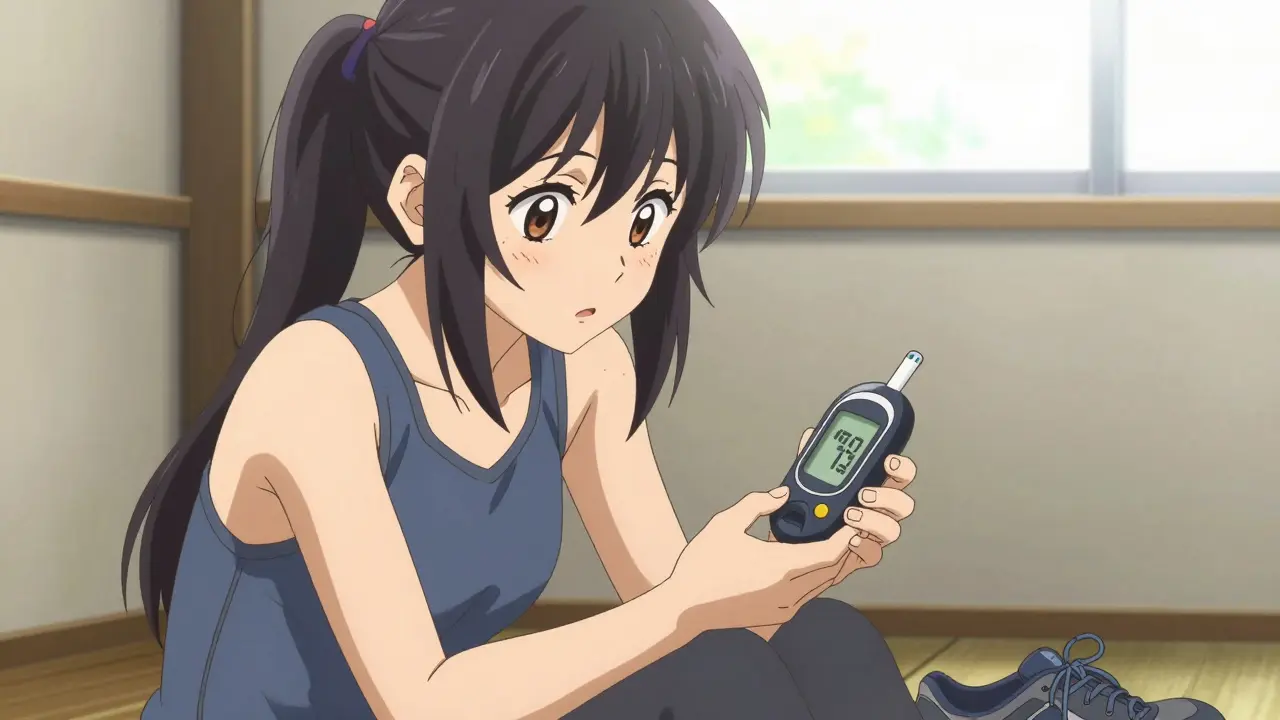
Imagine lacing up your running shoes, ready to crush a morning jog, but stopping dead in your tracks because you're terrified your blood sugar will crash. You're not alone. According to the American Diabetes Association, about half of adults with type 1 diabetes avoid physical activity primarily because they fear hypoglycemia is a condition where blood glucose levels drop below 70 mg/dL. This fear is real and valid, but it doesn't have to stop you from moving your body. With the right preparation, understanding your body's signals, and using modern technology, you can exercise safely and effectively.
Exercise is a cornerstone of diabetes management. The Mayo Clinic recommends at least 150 minutes of moderate-to-vigorous aerobic activity weekly. However, the interaction between physical activity is movement that increases heart rate and energy expenditure. and insulin therapy is medical treatment using synthetic insulin to regulate blood sugar. is complex. Muscles use glucose for fuel, and exercise increases insulin sensitivity for up to 72 hours afterward. If you don't adjust for this, your blood sugar can plummet. Let's break down exactly how to prevent these lows so you can focus on your fitness goals.
Understanding Why Blood Sugar Drops During Exercise
To prevent a low, you first need to know why it happens. When you exercise, your muscles contract and demand energy. They pull glucose from your bloodstream to burn it. This happens even without insulin, known as insulin-independent glucose uptake. Simultaneously, exercise makes your body more sensitive to the insulin already in your system. If you have active insulin on board, that insulin works harder than usual, potentially dropping your glucose levels rapidly.
This sensitivity doesn't just happen during the workout. Research shows insulin sensitivity can remain elevated for 24 to 72 hours after you finish. This is why you might wake up with a low blood sugar reading after a workout you did the day before. Understanding this delayed effect is crucial for long-term safety. It means your management strategy isn't just about the hour you spend at the gym; it's about the days that follow.
Pre-Workout Preparation and Thresholds
The most critical step happens before you even step out the door. Checking your blood glucose is the concentration of sugar in the blood measured in mg/dL or mmol/L. 15 to 30 minutes before exercise is non-negotiable. Different readings require different actions. If your reading is below 90 mg/dL, you need to eat. Guidelines suggest consuming 0.5 to 1.0 grams of carbohydrate per kilogram of body weight. For a 70 kg person, that's roughly 35 to 70 grams of carbs, depending on intensity.
For readings between 90 and 150 mg/dL, you might be okay to start, but keep fast-acting carbs nearby. If your level is above 250 mg/dL, check for ketones. If ketones are present, exercise could make things worse. The American Diabetes Association recommends 15 to 20 grams of carbohydrates if levels fall below 100 mg/dL before starting, rechecking after 15 minutes. It's better to be slightly high than to crash mid-workout. Some experts, like Dr. Anne Peters, suggest aiming for 150 to 180 mg/dL before high-intensity activities to create a safety buffer.
Insulin On Board and Timing
Timing is everything when you use insulin. You want to avoid exercising when your insulin is peaking. If you took a meal bolus an hour ago, that insulin is doing its heaviest lifting. Exercising now increases the risk of a severe low. This is where calculating insulin on board is the amount of active insulin remaining in the body from recent doses. becomes vital. UCLA Health endocrinologists note that the more insulin you have active, the higher the likelihood of a low glucose event.
Research indicates that 1.2 units of active insulin can behave like 2 to 3 units during physical activity. If you are on an insulin pump is a medical device that delivers continuous insulin through a catheter., you can use temporary basal rate reductions. The standard protocol is reducing the basal rate by 50% to 75% starting 60 to 90 minutes before moderate exercise. If you use multiple daily injections, you might need to reduce your pre-exercise bolus dose by 25% to 50%. Always try to exercise at consistent times daily to build predictable patterns.

Choosing the Right Type of Exercise
Not all workouts affect blood sugar the same way. Aerobic exercise is sustained rhythmic activity like running, swimming, or cycling. such as jogging or cycling typically causes a progressive decline in blood glucose. This is the most common cause of exercise-induced hypoglycemia. However, anaerobic activities like weightlifting or sprinting can actually raise blood sugar temporarily due to the release of stress hormones like adrenaline.
Combining these two types can be a game-changer. A 2018 study found that doing 45 minutes of resistance exercise before 45 minutes of aerobic activity reduced glucose decline significantly. High-intensity interval training (HIIT) with short bursts of 5 to 15 seconds also reduces hypoglycemia risk during and for up to 45 minutes after the workout. If you are prone to lows, consider starting your session with a few sets of weights or a short sprint before your main cardio routine. This creates a protective effect that helps stabilize your levels.
Monitoring During and After Activity
Checking your levels once isn't enough. You should check every 30 to 60 minutes during activity, especially if you are trying a new type of exercise. The learning curve for effective exercise management spans 3 to 6 months. During this period, check every 15 minutes to map out your personal response patterns. You need to know exactly how your body reacts to a 5K run versus a yoga session.
The danger doesn't end when you shower. Delayed-onset hypoglycemia affects 70% of type 1 diabetes patients and can occur 6 to 12 hours post-exercise. This is why nighttime monitoring is critical after a workout. You may need a strategic bedtime snack containing 15 grams of carbohydrates plus protein to prevent a nocturnal low. If you use a Continuous Glucose Monitor is a wearable device that tracks glucose levels in interstitial fluid. (CGM), ensure your alerts are set correctly. Models like the Dexcom G7 have an exercise mode that adjusts alert thresholds to prevent false alarms during sweat and movement.

Technology and Future Solutions
Technology is rapidly closing the gap in safety. The global diabetes management market is growing, with a focus on exercise-related features. In 2023, the FDA cleared an 'Exercise Impact' feature for the Tandem t:slim X2 pump. This uses machine learning to predict glucose decline based on your history and automatically adjusts insulin delivery. While not perfect, it reduces the cognitive load on you.
Adoption rates show that 68% of type 1 diabetes patients using CGMs check glucose before exercise compared to only 42% of non-CGM users. This data proves that visibility improves safety. Future directions include closed-loop systems that automatically adjust insulin during exercise. The NIH-funded 'Exercise-AP' trial is testing a dual-hormone artificial pancreas that delivers glucagon during lows. Preliminary data suggests this could reduce hypoglycemic events by 52% during physical activity. By 2026, integrated exercise management features are projected to become standard in most devices.
Troubleshooting Common Scenarios
Even with planning, things can go wrong. If you experience a low during a workout, stop immediately. Consume 15 grams of fast-acting carbs, wait 15 minutes, and recheck. Do not try to push through a severe low. If you consistently get lows at the same time of day, look at your insulin timing or your meal composition. Perhaps you need a higher protein snack before bed if you exercise in the afternoon.
User experiences on platforms like T1D Exchange show that 78% of members use temporary basal reductions, with 63% finding them effective. If you are struggling, look at your insulin-to-carb ratios. You might be over-correcting. Remember, accuracy in carbohydrate counting within ±5 grams is a critical skill. Don't be afraid to adjust your plan. Your body changes, and your management strategy should too.
What should I do if my blood sugar is below 90 mg/dL before exercising?
If your blood glucose is below 90 mg/dL, you should consume 0.5 to 1.0 grams of carbohydrate per kilogram of body weight. For most adults, this means eating a snack with 15 to 30 grams of fast-acting carbohydrates. Wait 15 minutes and recheck your levels before starting the activity to ensure they have risen to a safe range.
How does aerobic exercise affect blood glucose differently than resistance training?
Aerobic exercise typically causes a progressive decline in blood glucose because muscles use glucose for sustained energy. Resistance training, like weightlifting, can temporarily raise blood sugar due to the release of stress hormones. Combining resistance training before aerobic activity can help stabilize levels and reduce the risk of lows.
What is the risk of delayed hypoglycemia after a workout?
Delayed hypoglycemia can occur 6 to 12 hours after exercise due to increased insulin sensitivity. About 70% of type 1 diabetes patients experience this. To prevent it, monitor your glucose at night and consider a bedtime snack with protein and carbohydrates if you exercised earlier in the day.
How should I adjust my insulin pump settings for exercise?
For moderate exercise, reduce your basal rate by 50% to 75% starting 60 to 90 minutes before you begin. If you are using an insulin pump with exercise features, enable the specific exercise mode if available. Always monitor your glucose closely to see how your body responds to these changes.
Is it safe to exercise if I have ketones in my system?
No, if you have moderate to large ketones, you should not exercise. Physical activity can increase ketone production and lead to diabetic ketoacidosis (DKA). Treat the high blood sugar and ketones first, and wait until they are cleared before engaging in physical activity.