

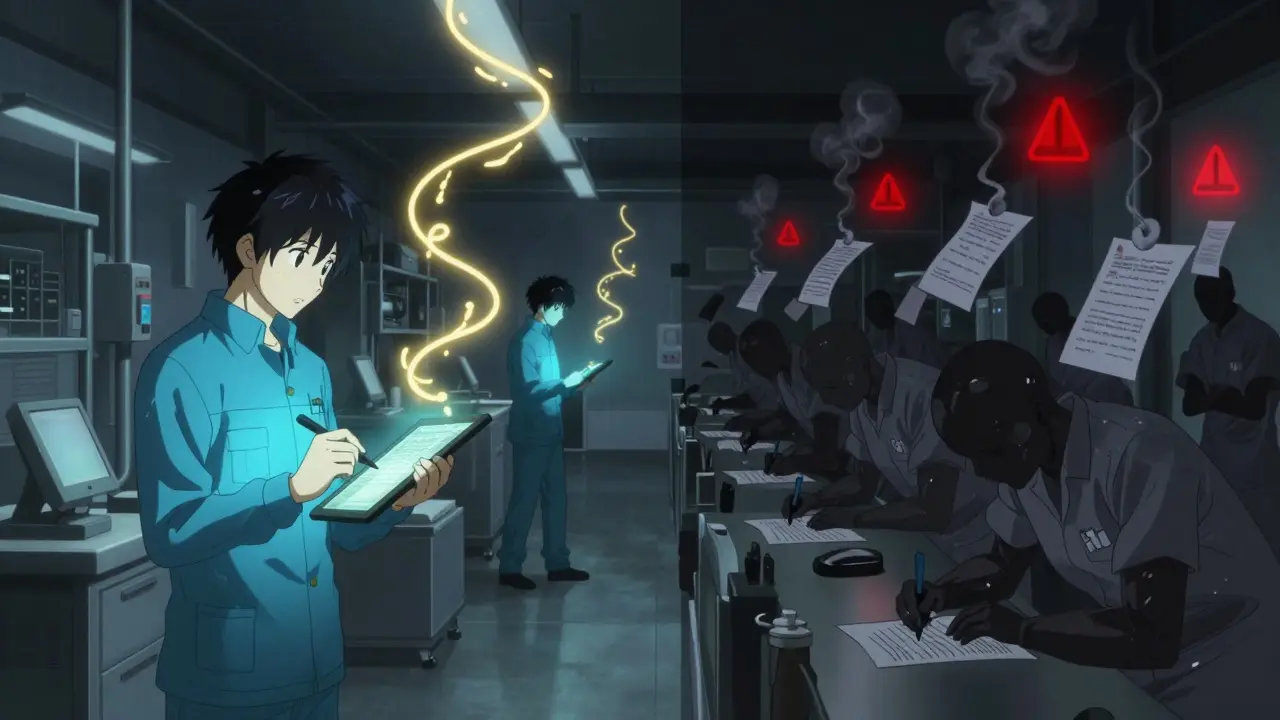
When a medicine batch fails, it’s rarely because the formula was wrong. More often, it’s because someone forgot to sign off on a temperature log, or a machine ID wasn’t recorded, or a handwritten note got smudged. In manufacturing-especially in pharma, medical devices, and food-documentation isn’t paperwork. It’s your last line of defense against contamination, mix-ups, and recalls that can cost millions-or worse, lives.
Why Documentation Isn’t Optional
The 1937 Elixir Sulfanilamide tragedy killed 107 people because no one tested the solvent used. That disaster led to the first real GMP rules. Today, those rules are written into law. In the U.S., it’s 21 CFR Part 211. In Europe, it’s EudraLex Volume 4. In 56 countries, it’s PIC/S guidelines. These aren’t suggestions. They’re legal requirements. If your records don’t meet the standard, regulators don’t just give you a warning. They issue Form 483 observations. They send warning letters. They shut down production. In 2022, Stericycle reported that a single recall due to poor documentation cost manufacturers an average of $10 million. That’s not a typo. Ten million dollars. And it’s not just about money. A 2021 FDA analysis found that 87% of warning letters cited data integrity failures. That means most compliance issues aren’t about dirty floors or broken equipment. They’re about missing, late, or altered records.What Gets Documented: Two Types of Records
There are two kinds of records you need: procedural documents and compliance records. Procedural documents are your instructions. These include:- Standard Operating Procedures (SOPs) written in active voice-no "it should be done," just "the operator shall verify temperature before starting."
- Testing methods validated under ICH Q2(R1) guidelines
- Emergency protocols for equipment failure or contamination events
- Material specs with exact tolerances: "moisture content: 3.5% ± 0.2% w/w"
- Bills of materials with unique IDs for every component
- Attributable-Who did it? Name, signature, date, time.
- Legible-Readable now and in 10 years. No pencil, no smudges.
- Contemporaneous-Recorded at the time of the activity. Not later. Not the next day.
- Original-The first data captured. Not a copy, not a transcription.
- Accurate-No guessing. No rounding unless allowed.
- Complete-All data, even the "failed" results.
- Consistent-No contradictions between logs, forms, or reports.
- Enduring-Stored securely for at least one year after product expiry.
- Available-Accessible for audits, inspections, investigations.
Electronic Systems: The New Normal
Paper records are fading. Most manufacturers now use electronic quality management systems (eQMS). But switching isn’t just installing software. It’s validating the whole system. Under GAMP 5 guidelines, every electronic system must be validated with over 150 test cases. That includes:- Can users only access what they’re authorized to?
- Is there a full audit trail that can’t be deleted?
- Do electronic signatures meet 21 CFR Part 11? That means identity verification, unique login, and timestamped actions.
- What happens if the server crashes? Is data recoverable?
Regional Differences That Trip Up Global Manufacturers
You might think GMP is the same everywhere. It’s not. The FDA requires every calculation to be verified by a second qualified person. The EU lets you use automated verification. Japan requires all documents to be in Japanese for local submissions. The EU’s MDR 2017/745 demands clinical evaluation reports with specific literature search methods-something the FDA doesn’t require. A 2022 Emergo by UL study showed manufacturers targeting both the U.S. and EU markets spend 37% longer on approvals just to reconcile documentation. And it costs an average of $2.1 million per year to keep up. Medical device makers face another layer: ISO 13485:2016 requires design history files with traceability matrices. FDA’s QSR doesn’t. So if you make a device and sell it in both markets, you’re writing two versions of the same thing.What Goes Wrong (And How to Fix It)
The Parenteral Drug Association’s Technical Report No. 60 breaks down the top four documentation failures:- 42%: Records created after the fact, not during the activity
- 29%: Investigations lack detail-"something went wrong" isn’t enough
- 18%: Original data lost or replaced with copies
- 11%: Changes to records aren’t properly documented or justified
- Clear-No jargon. Write at an 8th-grade reading level. FDA recommends this.
- Concise-No fluff. If it doesn’t affect quality, don’t write it.
- Complete-Every step, every number, every signature.
- Correct-Double-check. Use the four-eyes principle for critical entries.
- Compliant-Always tie back to your SOPs and regulations.

What’s Changing in 2025
Regulators aren’t slowing down. In fact, they’re speeding up. The European Commission’s 2024 revision of EudraLex will require risk-based documentation by January 2025. That means you must document your own risk assessments for every critical record process. No more blanket rules. The FDA’s 2023 draft guidance says hybrid systems (paper + electronic) must have audit trails for all electronic entries-with a minimum of 1,000 characters per entry. That’s to prevent people from deleting or editing without a trace. PIC/S is releasing a new GDocP guide in Q3 2024 to fix regional inconsistencies. And AI is starting to help: early adopters report 45% less time spent on batch records because systems auto-generate them from machine data. But regulators haven’t approved AI-generated records yet. Validation frameworks are still being built.How to Get Started
If you’re starting from scratch, expect 18 to 24 months to build a compliant system. Budget $1.2 to $2.5 million for implementation. Start here:- Map every process that affects product quality. Write down every step.
- For each step, define what needs to be recorded and why.
- Train everyone-not just QA. Operators, maintenance, logistics. Everyone.
- Choose an eQMS that’s validated and supports audit trails, electronic signatures, and data retention.
- Assign "documentation champions" in each department. People who know the rules and can answer questions.
- Review records weekly. Don’t wait for an audit.
What happens if I don’t keep proper manufacturing records?
Without proper records, regulators can issue Form 483 observations, warning letters, or shut down your facility. Product recalls due to documentation failures cost an average of $10 million per incident. In extreme cases, you could face criminal charges if patient harm is linked to your records. Non-compliance also destroys customer trust and makes it impossible to export products to regulated markets like the U.S. or EU.
Can I use handwritten records in GMP manufacturing?
Yes, but only if they meet ALCOA+ standards. Handwritten entries must be legible, signed, dated, and made at the time of the activity. Pencil is not allowed. Erasures or white-out are prohibited. Any change must be strikethrough, initialed, and dated. Most manufacturers are moving to electronic systems because paper is harder to audit, harder to store, and more prone to loss or damage.
How long do I need to keep manufacturing records?
Minimum retention is one year beyond the product’s expiration date. For some products, like medical devices or certain pharmaceuticals, regulators may require three years after distribution. Always check your specific regulation-FDA, EU GMP, and PIC/S all have slight variations. Electronic systems must ensure records remain accessible and readable for the entire retention period, even if the software is upgraded.
Do I need to validate every electronic system I use?
Yes. Any system used to create, modify, store, or retrieve GMP records must be validated under GAMP 5. This includes eQMS, LIMS, MES, and even Excel spreadsheets if they’re used for official records. Validation means proving the system works as intended under real conditions-testing security, data integrity, access controls, and recovery procedures. Skipping validation is a top reason for FDA warning letters.
What’s the biggest mistake manufacturers make with documentation?
The biggest mistake is treating documentation as an afterthought. Many teams wait until the end of a shift or even the next day to fill out records. That’s not contemporaneous. It’s not compliant. Regulators know when records are backfilled. The second biggest mistake is writing SOPs in legalese that operators don’t understand. If your staff can’t follow the instructions, they won’t follow the records. Write clearly. Test them. Train often.


Doreen Pachificus
Just read this after a 14-hour shift documenting batch logs. Honestly? I didn’t think anyone cared about this stuff outside QA. But the part about backfilled records being obvious? Yeah. That hit hard.
bob bob
Man, I used to hate documentation. Now I see it as the glue holding everything together. No more ‘I’ll write it later’ - that’s how recalls start.
Stephen Craig
Documentation isn’t about compliance. It’s about accountability. Every signature is a promise - to the patient, to the regulator, to the next person who picks up the log.
Charlotte N
ALCOA+ is everything… but who actually trains operators on it? We get a 10-minute slide deck and then we’re expected to write like FDA auditors after 12 hours on the line
Ethan Purser
They say records save lives - but let’s be real, it’s all just theater. The real problem is that no one in management actually cares until the FDA shows up with a subpoena. Then suddenly everyone’s a compliance guru. Pathetic.
Abhishek Mondal
Why do Americans treat GMP like sacred scripture? In India, we get results without 150 validation test cases. You over-engineer everything. Paper is fine if your people are trained. Your obsession with electronic systems is just fear dressed up as innovation.
Oluwapelumi Yakubu
Bro, in Lagos we used to write logs on napkins during power outages - and still passed audits because we had the right mindset. It’s not the medium, it’s the intention. Your systems are overcomplicating what should be simple.
Catherine HARDY
Have you ever wondered if these regulations are just a way for big pharma to crush small manufacturers? The cost of compliance is so high that only the giants can afford it… and then they charge you $2000 for a pill that costs $3 to make. It’s not about safety - it’s about control.
melissa cucic
The 5C rule is brilliant, but it assumes everyone can read. I’ve seen operators who are literate in their native language but struggle with English SOPs. We need multilingual documentation - not just translated, but culturally adapted. Otherwise, we’re setting people up to fail.
Jack Wernet
While I appreciate the technical depth of this post, I must emphasize the human element. Documentation culture begins with leadership. If managers treat record-keeping as a chore, it will remain one. But if they model diligence, respect, and clarity - it becomes part of identity, not obligation.
Roshan Aryal
Let me tell you something - in the U.S., you’re drowning in paperwork because you’re terrified of lawsuits. In China, they just lock the factory if something goes wrong. No forms. No audits. Just silence. Which system actually works better? Hmm?
Chris Cantey
AI-generated records? That’s the future. But they’ll never approve it because regulators are afraid of losing control. They’d rather have a thousand humans making the same mistakes than trust a machine that never sleeps. It’s not about safety - it’s about ego.
Vicki Yuan
Validation isn’t optional. I’ve seen a lab use Excel for batch release. No audit trail. No version control. One typo, one deleted row, and the whole batch gets flagged. It’s not a glitch - it’s negligence. And it’s everywhere.
Connor Hale
Most companies treat documentation like a checklist. But it’s not a task - it’s a narrative. Every entry tells a story: who did what, when, why, and how they knew it was right. That story needs to be clear, honest, and complete. That’s quality.
Uzoamaka Nwankpa
I’ve worked in three countries. In Nigeria, we didn’t have eQMS. We had trust. We had mentors. We had people who cared. Now everything is tracked, logged, and digitized - but no one remembers why we do it anymore. We lost the soul of quality.