
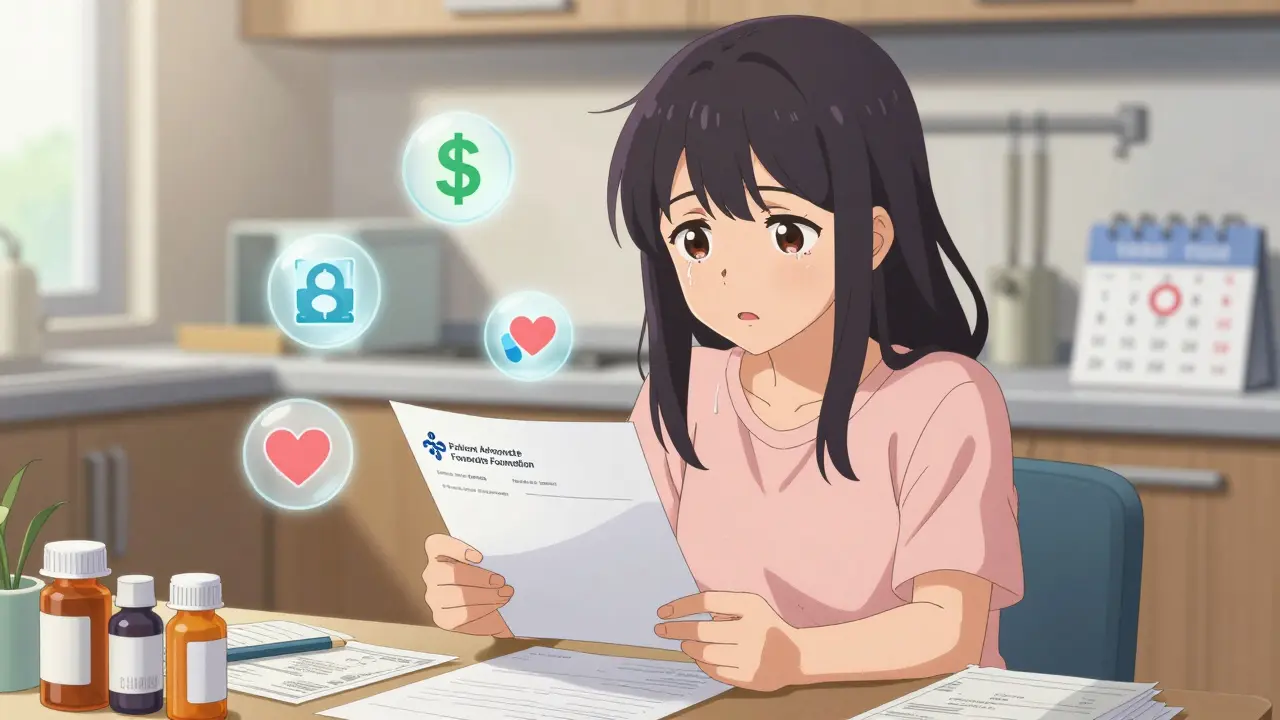
Getting the medicine you need shouldn’t mean choosing between paying rent or filling your prescription. Yet every day, thousands of Americans skip doses, split pills, or go without because the cost is too high-even if they have insurance. That’s where patient advocacy foundations come in. These nonprofits don’t just offer hope. They give real money to help people afford life-saving drugs.
What Patient Advocacy Foundations Actually Do
Patient advocacy foundations like the Patient Advocate Foundation (PAF) are nonprofit groups that step in when insurance falls short. They don’t sell drugs. They don’t run clinics. They give grants-direct financial help-to patients who can’t cover out-of-pocket costs for prescriptions. PAF, founded in 1996, runs two main programs: Financial Aid Funds and the Co-Pay Relief Program. The first helps uninsured or underinsured patients with general treatment costs, including meds, lab tests, or travel to appointments. The second targets people with commercial insurance who still struggle with high co-pays-something that’s become more common as insurance plans have higher deductibles. These aren’t loans. They’re grants. Once approved, the money goes straight to your pharmacy or provider. You don’t pay it back. But there’s a catch: funds run out. Fast.Who Qualifies for These Grants
Eligibility isn’t based on being poor. It’s based on being stuck. Here’s what you need:- A confirmed diagnosis of a serious health condition (like cancer, autoimmune disease, or rare disorders)
- Active treatment-or starting within the next 60 days
- U.S. citizenship or permanent residency
- Treatment happening in the U.S. or a U.S. territory
How to Apply: Step by Step
Applying feels overwhelming, but it’s simpler than it looks. Here’s how real people do it:- Find your fund. Go to patientadvocate.org and click on “Financial Aid Funds.” You’ll see a list by condition: cancer, multiple sclerosis, thyroid eye disease, sepsis, and more. Pick the one matching your diagnosis.
- Check deadlines. Many funds require you to apply within 6 months of diagnosis. Don’t wait. If you were diagnosed last month, start now.
- Gather documents. You’ll need proof of diagnosis (a doctor’s letter or lab report), proof of income (tax return or pay stubs), proof of insurance (a recent statement), and proof of residence (utility bill or lease).
- Get your doctor involved. Your provider must fill out a form confirming your diagnosis and treatment plan. Call their office early-they’re busy. Ask if they’ve done this before for PAF.
- Submit online or by phone. You can apply at patientadvocate.org or call the number listed for your specific fund. For example: 855-824-7941 for Sepsis, 844-462-8072 for the Caregiver Support Fund.

What Happens After You Apply
Once you submit, you’ll get an email or call within 7-10 business days. If approved, the grant is sent directly to your pharmacy or provider-not to you. That means you won’t have to pay at the counter. Grants usually cover 1-3 months of medication at a time. You’ll need to reapply if you still need help after that. Some funds refill monthly. Others only reopen when donations come in. That’s why timing matters. Pro tip: Apply on the first business day of the month. That’s when most funds reset. If you apply on the 15th and the fund is already gone, you’ll have to wait weeks-or months-for it to reopen.Why This Works Better Than Pharmaceutical Company Programs
Drug makers offer their own patient assistance programs (PAPs). They’re great-if you need one specific drug and have no insurance. But here’s the problem: most people take multiple medications. Say you have rheumatoid arthritis and take three different drugs. You’d need to apply to three separate PAPs. Each has different rules. Each requires separate paperwork. Each has its own approval timeline. PAF’s Co-Pay Relief Program covers over 130 medications from dozens of manufacturers-all in one application. You don’t need to track down six different forms. You just pick your condition, and PAF matches you to every eligible drug. Plus, PAF offers free case management. If you’re confused about your insurance, they’ll call your insurer for you. If your claim gets denied, they’ll help you appeal. That’s something most drug company programs don’t do.What Doesn’t Work
Not every patient qualifies. Here’s what usually gets rejected:- People on Medicare Part D without supplemental insurance
- Those without a confirmed diagnosis
- Applicants who submit incomplete forms
- People who wait until their meds run out to apply

What to Do If the Fund Is Full
This happens often. The Sepsis fund, for example, ran out in November 2025 and didn’t reopen until January 2026. That’s a two-month wait. When a fund is closed, don’t give up. Do this:- Check the website daily. Funds reopen without notice.
- Call the number listed for your fund. Sometimes staff can tell you when it’s likely to reopen.
- Look for alternatives. Some hospitals have charity care programs. Local nonprofits may offer small grants.
- Ask your pharmacist about discount cards. GoodRx and RxSaver can cut costs by 50-80% on some meds.
Real Stories, Real Results
Maria, 58, from Ohio, was diagnosed with rheumatoid arthritis in 2024. Her insurance covered the drug, but her co-pay was $420 a month. She couldn’t afford it. She applied to PAF’s Co-Pay Relief Program on the first day of the month. Within a week, she got a call: approved. Her co-pay dropped to $0. She’s been on the program for 14 months now. James, 32, from Texas, had a rare autoimmune disorder. His treatment cost $12,000 a month. He had no insurance. He applied to PAF’s Financial Aid Fund. They approved him for $2,500 a month for six months. That covered half his meds. He used the rest to pay for travel to his specialist. These aren’t rare cases. PAF says they helped over 120,000 people in 2024 alone.Final Tips to Avoid Common Mistakes
- Apply early-don’t wait until your meds are gone.
- Double-check your doctor’s form. Missing signatures = instant rejection.
- Keep copies of everything you send.
- Call if you don’t hear back in 10 days. Don’t assume silence means no.
- Update your info if your income or insurance changes.
Can I apply for a medication grant if I have Medicare?
Most PAF co-pay relief programs don’t accept Medicare patients. But if you’re on Medicare and have a serious condition, you might qualify for their Financial Aid Funds, which help with treatment costs beyond just co-pays. You’ll need to show financial hardship and a confirmed diagnosis. Call 844-974-0257 to ask about your options.
How much money can I get from a patient advocacy foundation?
It varies. Co-Pay Relief grants typically cover $500-$10,000 per year, depending on the drug and your income. Financial Aid Funds usually give $100-$5,000 per application, often for one-time needs like travel or lab tests. Most grants last 1-3 months and require reapplication.
Do I have to pay back the grant money?
No. These are grants, not loans. You don’t repay them, even if your financial situation improves later. The money comes from donations and is meant to be a one-time safety net.
Can I apply for multiple funds at once?
Yes. If you have more than one diagnosis-for example, diabetes and kidney disease-you can apply for separate funds for each. Just make sure each application meets the specific requirements for that condition. Don’t combine them into one form.
What if my application is denied?
If you’re denied, PAF will tell you why. Common reasons: incomplete forms, wrong insurance type, or missing diagnosis proof. You can reapply if your situation changes-like if you lose your job or your doctor confirms a new diagnosis. Call their case management line at 1-800-532-5274 for help fixing your application.
How long does it take to get approved?
Most decisions come within 7-10 business days after your application is complete. If your doctor’s form is delayed, it can take longer. To speed things up, call your provider’s office and ask them to prioritize the PAF form. Many offices have a template ready.



Prakash Sharma
These foundations are just band-aids on a bullet wound. The system’s broken, and now we’re supposed to be grateful for scraps? In India, we don’t have this luxury-people just die quietly. At least here, you get a form to fill out before you starve.
Donny Airlangga
I’ve helped my sister apply to PAF last year for her MS meds. Took three tries, but once the doctor’s form got signed, it was smooth sailing. The best part? They called her back within a week. No one else does that. Seriously, if you’re struggling, don’t give up. This thing works-if you do the paperwork.
swati Thounaojam
my doc said to apply on the 1st. i did. got approved in 5 days. zero co-pay now. life saver.
Aubrey Mallory
Look, I’m not here to sugarcoat this: if you’re on Medicare and you’re sick, you’re basically screwed unless you’ve got a second insurance or a miracle. PAF’s Financial Aid Fund is your only lifeline-but even then, you need to fight like hell. I’ve walked people through this process for years. If you’re reading this and you’re scared? You’re not alone. But you’re also not powerless. Start today. Don’t wait for the ‘right time.’ There is no right time. Only now.
Dave Old-Wolf
Wait, so if I have insurance but my co-pay is still $500 a month, I can get help? And it’s not a loan? That’s wild. I thought all this stuff was just for people with no insurance at all. So if I’m working but still can’t afford my meds, I’m still eligible? And I just need a doctor’s note? Man, I wish I knew this last year when I skipped doses for three months.
Annette Robinson
Applying for these grants feels like running a marathon while carrying a backpack full of paperwork. But here’s the thing-you don’t have to do it alone. Reach out to your pharmacist. Ask your nurse if they’ve helped others. Call the number on the website. These people are not bureaucrats-they’re humans who’ve seen too many people choose between insulin and rent. You deserve to live. Don’t let fear stop you from asking for help. And if you’re reading this and you’re healthy? Share this. Someone you know might need it.
Luke Crump
So we’re celebrating a nonprofit that fills the gaps left by a healthcare system that’s been looted by corporations? This isn’t charity-it’s a confession. We’ve failed. We’ve let the market decide who lives and who dies, and now we pat ourselves on the back because a nonprofit gives someone $2,500 so they can breathe for another month. This isn’t hope. This is grief dressed in a ribbon.
Molly Silvernale
Imagine a world where your life isn’t a spreadsheet of income thresholds and co-pay caps. Where your diagnosis doesn’t come with a waiting list. Where ‘affordable’ isn’t a word whispered by people who’ve already lost too much. PAF? It’s a flickering candle in a hurricane. Beautiful. Broken. Necessary. I cried when I got my first grant. Not because I was saved-but because I realized how many others were left in the dark. And still are.
Joanna Brancewicz
Co-pay relief programs are underutilized due to systemic barriers: lack of provider awareness, fragmented eligibility criteria, and insufficient case management infrastructure. The administrative burden disproportionately impacts low-literacy and marginalized populations. Proactive outreach and standardized digital workflows could increase uptake by 40-60%.
Evan Smith
So… you’re telling me I can get my $800/month drug for free if I just call my doctor and fill out a form? And no one’s gonna come knock on my door asking for the money back? Dude. I’m applying tomorrow. I’ve been paying for this with my Netflix subscription. That’s not a choice. That’s a crime.