
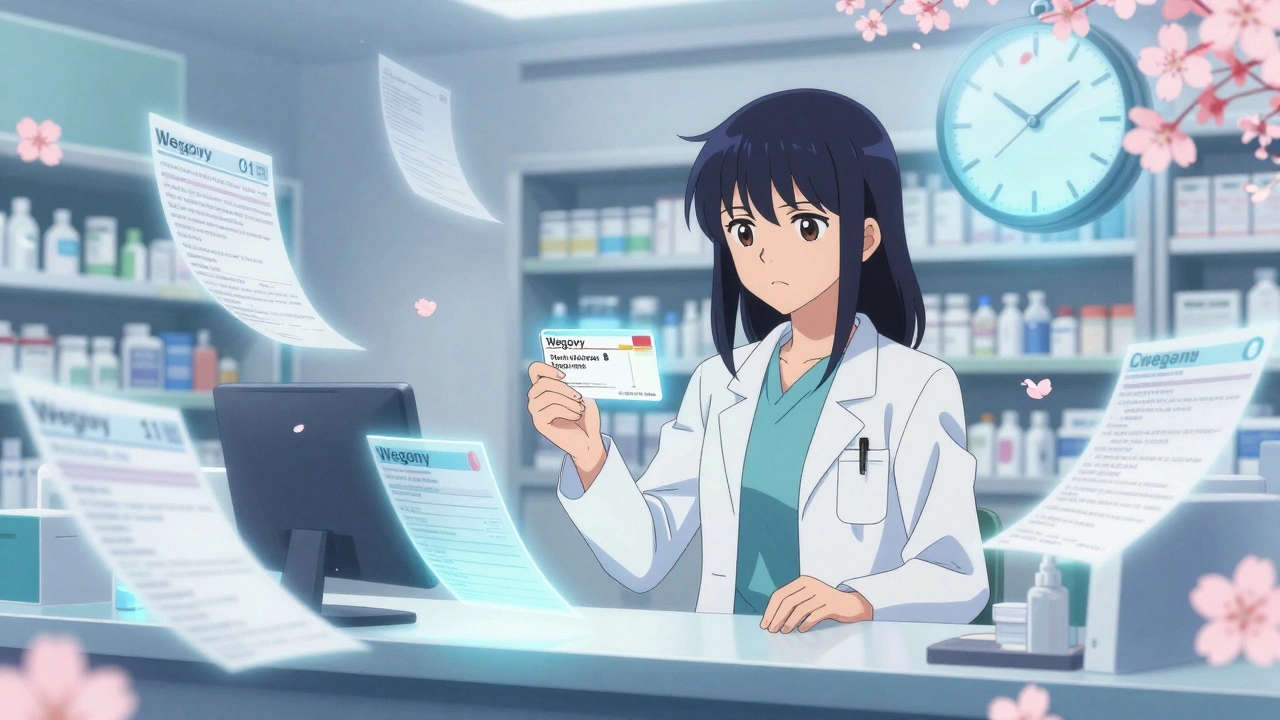
When a pharmacist fills a prescription for a brand-name drug like Wegovy or Humira, they don’t just hand it over. Behind the counter, there’s a hidden battle-insurance companies demanding proof that cheaper generic alternatives failed first. This isn’t bureaucracy for the sake of bureaucracy. It’s a system called prior authorization, and it’s reshaping how medications reach patients. For pharmacists, it’s not just about counting pills anymore. It’s about navigating a maze of rules, deadlines, and paperwork that can delay care-or stop it altogether.
Why Generic Alternatives Trigger Prior Authorization
Insurance companies don’t refuse brand-name drugs because they’re evil. They do it because generics cost 80% less and work just as well. The FDA requires generics to have the same active ingredient, strength, dosage form, and route of administration as the brand. That’s not theory-it’s science. And yet, insurers still require doctors to prove the generic didn’t work before approving the more expensive option. This is called step therapy. In 2023, 97% of commercial insurers required prior authorization for brand-name drugs when a generic was available. Medicaid programs? 100%. The goal? Cut costs. The reality? It creates delays, confusion, and sometimes, patients who give up on treatment entirely.The Seven-Step Process Pharmacists See Every Day
Here’s what actually happens when a brand-name prescription hits the pharmacy:- Prescription arrives. The pharmacist checks the formulary. Is there a generic? Yes. Is prior authorization required? Usually.
- Documentation gap. The doctor’s note says “prescribe as directed.” No mention of failed generics. No lab results. No symptom logs.
- Phone call to the prescriber. “Did the patient try metformin for six weeks? What was their HbA1c?” Most clinics don’t track this. The pharmacist becomes the detective.
- Submission. The request goes in-electronically if lucky, by fax if not. Electronic submissions get approved 78% faster than fax.
- Waiting. Cigna says 5-10 business days. UnitedHealthcare says 7-14 calendar days. But what if the patient needs the drug tomorrow?
- Denial. 41% of initial requests get rejected. Why? Incomplete documentation. Missing ICD-10 codes. No proof the patient tried two generics.
- Appeal. Now the pharmacist has to re-submit with more records. Sometimes it takes weeks.
How Insurers Set the Rules-And Why They Vary
Not all insurers play by the same rules. Aetna might require a 14-day trial of a generic before approving the brand. UnitedHealthcare demands 30 days. Medicare Part D plans average 18.7% of brand-name prescriptions requiring prior authorization. Commercial plans? 32.4%. Some insurers use “gold carding”-a system where providers with a 95%+ approval rate get automatic approvals. Sounds fair, right? But here’s the catch: only 29% of eligible providers even know they qualify. Most pharmacists don’t know which doctors are gold-carded. So they waste time submitting requests that could be auto-approved. Specialty drugs are the worst. In oncology, 94% of brand-name treatments require prior authorization when a biosimilar exists. That’s not just paperwork-it’s life-or-death timing.
The Hidden Cost: Time, Stress, and Burnout
A 2024 JAMA Internal Medicine study calculated that prior authorization costs U.S. providers $13.4 billion a year in wasted time. Sixty-three percent of that time is spent on generic alternative requests. One physician on Sermo, a doctor-only forum, reported spending 14.6 hours a week just on prior authorizations. That’s almost two full workdays. Pharmacists aren’t exempt. They’re the ones calling clinics, chasing records, explaining denials to patients, and re-filing forms. And it’s getting worse. The average prior authorization request for a complex condition like multiple sclerosis requires 7.3 pages of documentation. No one has time for that.What Works: Real Strategies That Cut Through the Noise
Pharmacists aren’t powerless. Here’s what actually moves the needle:- Submit 14 days before the script is needed. Waiting until the last minute guarantees delays.
- Document failure with numbers. Saying “the patient didn’t respond” gets denied. Saying “HbA1c dropped from 8.2 to 7.9 after 8 weeks on metformin” gets approved. 87% of approvals come with specific, measurable failure criteria.
- Use payer-specific templates. Every insurer has its own form. Using the right one cuts denials by 37%.
- Go electronic. Fax requests take weeks. ePA systems like CoverMyMeds get 83% of straightforward cases approved the same day.
- Know who’s gold-carded. Ask clinics. Check insurer portals. It saves hours.
- Designate a prior auth coordinator. Practices that assign one person to handle this cut processing time by 52%.

What’s Changing in 2026-And Why It Matters
Big changes are coming. Starting January 1, 2026, Medicaid managed care plans must respond to standard prior authorization requests within seven calendar days. For urgent cases? 72 hours. They also must explain every denial in writing. The CMS Interoperability and Prior Authorization Rule (CMS-0057-P) will require real-time benefit tools to show prior authorization requirements at the moment a doctor writes a prescription. That means no more surprises at the pharmacy. And AI is stepping in. Health systems are testing tools that auto-fill prior auth forms using patient records. Early results show a 44% drop in submission time. By 2027, all major payers will use FHIR-based APIs to share data instantly. That could bring approval times down to under 24 hours.The Bottom Line: It’s Not About Saving Money-It’s About Saving Time
The argument for prior authorization sounds good: use generics to save money. But the data shows something else. Patients delay or skip care. Clinics burn out. Pharmacists become case managers instead of medication experts. The real win isn’t cutting $50 off a drug price. It’s getting the right medicine to the right patient, on time, without a five-page form. For pharmacists, the path forward is clear: know the rules, document like a scientist, use technology, and push back when the system fails patients. Because at the end of the day, this isn’t about insurance policies. It’s about whether someone gets better-or just gives up.Why do insurance companies require prior authorization for generic alternatives?
Insurance companies require prior authorization for generic alternatives to enforce step therapy-meaning patients must try and fail on cheaper, equally effective generics before getting approved for more expensive brand-name drugs. This is meant to control costs, but it often creates delays and administrative burdens without improving health outcomes.
How long does prior authorization for a generic alternative typically take?
Processing times vary by insurer. Cigna allows 5-10 business days, UnitedHealthcare 7-14 calendar days. Starting January 1, 2026, Medicaid plans must respond within 7 calendar days for standard requests and 72 hours for urgent cases. Electronic submissions (ePA) can get approvals in the same day.
What documentation is needed to get prior authorization approved?
You need clear evidence that the generic alternative failed. This includes specific metrics: e.g., “HbA1c remained above 8.0 after 8 weeks on metformin,” or “migraine frequency decreased by only 15% after 4 weeks on ibuprofen.” Vague statements like “patient didn’t respond” are routinely denied. ICD-10 and CPT codes must also be included.
What happens if a prior authorization is denied?
If denied, the pharmacy or provider can appeal. The insurer must provide a written reason for denial. Many denials are due to incomplete documentation, so resubmitting with more detailed clinical evidence often leads to approval. In 2023, CMS found 17.3% of denials were medically inappropriate, meaning patients were wrongly denied care.
Are there ways to avoid prior authorization delays?
Yes. Submit requests at least 14 days before the medication is needed. Use electronic prior authorization (ePA) instead of fax. Use payer-specific templates. Document failure with measurable data. Know which prescribers are “gold-carded” for automatic approvals. Practices that assign a dedicated staff member to handle prior auth see 52% faster processing.
Is prior authorization for generics going away?
No, but it’s changing. New rules in 2026 will force faster decisions and clearer denials. AI tools and real-time benefit checks will reduce surprises. Some experts argue for automatic approval of FDA AB-rated generics-those proven to be therapeutically equivalent-without prior authorization. That change is being debated, but not yet implemented.
How do pharmacists help patients navigate prior authorization?
Pharmacists act as advocates and coordinators. They contact prescribers to gather missing documentation, explain requirements to patients, track submission status, file appeals, and suggest alternative medications when possible. Many pharmacists now maintain logs of insurer requirements and approval timelines for their most common prescriptions.
![Alkeran (Melphalan) Guide: Uses, Dosage, Side Effects, Safety [2025]](/uploads/2025/08/thumbnail-alkeran-melphalan-guide-uses-dosage-side-effects-safety.webp)



Deborah Andrich
I've seen patients cry because they couldn't get their meds on time. One woman with MS skipped her dose for 3 weeks because the insurer kept denying her biosimilar approval. She ended up in the ER. This isn't policy. It's cruelty wrapped in bureaucracy.
Pharmacists are the unsung heroes here. They're doing the work of case managers, therapists, and detectives all while getting paid minimum wage for the emotional labor.
Stop calling it 'cost control'. It's cost shifting onto the most vulnerable.
And yeah I'm angry. You should be too.
Tommy Watson
lol why do we even bother with generics if we gotta jump through 7 flaming hoops to get em? insurance companies are just trying to make us all hate healthcare.
my aunt got denied for humira 3 times. she gave up. now she’s on disability. thanks, blue cross.
also who the fuck writes 7 page forms for a pill???
Donna Hammond
Let me be clear: prior authorization isn’t the problem. The lack of standardized, interoperable systems is.
Every insurer has a different form, different codes, different deadlines. That’s not efficiency-that’s chaos.
The solution isn’t to abolish PA-it’s to automate it with FHIR APIs and EHR integration. We already have the tech.
Pharmacists shouldn’t be data entry clerks. We need AI to auto-populate ICD-10 and lab values from existing records.
And yes-gold carding should be mandatory knowledge. If a provider has a 95% approval rate, their requests should be auto-approved. Period.
This isn’t theoretical. UPMC cut approval time from 9 days to 2.1. It’s possible. We just need leadership to stop treating this like a paperwork game.
Willie Onst
man i remember when you just walked into the pharmacy and got your meds. no forms, no calls, no waiting.
now it’s like applying for a loan just to get your diabetes pills.
we’re not saving money-we’re just making everyone sadder and more tired.
also i love how insurers act like generics are ‘less effective’ when they’re literally the same damn chemical.
smh. i’m just glad my pharmacist is a saint.
Shelby Ume
As a clinical pharmacist with 14 years in community practice, I can confirm the 67% abandonment rate cited in the study is conservative. I’ve had patients tell me they’d rather pay out-of-pocket than deal with the system.
Step therapy protocols are not evidence-based-they’re budget-based.
The 2026 Medicaid rule change is a start, but it doesn’t touch commercial insurers who control 70% of prescriptions.
Until we mandate real-time benefit checks at the EHR level, we’re just rearranging deck chairs on the Titanic.
Pharmacists need legal standing to advocate directly for patients in appeals-not just as intermediaries, but as licensed clinicians with prescribing authority in these cases.
It’s time we stop treating pharmacists like administrative assistants and start recognizing them as frontline care providers.
Jade Hovet
OMG YES!! I work at a pharmacy and this is my LIFE 😭
just yesterday a kid with migraines had to wait 11 days for his triptan because the doc didn’t document the 3 failed OTC trials 😫
we use CoverMyMeds now and it’s a GAME CHANGER 💪
also-please stop faxing. I’m not 80. I’m 26 and I have carpal tunnel from faxing.
we need more ePA. less paperwork. more hugs for pharmacists. 🤗❤️
nithin Kuntumadugu
they’re lying. generics aren’t equal. they use different fillers. big pharma owns the FDA. you think they’d let a $2 pill replace a $500 one? nah. this is all a psyop to make you dependent on their patented drugs.
the ‘72 hour rule’? fake news. they’ll just delay it another way.
watch: next they’ll say ‘your blood test isn’t certified by our lab’.
they want you sick. they want you broke. they want you begging.
they own the system. and we’re just rats in their maze.
Harriet Wollaston
I’m a mom of a kid with juvenile arthritis. We’ve been through 4 prior auth denials for Humira.
Every time I had to call the doctor at 10pm to beg for a note.
My pharmacist stayed late three nights in a row to get it through.
She didn’t get paid extra. She didn’t get a thank you card.
But she kept going.
That’s the real hero here.
And we need to fix this so no other family has to cry in a pharmacy aisle.
Cole Newman
you guys are all missing the point.
the real issue is that doctors don’t document properly. if they wrote ‘patient failed metformin at 1000mg for 8 weeks with HbA1c 8.1’ instead of ‘patient didn’t respond’, none of this would happen.
it’s not the insurance’s fault. it’s the docs being lazy.
also why do pharmacists think they’re entitled to be case managers? that’s not in their job description.
stop blaming the system. blame the people who don’t do their job right.
Casey Mellish
As an Aussie pharmacist who’s seen this mess up close, I can say-this is uniquely American.
Here in Oz, we have the PBS. If it’s on the list, you get it. No forms. No faxing. No waiting.
Generics? Approved automatically. Brand names? Only if clinically necessary.
Costs are lower. Outcomes are better. Patients aren’t traumatized.
It’s not magic. It’s just common sense.
Stop pretending bureaucracy is innovation. It’s just broken.