
Every day, over 90% of prescriptions filled in the U.S. are for generic drugs. That means pharmacy technicians are handling generic medications more often than brand-name ones. But knowing the difference between metformin and Glucophage, or atorvastatin and Lipitor, isn’t just helpful-it’s life-or-death. A mix-up can lead to wrong dosages, dangerous interactions, or even death. That’s why generic drug competency isn’t a nice-to-have skill-it’s the foundation of safe pharmacy practice.
Why Generic Drug Knowledge Matters More Than Ever
Generic drugs aren’t cheaper because they’re less effective. They’re cheaper because the patent expired. But that doesn’t make them easier to identify. Many generics look completely different from their brand-name counterparts. A blue oval pill today might be a white capsule tomorrow, if the manufacturer changed. And with 15 to 20 new generic drugs hitting the market every month, even experienced technicians can get caught off guard.
The stakes are high. According to the Institute for Safe Medication Practices, about 10-15% of medication errors linked to pharmacy technicians involve confusion between generic and brand names. These errors contribute to roughly 7,000 preventable deaths each year in the U.S. That’s not a statistic-it’s a pattern. And it’s avoidable.
The FDA, PTCB, and VA all agree: if a pharmacy technician can’t confidently identify a generic drug by name, strength, and appearance, they shouldn’t be handling prescriptions. That’s not opinion. It’s policy.
What the Major Certification Bodies Require
If you’re training to become a certified pharmacy technician, you need to know exactly what’s expected. The Pharmacy Technician Certification Board (PTCB) sets the standard for most states. Their 2026 exam now dedicates 18% of its content to generic drug knowledge-up from 14% just two years ago.
Here’s what the PTCB expects you to know:
- Generic and brand names of the top 200 most prescribed drugs
- Drug classifications (e.g., ACE inhibitors, SSRIs, statins)
- Therapeutic duplication risks (e.g., taking two different drugs that do the same thing)
- Strengths and dosage forms (e.g., 10 mg tablet vs. 20 mg extended-release)
- Physical appearance: color, shape, imprint codes
The National Healthcareer Association (NHA) has a slightly lower bar-150 drugs for the ExCPT exam. But in hospitals, the standards are stricter. The American Society of Health-System Pharmacists (ASHP) requires technicians to know high-alert medications cold: insulin, heparin, warfarin, and opioids. Mistakes here aren’t just errors-they’re catastrophes.
The Department of Veterans Affairs (VA) has the most rigorous requirements. Their HT38 standard demands that technicians identify 100% of Schedule II-V controlled substances by both generic and brand name. And starting in January 2025, VA pharmacy techs must pass a quarterly competency test with 90% accuracy on 100 randomly selected drugs from a 300-item list.
The Real-World Skills You Need to Build
Memorizing lists isn’t enough. You need to recognize drugs fast-even when the label is smudged, the bottle is unfamiliar, or the system is down.
Here’s what works for top performers:
- Group by therapeutic class: Don’t memorize drugs one by one. Learn them in families. For example: all statins end in “-statin” (atorvastatin, rosuvastatin, simvastatin). All SSRIs end in “-oxetine” or “-pram” (fluoxetine, sertraline, escitalopram). This helps you guess correctly even if you forget a name.
- Use visual cues: Many techs swear by imprint codes and pill colors. A yellow, oval pill with “10” and “A” on it? That’s 10 mg amoxicillin. A white, round pill with “20” and “C” on it? That’s 20 mg citalopram. Apps and flashcards with photos help build this skill.
- Practice with look-alike/sound-alike pairs: The ISMP lists 37 dangerous pairs. Hydroxyzine (an antihistamine) vs. hydralazine (a blood pressure drug). Glipizide (for diabetes) vs. glyburide (also for diabetes). One letter off can mean a wrong drug. Drill these until you can spot them in your sleep.
- Learn the formulary: Hospitals and insurers have lists of preferred generics. Knowing which ones your pharmacy covers saves time and prevents claim denials.
One tech on Reddit, who goes by ‘GenericGuru’, shared a trick: “I sort drugs by color and shape. Blue pills? Likely antidepressants. Red ones? Often blood pressure meds. It’s not perfect, but it cuts my lookup time in half.” That’s the kind of practical thinking that saves lives.

How Training Programs Are Adapting
Community colleges and online training programs have adjusted. Most now include 35-40 hours of dedicated drug identification training within their 1,200-hour certification programs. The “Top 200 Drugs” list is the gold standard. But here’s the catch: many still teach it as a static list.
The problem? The market doesn’t stand still. A drug you studied last year might have a new manufacturer, a different imprint, or even a new generic name. In 2024, a survey of 2,315 technicians found that 57% had to relearn at least five drugs they thought they knew after certification.
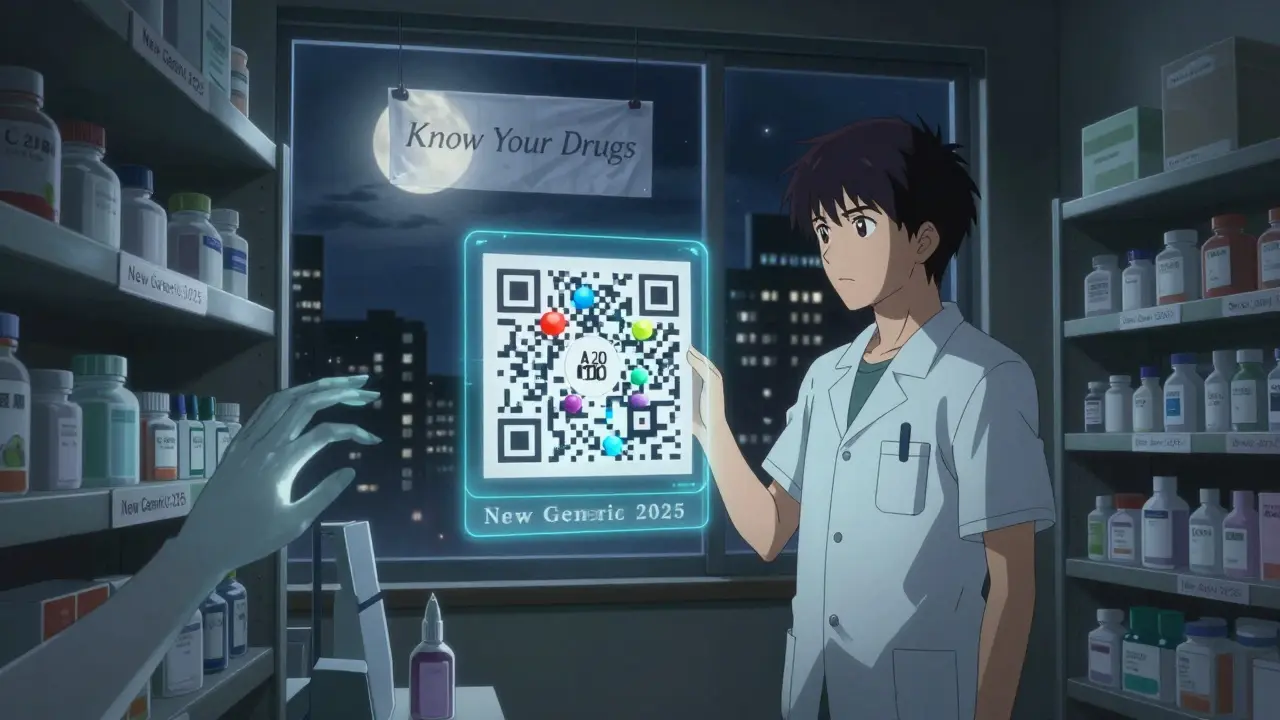
Leading institutions are responding. The VA updates its drug reference guides quarterly. Walmart rolled out AI-powered training in 2024 that adapts to new drugs in real time, reducing onboarding time by 35%. Other pharmacies are using QR codes on drug cards that link to updated images and manufacturer info.
But not all pharmacies are this advanced. Nearly half of independent pharmacies still rely on printed pocket guides updated only once a year. That’s a gap-and a risk.
What Happens When Techs Don’t Get It Right
It’s not theoretical. A 2023 University of Utah study tracked 1,247 pharmacy technicians across 42 pharmacies. Those who scored below 70% on generic drug identification tests made 3.2 times more errors in prescription processing than those who scored above 85%.
And the financial cost? Dr. Lucinda Maine told Congress in March 2025 that inadequate generic drug knowledge costs the U.S. healthcare system $2.4 billion a year. That’s not just wasted money-it’s wasted time, repeated hospital visits, and preventable harm.
On the flip side, pharmacies where technicians scored above 90% on drug ID tests saw 22% fewer dispensing errors, according to the National Community Pharmacists Association. That’s not just good practice-it’s good business.
What’s Changing in 2025 and Beyond
The rules are tightening. The PTCB is adding biosimilars to the exam. These are complex, biologic drugs that mimic brand-name treatments like Humira or Enbrel. Their names are longer and harder to remember-think “adalimumab-atto” instead of just “Humira.”
Some experts, like Dr. Jerry Fahrni from the University of Minnesota, argue we’re over-relying on memorization. “We should be teaching pharmacologic classes, not flashcards,” he says. “If you know that all beta-blockers lower heart rate, you can reason your way through most substitutions.”
By 2030, experts predict competency standards will include pharmacogenomics-how a patient’s genes affect how they respond to a generic drug. That’s the future. But right now, the priority is simple: know your drugs.
How to Build Your Generic Drug Fluency
If you’re studying for the PTCB, ExCPT, or just starting out, here’s your roadmap:
- Start with the Top 200 drugs. Use PTCBTestPrep or RxTechExam’s free lists.
- Break them into 20-drug chunks. Master one group per week.
- Use flashcards with photos of the actual pills-not just names.
- Test yourself daily. Even 10 minutes helps.
- Join a study group. Talking through drug classes reinforces learning.
- After you pass, keep reviewing. Subscribe to the FDA’s Orange Book updates.
Don’t wait until exam day to care. Every time you confirm a generic name, you’re preventing a mistake. That’s the job.
FAQ
Why do pharmacy technicians need to know generic drug names if pharmacists check everything?
Pharmacists don’t catch every error. Technicians are the first line of defense-they pull, count, label, and verify prescriptions before they reach the pharmacist. If a technician grabs the wrong generic because they confused two similar names, the pharmacist might miss it, especially during busy hours. The system relies on multiple checks. One weak link can break the chain.
Is it enough to just memorize the top 100 drugs?
No. While the top 100 cover about 70% of prescriptions, the remaining 30% include high-risk drugs like insulin, anticoagulants, and psychiatric medications. Missing one of those can be deadly. The PTCB and VA both require knowledge of 200+ drugs for a reason. Start with the top 100, but don’t stop there.
What if a generic drug changes its appearance after I’ve learned it?
That happens often. Generic manufacturers change suppliers, packaging, or imprint codes. Always double-check the National Drug Code (NDC) on the label and compare it to your pharmacy’s database. Never rely on how a pill looks alone. Use the NDC as your anchor. If you’re unsure, ask the pharmacist.
Do I need to know international generic names?
In the U.S., you only need to know the FDA-approved generic names. International names like “paracetamol” (acetaminophen) or “furosemide” (Lasix) are rarely used here. But if you’re working in a pharmacy that dispenses imported medications, learn the U.S. equivalents. Always confirm with your pharmacist if you’re unsure.
How often should I review generic drug names after certification?
At least once a month. The FDA approves new generics constantly. Set a weekly reminder to review 10 new or changed drugs. Use free resources like the FDA’s Orange Book or the PTCB’s monthly updates. Even 15 minutes a week keeps you sharp. This isn’t just for exams-it’s for patient safety.



Stewart Smith
Man, I’ve seen techs grab hydroxyzine instead of hydralazine and just shrug like it’s no big deal. We’re not selling candy here.
Aaron Bales
Start with the top 200. Group by class. Use pill images. Test yourself daily. That’s it. No fluff. Do this and you’ll never mix up a script again.
Sara Stinnett
Oh, so now we’re treating pharmacy techs like human drug dictionaries? Brilliant. Next they’ll require us to recite the chemical structures of every SSRI while blindfolded. The FDA’s Orange Book isn’t a novel, it’s a reference guide. Stop memorizing. Start understanding. But hey, if you like flashcards, by all means-keep drowning in them.
Brandon Boyd
Just started my PTCB prep last week and this post hit different. I used to think memorizing was boring-until I saw a coworker almost give a patient gabapentin instead of gabapentin enacarbil. No joke. That’s when I started using flashcards with pictures. Now I quiz myself while brushing my teeth. Small steps, big saves.
Retha Dungga
life is a loop 🔄 drugs change colors but the soul of the pill stays the same 💊✨ know the class not the shape 🌱
Martin Viau
Why does the U.S. even bother with generics? Canada just uses the brand names and charges less. This whole system is a bureaucratic circus. We’re overcomplicating a simple task because someone in Washington decided ‘efficiency’ meant memorizing 300 pill imprints.
Darren Pearson
The notion that pharmacy technicians require rote memorization of pharmaceutical nomenclature reflects a fundamental misunderstanding of clinical pharmacology. The true competency lies in pharmacodynamic reasoning, not visual recall of pill imprints. One cannot reasonably expect human memory to be a dynamic database in an environment where formulations change monthly. The PTCB’s approach is archaic and dangerously reductionist. We must transition to algorithmic decision-support systems integrated directly into dispensing workflows.
Furthermore, the assertion that visual cues like color and shape are reliable is empirically unsound. A 2023 JAMA study demonstrated a 63% misidentification rate among technicians relying on morphology alone. This is not training-it’s gambling with patient lives.
Let us not mistake procedural compliance for clinical competence. The future of pharmacy lies in AI-assisted verification, not flashcards.
Branden Temew
So if I know that all -statins lower cholesterol… does that mean I can just hand out any statin and call it a day? Because that’s what this feels like-teaching people to guess instead of know. What’s the difference between being smart and being lucky? One’s a skill. The other’s a roll of the dice.
And yet… I get it. We’re asking people to hold the weight of a system that’s designed to move fast and break things. Maybe the real problem isn’t the techs. Maybe it’s the system that expects them to be perfect.
Robb Rice
i’ve been a tech for 11 years and i still check the ndc every time. even if i’ve seen the pill a hundred times. because one day, it’ll be different. and someone’s life will depend on me not assuming. thanks for the reminder. 🙏
Emma Hooper
Let’s be real-half the pharmacies still use those laminated paper cheat sheets from 2018. I saw one that listed ‘Lipitor’ as ‘atorvastatin 10mg’ and had a photo of a pink pill… which is actually the 20mg version. And the tech? She didn’t even blink. This isn’t about training. It’s about laziness dressed up as tradition.
linda permata sari
OH MY HEART. I just watched my cousin almost give a patient warfarin instead of rivaroxaban because the pills looked similar. She cried for an hour. We need more than flashcards-we need heart. We need to see the faces behind the prescriptions. Every pill is someone’s quiet hope. Don’t let them down.
Jenny Salmingo
my mom’s a pharmacy tech in rural texas. she says the hardest part isn’t the drugs-it’s the people who think ‘generic’ means ‘fake.’ i tell her she’s a hero. she says she’s just doing her job. but she’s saving lives every day. ❤️