
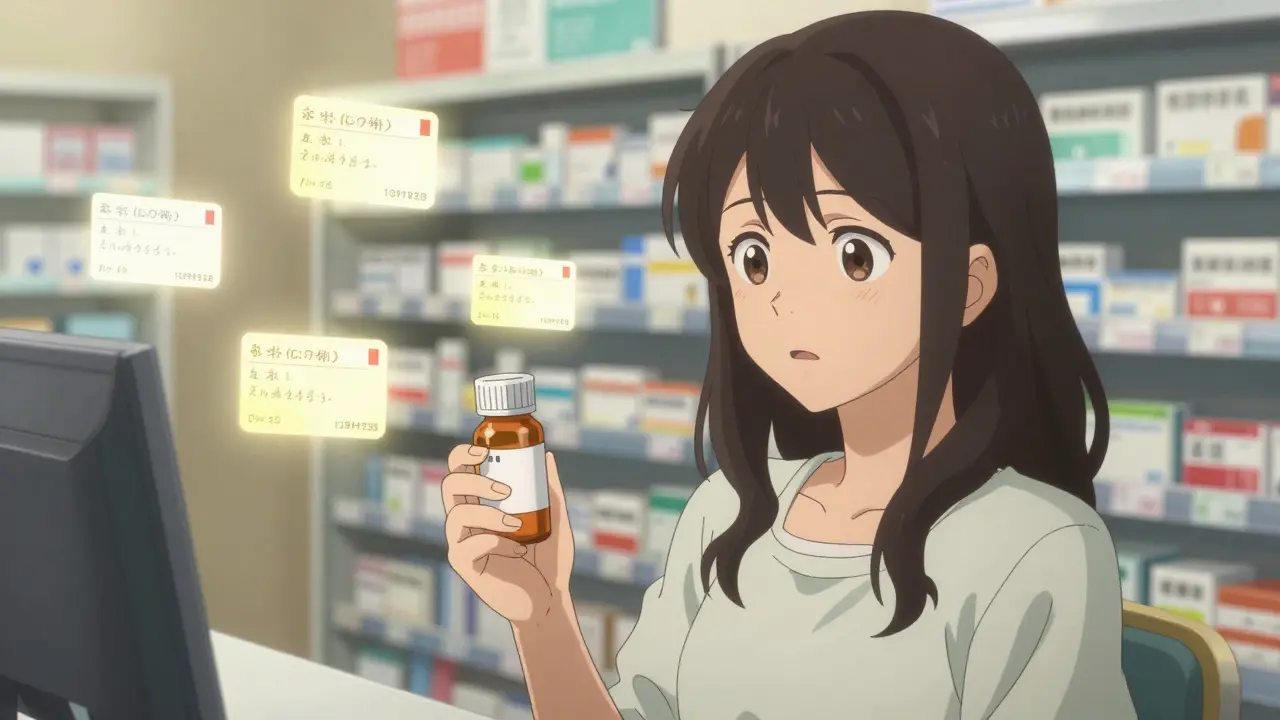
Every time you pick up a prescription, you’re holding a safety document that could prevent a serious mistake-or cause one if you don’t read it right. In 2022, U.S. pharmacies filled nearly 5 billion prescriptions. That’s 5 billion chances for something to go wrong. And according to the FDA, 22% of medication errors happen because patients misunderstood their prescription labels.
It’s not about being careless. It’s about complexity. Labels have tiny print, medical jargon, abbreviations, and details buried on the back. A 2021 study found only 42% of U.S. patients correctly understood their labels. Compare that to Germany, where standardized formats helped 63% get it right. The difference? Clarity.
What’s on Your Prescription Label? The 9 Must-Check Items
Your label isn’t just a receipt. It’s a legal document with nine mandatory pieces of information. If any are missing or unclear, ask. Here’s what to look for:
- Patient name - Is it spelled right? A mix-up between "Anna Smith" and "Ann Smith" has led to fatal errors.
- Prescriber name - Who ordered this? Make sure it’s your doctor, not someone else’s.
- Drug name - Both brand (like "Lipitor") and generic ("atorvastatin") should be listed. If only the brand is there, ask why.
- Strength - Is it 10 mg or 100 mg? A 10x difference can be deadly.
- Dosage form - Tablet? Capsule? Liquid? If you expected a pill but got a liquid, double-check.
- Quantity - How many pills are you getting? If you were told 30 but got 60, ask why.
- Directions for use - "Take one by mouth daily" is clear. "Take q.d."? That’s Latin for daily-but not everyone knows that.
- Number of refills - How many times can you get more? Some meds need prior authorization after the first refill.
- Pharmacy contact info - Can you call them if something’s confusing? Save the number.
These aren’t suggestions. These are federal requirements under the National Association of Boards of Pharmacy. If any of these are missing, the pharmacy is out of compliance.
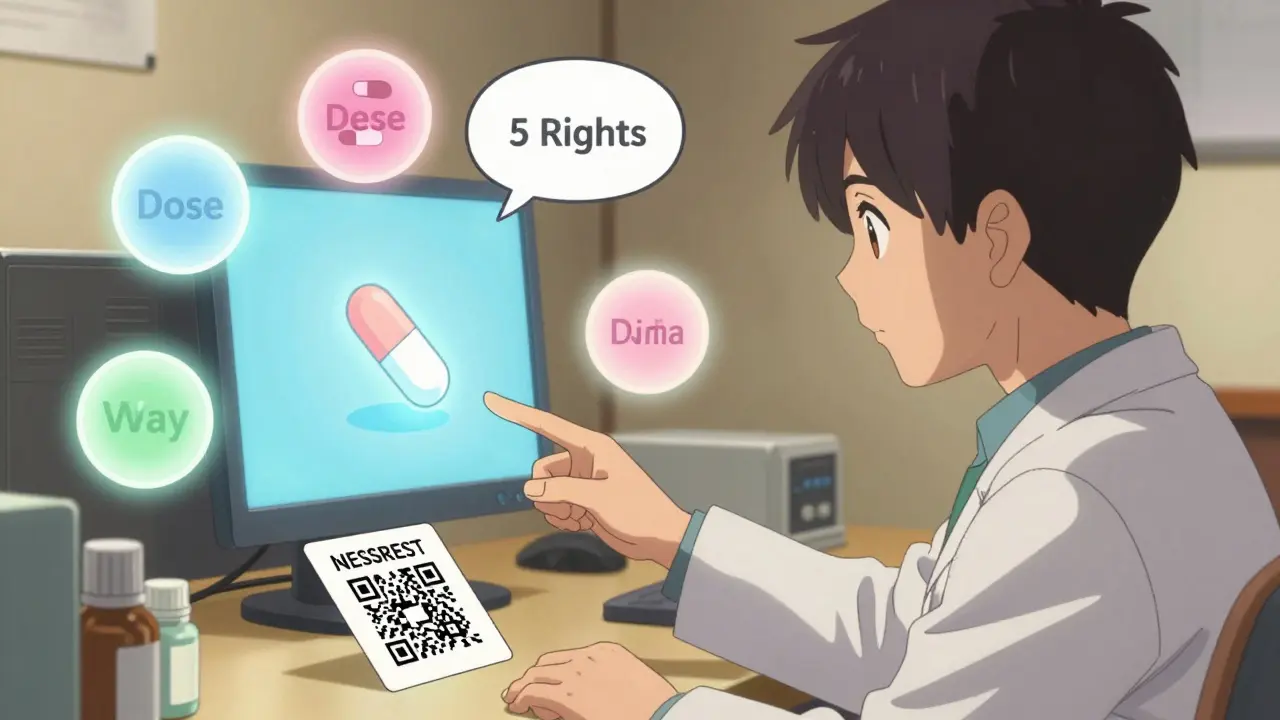
Ask About the "5 Rights" - Your Personal Safety Checklist
Healthcare professionals use the "5 Rights" system to avoid errors. You should too. Before you leave the counter, run through them:
- Right Patient - Is your name on the label? Not your spouse’s, not your child’s.
- Right Medicine - Does the drug look like what your doctor described? If you’ve taken this before, does it look the same? Color, shape, markings? If not, ask.
- Right Amount - Is the dose correct? A blood pressure pill at 25 mg instead of 12.5 mg can send your heart into distress.
- Right Way - Is it swallowed? Injected? Applied to skin? Some meds can’t be crushed or taken with food.
- Right Time - Once a day? Before bed? With meals? Timing affects how well it works.
A 2022 report from the American Society of Health-System Pharmacists found patients who verified all five rights reduced medication errors by 58%. That’s not luck. That’s active participation.
Storage Matters More Than You Think
You wouldn’t leave milk out all day. Why treat your medicine differently?
According to a 2022 survey by the American Pharmacists Association:
- 78% of prescriptions need room temperature storage (68-77°F / 20-25°C)
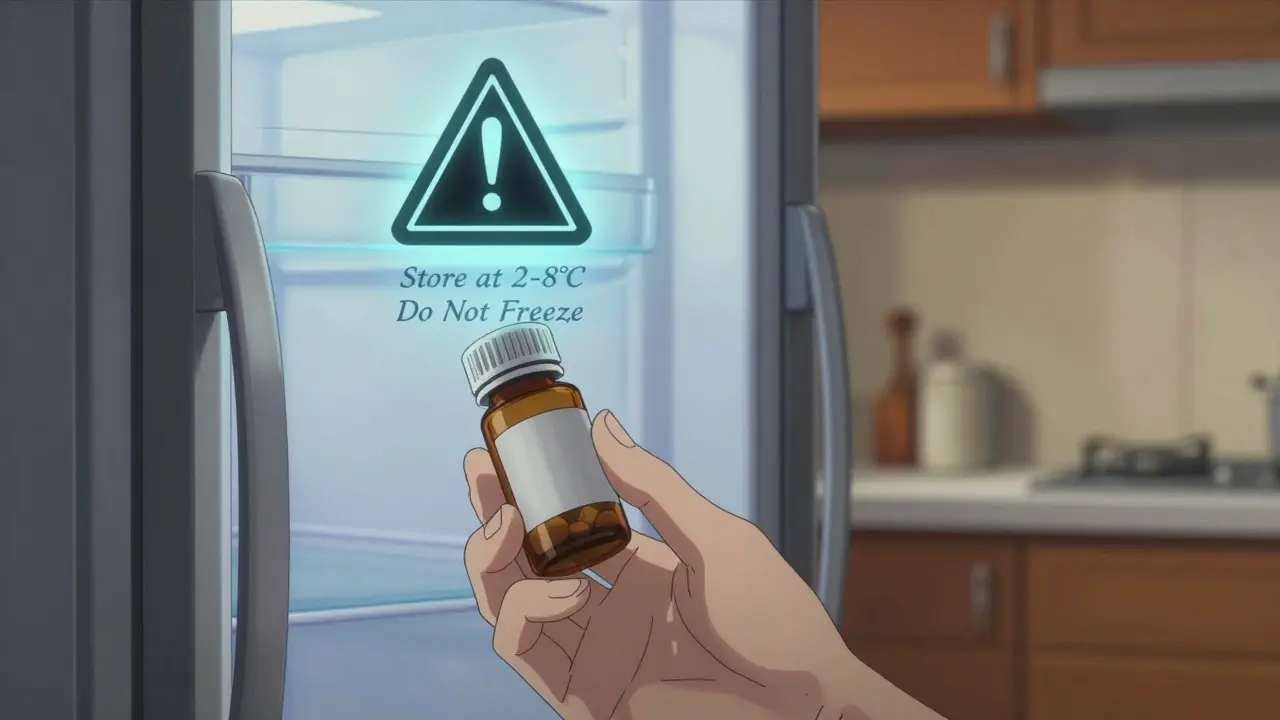
- 15% must be refrigerated (36-46°F / 2-8°C)
- 7% need special handling - like keeping them dry or away from light
Insulin, some antibiotics, and hormone treatments like estrogen often need cold storage. One Reddit user shared: "I kept my blood pressure med on the counter for two weeks because the tiny print on the back said 'store below 77°F.' I thought that meant 'don’t put it in the freezer.'"
Ask: "Does this need to go in the fridge?" And if yes, ask where in the fridge. Some meds can’t be near the freezer compartment.
What About Refills and Expiration Dates?
Don’t assume your refill count is correct. Sometimes, your doctor limits refills to check your progress. Other times, insurance changes what’s covered.
Check the expiration date. The FDA says meds are safe and effective until that date-if stored right. But if you’ve had the bottle for over a year, even if it’s not expired, ask if it’s still good. Some antibiotics lose potency fast.
Also, ask: "Can I get a smaller supply if I’m not sure this works for me?" Many pharmacies now offer 7-day or 14-day starter packs for new meds. That saves money and reduces waste if you have side effects.
Special Warnings and Medication Guides
Some drugs come with a separate printed guide called a Medication Guide. The FDA requires this for 107 high-risk medications as of 2023, including opioids, blood thinners, and isotretinoin (for acne).
These guides explain serious risks: birth defects, liver damage, suicidal thoughts. But they’re often tucked inside the bag. Don’t skip them.
Ask: "Do I get a Medication Guide for this?" If they say no, ask why. If you’re getting a controlled substance, you should.
Also look for warning symbols. A black box warning? That’s the FDA’s strongest alert. It means the drug can cause serious or life-threatening side effects. Don’t ignore it.
Language, Vision, and Health Literacy
One in three U.S. adults has trouble reading medical instructions. That’s not about intelligence. It’s about complexity.
If you struggle with small print, ask for a large-print label. 92% of U.S. pharmacies offer this for free.
If English isn’t your first language, ask for translation help. The Affordable Care Act requires pharmacies that take federal funds (like Medicare) to provide free interpretation services.
Don’t be shy. Say: "Can you read this to me slowly?" Or: "Can you explain the directions in simpler terms?"
Pharmacists are trained to help. A 2023 study from the American Association of Colleges of Pharmacy found patients who asked clear questions reduced adverse drug events by 47%.
What’s New in Prescription Labels?
Labels are changing. In 2023, Walgreens started testing augmented reality labels. Point your phone at the bottle, and it shows a video of how to take the pill. It’s still rare-but coming fast.
More pharmacies now use QR codes on labels. Scan it, and you get a video, audio explanation, or safety checklist. A 2022 study showed this cut errors by 31%.
By 2026, the FDA plans to require scannable QR codes on all high-risk medications. This is a big step toward making labels work for everyone, not just those with perfect vision and high literacy.
When to Walk Away
If you’re confused and the pharmacist brushes you off, don’t take the med. Walk out. Call your doctor. Go to another pharmacy.
Independent pharmacies have higher customer satisfaction ratings than big chains. A 2023 Trustpilot analysis showed independent pharmacies averaged 4.3/5 stars for labeling clarity, while CVS and Walgreens scored around 3.1-3.2.
Why? Smaller pharmacies spend more time with each patient. They’re more likely to say: "Let me go over this with you."
Don’t feel bad for asking. The Institute for Safe Medication Practices calls label verification the #1 patient safety tip. You’re not being difficult. You’re being smart.
Final Tip: Make It a Habit
Spending two minutes at the pharmacy counter every time you pick up a prescription can save your life. Here’s your quick checklist:
- Verify your name and the drug name
- Confirm the dose and how to take it
- Check storage needs
- Ask about refills and expiration
- Request a Medication Guide if it’s a high-risk drug
- Ask for large print or translation if needed
You’re not just picking up medicine. You’re taking control of your health. And that’s worth a few extra questions.
Praseetha Pn
Okay but have you seen the new QR code labels? I scanned mine and it played a 3-minute video of a pharmacist screaming at a mannequin to "TAKE IT WITH FOOD OR YOU’LL DIE"-and it was in Spanish, Mandarin, and ASL. I think my pill is now sentient. Also, the pharmacy sent me a text saying "Your blood pressure med is 10x stronger than your ex’s attitude." I didn’t ask for that. #PharmacyHorrorStory
Ryan Otto
It is not merely a matter of patient literacy-it is a systemic failure of regulatory standardization. The FDA’s 22% error rate is statistically insignificant when compared to the 87% of U.S. pharmacies that fail to comply with the NABP’s mandatory labeling protocols. The German model is not merely superior-it is an indictment of American pharmaceutical capitalism, where profit margins dictate font size, not patient safety. This is not negligence. It is design.
Chuck Dickson
Y’all need to stop treating your meds like a mystery box. I teach my elderly neighbors to ask the pharmacist: "Is this the same as last time?" and they’ve avoided three ER trips this year. Seriously-it’s two minutes. You’re worth it. And if the pharmacist rolls their eyes? Go to the one that gives you free gummy bears. #PharmacistWin
Naomi Keyes
Wait-did you just say "q.d."? That’s Latin. You’re telling people to understand Latin abbreviations in 2024? That’s not just unclear-that’s archaic. And the FDA hasn’t mandated plain-language directions? That’s criminal. Also, you didn’t mention that some labels still use "tid" and "qid"-which means nothing to 90% of Americans. This entire post is a band-aid on a hemorrhage.
Dayanara Villafuerte
OMG I just realized my insulin has been chilling next to the leftover lasagna for 3 months 😱 I thought "store below 77°F" meant "don’t freeze it" not "don’t leave it in the sun on the counter" 🤦♀️ I’m going back to the pharmacy with a signed affidavit and a cup of coffee. They owe me.
kenneth pillet
ask for large print if you need it. its free. dont be shy.
Jodi Harding
They don’t want you to ask questions. That’s why the labels are designed to confuse. You’re not paranoid. They’re just profitable.
Zoe Brooks
My grandma reads her labels out loud to her cat before taking them. I used to think it was cute. Now I think it’s the only thing keeping her alive. If you’re not checking your meds like your life depends on it… maybe it should.
Kristin Dailey
Germany doesn’t have this problem because they don’t have Medicaid fraud, fake doctors, or 5000 different pill colors. We’re a mess. Fix the system, not the labels.
Jay Clarke
Let me guess-you think asking questions is "being difficult"? Honey, if your pharmacist can’t explain why your pill looks like a rainbow gumball and tastes like regret, you’re not the problem. The entire American healthcare industrial complex is. I cried reading this. And I don’t cry over pills. Unless they’re lithium. Then I cry every day.
Eric Gebeke
You think this is about labels? No. This is about people who don’t care enough to read them. If you’re too lazy to check your own medicine, you deserve what you get. I’ve been on 12 different prescriptions since 2019. I’ve never made a mistake. Because I’m not a victim. I’m vigilant. And you? You’re just another statistic waiting to happen.