
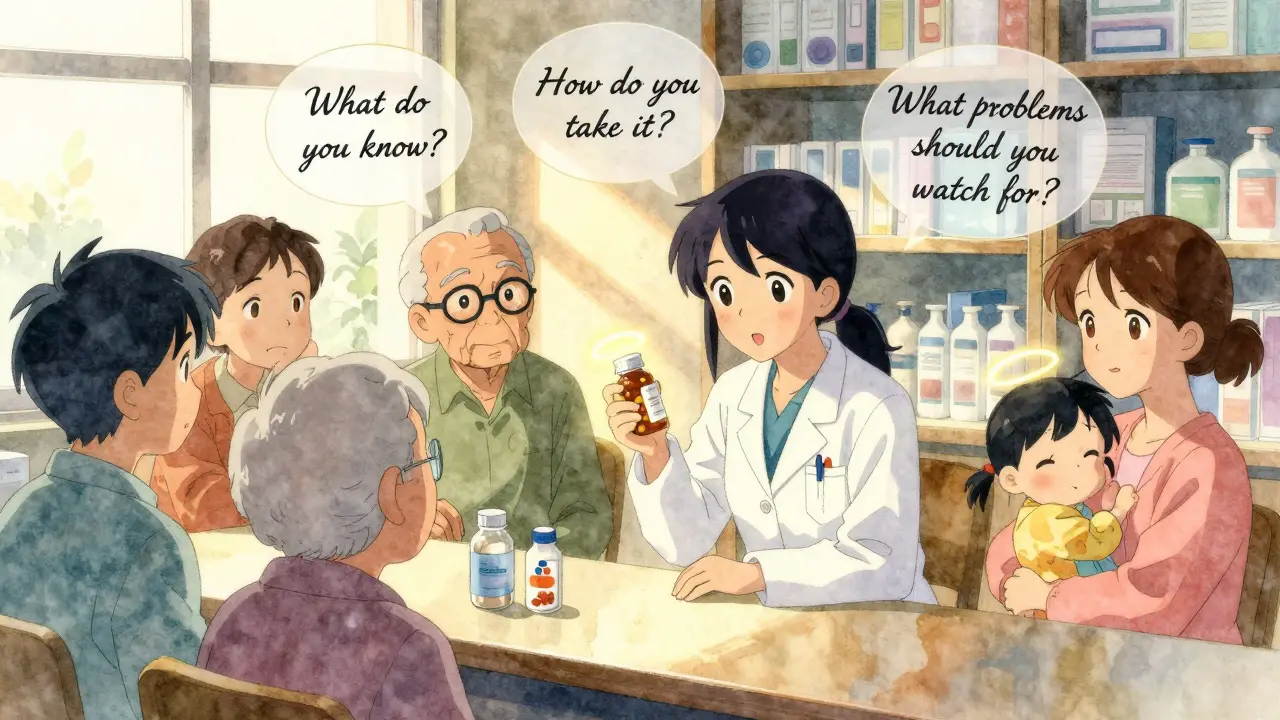
Pharmacists don’t just hand out pills. They’re the last line of defense against medication errors, misunderstandings, and dangerous side effects. But in a busy pharmacy, with 20 patients waiting and a clock ticking, how do you make sure each one walks away with clear, accurate information? That’s where pharmacist counseling scripts come in. These aren’t robotic scripts to read word-for-word. They’re practical, proven frameworks that help pharmacists cover the essentials-every time-without forgetting the human side of care.
Why Scripts? It’s Not About Reading, It’s About Not Missing Anything
Think of a counseling script like a pilot’s checklist. You don’t fly a plane by memory. You check the fuel, the instruments, the weather. Same with medication counseling. The stakes are high: nearly half of all patients don’t take their meds as prescribed. That’s not laziness-it’s confusion. One patient thinks their blood pressure pill is a vitamin. Another stops taking their antibiotic because they feel better after three days. These aren’t rare mistakes. They’re predictable-and preventable.
The push for structured counseling started in 1990 with OBRA ’90. It didn’t just say pharmacists should counsel. It said they must, or they wouldn’t get paid by Medicaid. Suddenly, every pharmacy had to prove they were doing it. That’s when scripts became more than a good idea-they became a necessity.
The Core Three: What Every Script Must Cover
Not all scripts are the same, but the most effective ones, especially for training new pharmacists, follow a simple, powerful pattern borrowed from the Indian Health Service model. It’s not fancy. It’s just three questions that cut through the noise:
- What do you know about this medication? This isn’t a test. It’s a diagnostic tool. If the patient says, “It’s for my heart,” but they’re actually on insulin, you’ve found your first gap.
- How do you take it? Dosage, timing, food rules-this is where most errors happen. “Take one daily” doesn’t mean much if they don’t know if it’s morning or night, with food or on an empty stomach.
- What problems should you watch for? Don’t just list side effects. Focus on the ones that matter: dizziness that could cause a fall, swelling that could mean an allergic reaction, or confusion that could signal a dangerous interaction.
These three questions cover 90% of what patients need to know. And they’re flexible. You can use them in a 2-minute chat at the pickup window or in a 15-minute consultation with a new diabetic patient. The structure stays the same. The depth changes.
What the Law Actually Requires (And What It Doesn’t)
OBRA ’90 set the floor, but states built the ceiling. In 32 states, pharmacists only need to offer counseling. In 18, they’re required to actually do it. California demands detailed notes on what was said. Texas lets you check a box. That’s why a single script won’t work everywhere.
Here’s what’s legally required across most states:
- The name and purpose of the medication
- How to take it (dose, frequency, route)
- How long to take it
- Special instructions (e.g., “don’t drink alcohol,” “take with food”)
- Common and serious side effects
That’s it. No need to explain every possible interaction or dive into pharmacokinetics. Stick to what’s essential. Anything beyond that is value-add, not compliance.
Where Scripts Fall Short (And How to Fix It)
Some pharmacies hand out scripts like instruction manuals and expect pharmacists to read them aloud. That’s a mistake. Patients tune out when they hear a robot. A 2006 study by Dr. Daniel Holdford found that when pharmacists read scripts verbatim, patients remembered less-not more.
The fix? Use the script as a mental outline, not a script. Ask the three questions. Listen. Then respond in your own words. If a patient says, “I thought this was for headaches,” don’t just correct them. Say, “That’s a common mix-up. This is actually for your blood pressure. Let me explain why that matters.”
And always use the teach-back method. After you explain, ask: “Can you tell me how you’ll take this?” If they say, “Take one when I feel bad,” you’ve got more work to do. If they say, “Take one tablet every morning with breakfast, even if I feel fine,” you know they got it.

Special Cases: Opioids, Anticoagulants, and More
Not all meds are created equal. A script for a painkiller is different from one for warfarin.
For opioids, the script must include:
- How to store it safely (away from kids, locked up)
- How to dispose of unused pills (don’t flush them)
- That naloxone is available-free, no prescription needed-in most states
For blood thinners like warfarin:
- Signs of bleeding (bruising, blood in urine, nosebleeds)
- Why you can’t suddenly start taking ibuprofen
- The need for regular INR checks
These aren’t optional. They’re life-saving. And they’re built into specialized training modules used by pharmacies like Walgreens and CVS since 2021.
Technology Is Making Scripts Smarter
Most pharmacies now use electronic systems that auto-trigger counseling prompts when a prescription is filled. Some even have checkboxes for documentation: “Counseling offered,” “Accepted,” “Patient understood.” That’s good. But the best systems are doing more.
Pilot programs at CVS and Walgreens now use AI-assisted tools that adapt the script based on patient responses. If a patient says they’re confused about timing, the system suggests adding a visual chart. If they mention they’re on a tight budget, it prompts the pharmacist to talk about generic alternatives. Early results show a 23% improvement in patient comprehension.
Documentation has also gotten easier. Ninety-two percent of chain pharmacies now use integrated systems that log counseling automatically-no more paper logs, no more last-minute entries.
Training New Pharmacists: The 8-Week Rule
Learning to use scripts well isn’t a one-day workshop. At the University of North Carolina, new pharmacists spend 8 to 12 weeks under supervision before they stop reading scripts and start having real conversations. They start by memorizing the three core questions. Then they practice with role-plays. Then they do real counseling with feedback.
By week 6, most can adapt the structure to fit the patient. By week 10, they’re not thinking about the script anymore. They’re thinking about the person.
Continuing education matters too. The American Society of Consultant Pharmacists recommends 15 hours a year just on counseling skills. That’s not optional. It’s how you stay sharp.

What Works in the Real World
One community pharmacist in Ohio told Pharmacy Times: “The three-question script cut my average counseling time from 4.2 minutes to 2.9. I didn’t lose anything. I gained consistency.”
Another in Florida said: “I used to skip counseling if the patient was in a hurry. Now I use the script as a guide. Even if I only have 90 seconds, I cover the three things. And patients notice. They say, ‘You actually explained it this time.’”
But not all stories are positive. A 2022 survey found 42% of pharmacists felt “script fatigue” when corporate policies forced rigid, one-size-fits-all scripts that ignored patient literacy or cultural context. The solution? Localize. Adapt. Don’t just follow the script-use it as a foundation.
The Bigger Picture: Why This Matters
Medication non-adherence costs the U.S. system $312 billion a year. That’s not just wasted pills. It’s more ER visits, more hospital stays, more lost productivity. Pharmacists using structured counseling reduce non-adherence by up to 30%-according to 2022 IMS Health data.
And it’s not just about money. It’s about trust. When a patient feels heard, when they understand why they’re taking a pill, they’re more likely to stick with it. That’s the real win.
Getting Started: Your First Steps
If you’re a new pharmacist, start here:
- Memorize the three core questions.
- Practice them out loud-even in front of a mirror.
- Use the teach-back method on every patient, even if they say they’re fine.
- Document: Was counseling offered? Accepted? Did the patient understand?
- After 2 weeks, ask yourself: “Did I sound like a robot, or like someone who cares?”
If you’re a pharmacy manager, don’t just hand out a PDF. Train. Role-play. Give feedback. Let pharmacists adapt. The best scripts are the ones that feel natural.
Are pharmacist counseling scripts mandatory by law?
Yes, but it depends on the state. Federal law (OBRA ’90) requires counseling for Medicaid patients. Thirty-two states only require pharmacists to offer counseling, while 18 require actual counseling. California and New York have stricter documentation rules than most. Always check your state’s pharmacy board guidelines.
Can I use the same script for every patient?
No. Scripts are templates, not scripts to read aloud. A 70-year-old with high blood pressure needs different details than a 22-year-old on birth control. Use the core three questions as your anchor, then tailor the rest to the person in front of you. Their age, literacy level, and health history matter more than the script.
What if the patient doesn’t speak English?
Use professional interpreters-never family members. Most pharmacies have access to telephonic or video interpretation services. Pre-translated written materials in over 150 languages are also available through services like Language Access Network. Never assume understanding. Always use the teach-back method, even with an interpreter present.
Do I need to document every counseling session?
Yes. Most states require you to document that counseling was offered, accepted or refused, and your assessment of the patient’s understanding. Electronic systems now auto-fill these fields, but you still need to verify accuracy. Poor documentation can lead to legal risk-even if you did the counseling correctly.
How do I know if my counseling is working?
Track adherence. If a patient refills their prescription on time, they likely understood. Use the teach-back method to check understanding right after counseling. Some pharmacies now use patient surveys or follow-up calls. The real test? Fewer calls to the pharmacy asking, “What’s this pill for?” or “Why do I feel dizzy?”
Final Thought: It’s Not About the Script. It’s About the Person.
Scripts are tools. Not replacements for empathy. The best pharmacists don’t memorize lines. They learn to listen. They ask the right questions. They slow down long enough to make sure someone really understands. That’s what saves lives. Not the script. The person behind it.




Mandy Kowitz
Oh great, another pharmacy checklist disguised as ‘patient care.’ Next they’ll make us sign a waiver before breathing near a pill bottle.
Michael Rudge
Let me guess - the real goal here is to turn pharmacists into compliance robots so corporate can cut staff and still claim they ‘met federal standards.’ OBRA ’90 was never about patients. It was about liability insurance premiums.
Vicki Yuan
This is actually one of the most thoughtful breakdowns of counseling I’ve seen in years. The three-question framework is genius because it’s adaptable - not rigid. I’ve used it with elderly patients, non-native speakers, and even teens on ADHD meds. The teach-back method alone has cut my error rate by half. No script replaces listening, but this gives you a structure so you don’t forget the essentials when you’re swamped.
Also, props to the part about cultural context. A script that doesn’t account for literacy or language isn’t a tool - it’s a trap.
Jennifer Glass
I wonder how many of these scripts actually get used by pharmacists who’ve been doing this for 20 years. Do they even read them? Or do they just nod along because HR says it’s mandatory?
And what about the ones who don’t have time? If you’re doing 40 scripts a day, and each one takes 90 seconds, that’s over an hour of pure counseling. No breaks. No lunch. No bathroom. Is that sustainable?
Maybe the real issue isn’t the script - it’s the system that forces humans to be machines.
Joseph Snow
OBRA ’90 was a federal overreach disguised as patient safety. The entire system is designed to extract more revenue from pharmacies under the guise of ‘care.’ AI-driven counseling prompts? That’s not innovation - it’s surveillance. Every interaction is logged, monitored, and weaponized for audits. This isn’t healthcare. It’s corporate compliance theater.
John Ross
From a clinical pharmacy standpoint, the triad of ‘What do you know? How do you take it? What to watch for?’ is aligned with the WHO’s Medication Safety Framework and the ASHP Guidelines on Patient Counseling. The real value is in standardizing cognitive load reduction for pharmacists operating under high-stress, low-resource environments. The AI integration is particularly promising - dynamic adaptation based on patient feedback leverages behavioral economics principles to improve health literacy retention.
That said, the 23% comprehension gain in CVS/Walgreens pilots is statistically significant (p<0.01), but generalizability remains limited by selection bias in urban chain settings.
jigisha Patel
These scripts are a joke. In India, pharmacists don’t need scripts - they have decades of experience and direct patient relationships. You don’t need a checklist to tell someone not to mix blood thinners with NSAIDs. You need judgment. What you’re describing is infantilizing the profession. This is why American healthcare is so expensive - you outsource critical thinking to paperwork.
Jack Wernet
I’ve been a pharmacist for 18 years. I used to hate scripts. Then I had a patient who died because she didn’t know her new med interacted with her herbal tea. I didn’t miss anything - I just didn’t ask the right questions. Now I use the three-question model every time. Not because I have to. Because I owe it to the people who trust me with their health.
Charlotte N
the teach back thing is so important i had a patient last week who said she took her blood pressure med at night because she "felt better" then... i asked her to repeat it back and she said "take when i feel dizzy"... yeah... that's not gonna work
Catherine HARDY
AI-assisted counseling? So now the algorithm decides what information you get? What’s next - a chatbot replacing the pharmacist entirely? I’ve heard stories about pharmacies using voice recognition to auto-document counseling. What if the patient says something off-script? Does the system flag them as ‘non-compliant’? This feels like the beginning of something dark.
bob bob
Love this. Seriously. I’m not even in healthcare but my mom’s a diabetic and her pharmacist started using this approach last year. She says he actually talks to her now - not at her. That’s the difference. Scripts aren’t the enemy. Robot mode is.
Uzoamaka Nwankpa
You talk about cultural context like it’s optional. My grandmother in Nigeria was told her insulin was for ‘energy’ because the pharmacist didn’t know how to explain it in pidgin. No one asked her what she understood. No one cared. This system isn’t broken - it was built to ignore people like us.
Oluwapelumi Yakubu
Man, this is like the pharmacists’ version of a Jedi mind trick - you give ‘em the three questions, they think they’re getting wisdom, but really you’re just planting the seed of compliance. And the AI? That’s the dark side talking through the headset. But hey - at least now they’re not just yelling ‘Take one daily!’ while handing over a bag of pills like it’s a lottery ticket.
Terri Gladden
so i just got my prescription filled and the pharmacist read me this script like she was reading a cereal box and then asked if i understood and i said no and she just said oh well youll figure it out and walked away?? like??? is this what we’ve become??
Enrique González
Used this method with a veteran on opioids. Didn’t just read the script - asked him what he thought the pill was for. He said, ‘To make the pain go away.’ I said, ‘Yeah, but what’s the risk?’ He looked at me like I’d spoken another language. We talked for 12 minutes. He left with naloxone. That’s the win.